The Drill Press in the Machine Shop: A Practical Guide
In a machine shop full of lathes, mills, and grinders, the drill press is easy to treat as the simple tool in the corner. That is a mistake. A well-used drill press is one of the most-reached-for machines in the shop, handling the everyday drilling, reaming, countersinking, and tapping that would tie up a mill for no good reason. The shops that get the most from a drill press are the ones that treat it as a precision machine with its own techniques, not just a motorized way to make holes. This guide covers how a drill press earns its place in a working machine shop.
A drill press in the machine shop is a stationary drilling machine, benchtop or floor, used for producing accurate holes and related operations in metal. What separates shop use from casual use is the demand for accuracy, repeatability, and the right technique for metal, which asks more of the machine and the operator than drilling a hole in a board ever will. Understanding those demands is what turns the corner machine into a genuine asset.
What the drill press does best in a shop
The drill press is the right tool for a specific and large set of shop jobs. It drills accurate holes to a set depth using the depth stop, faster and with less setup than a mill. It reams holes to precise size and finish. It countersinks and counterbores for fasteners. With a tapping head or careful hand control, it taps threads square to the surface. And it spot-drills and center-drills to start holes accurately for other operations. For all of these, its rigidity and controlled quill feed make it more accurate than a hand drill and quicker than setting up a mill.
Knowing what it does best also means knowing its limits: a drill press is not a mill and should not take side loads from milling cutters, which its spindle bearings are not built to handle. Respecting that line keeps the machine accurate and safe.
Technique for metal
Shop drilling is mostly metal, which demands correct technique. Set the spindle speed to the material and bit diameter: slower for large bits and hard metals, faster for small bits and soft materials, using the machine’s speed chart. Running too fast is the fastest way to burn a bit in steel. Use cutting fluid on metal to cool the edge and clear chips, which extends bit life and improves the hole. Feed steadily with enough pressure to keep the bit cutting rather than rubbing, and peck-drill deep holes to clear chips. Spot-drill or center-punch first so the bit starts true.
Keep the bits sharp and correct. A properly ground twist bit cuts cleanly and drills to size; a dull or badly ground bit wanders, oversizes the hole, and works the machine hard.
Work-holding is non-negotiable
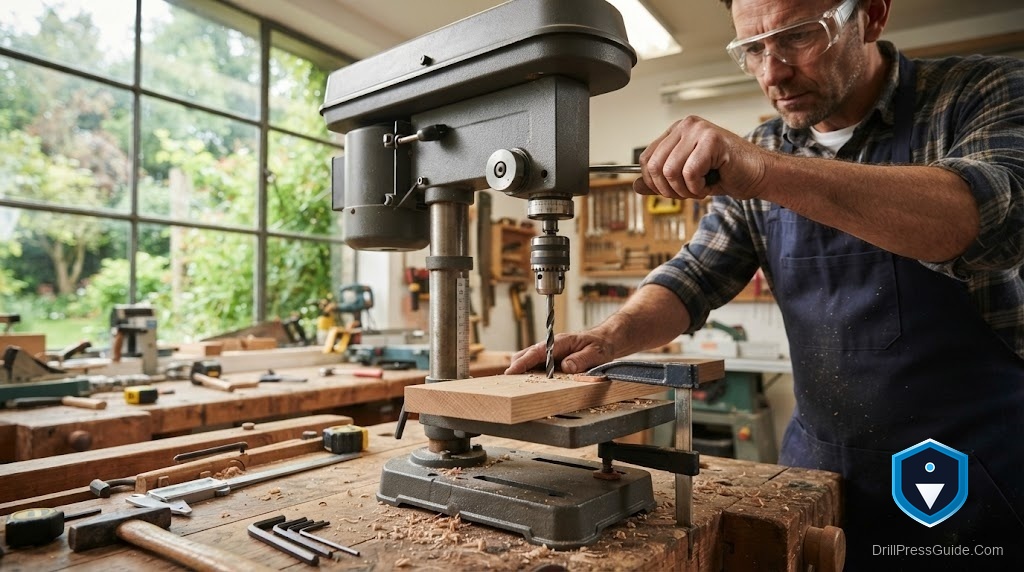
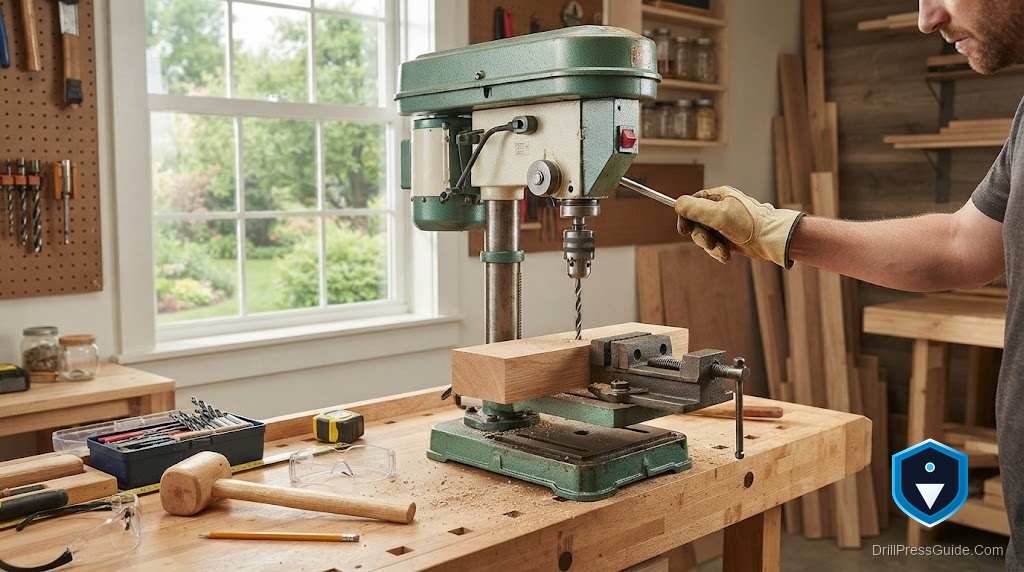
In a machine shop, holding metal by hand at the drill press is a serious hazard, because a bit that grabs will spin the workpiece into a blade. Every metal job should be clamped. A heavy cast-iron drill press vise bolted to the table holds stock securely against the drilling torque, which is both a safety measure and the foundation of accurate, repeatable holes. When a job needs the work positioned precisely under the spindle in two axes, a cross-slide drill press vise lets you dial the position in, at the cost of some rigidity and added height. Size the vise to the table and the work rather than reaching for the largest one.
Keep the machine accurate
A shop drill press earns its accuracy through maintenance. Keep the table square to the spindle and check it periodically. Keep the chuck running true; if the old chuck is worn and drilling off center, confirm the arbor taper, commonly JT33 on many machines, and fit a standard JT33 keyed chuck once the old one is driven off, checking runout before precision work. Keep the quill clean and properly lubricated so it feeds smoothly, and protect the cast-iron table from rust so work sits flat.
Conclusion
The drill press deserves better than corner-tool status in a machine shop. Used well, it handles the everyday drilling, reaming, countersinking, and tapping that keep the mills free for real milling, and it does so accurately when the operator respects metal technique, clamps every workpiece, and keeps the machine true. Set the right speed, use cutting fluid, clamp the work in a solid vise, and maintain the table, chuck, and quill, and the drill press becomes one of the most valuable machines on the floor.
Three takeaways: the drill press excels at accurate holes, reaming, countersinking, and tapping but is not a mill, correct speed and cutting fluid are essential for metal, and every metal workpiece must be clamped in a vise.
Frequently Asked Questions
What is a drill press best used for in a machine shop? Accurate drilling to depth, reaming to size, countersinking and counterboring, tapping square threads, and spot-drilling. Its rigidity and controlled feed make it more accurate than a hand drill and quicker than a mill for these.
Can I use a drill press for milling? No. A drill press spindle and bearings are not built for the side loads of milling cutters, and using it that way damages the machine and is unsafe. Use a mill for milling.
What speed should I use for drilling metal? Slower for large bits and hard metals, faster for small bits and soft materials, following the machine’s speed chart. Running too fast is the fastest way to burn a bit in steel.
Do I need cutting fluid on a drill press? For metal, yes. Cutting fluid cools the bit edge and clears chips, extending bit life and improving the hole. Dry drilling in steel dulls bits quickly.
Why must I clamp work on a drill press? Because a bit that grabs will spin an unclamped workpiece into a blade. Clamping in a heavy vise is both a safety requirement and the basis of accurate, repeatable holes.
How do I keep a shop drill press accurate? Keep the table square to the spindle, keep the chuck running true and replace a worn one, lubricate the quill so it feeds smoothly, and protect the table from rust so work sits flat.
References
- Jacobs Chuck Manufacturing, Mounting and Removing Chucks. http://www.jacobschuck.com/uploads/ueditor/file/20200604/1591240204146153.pdf
- VintageMachinery.org, machine tool literature and references. http://vintagemachinery.org