Vintage Drill Press Value: What to Inspect Before Buying or Restoring One
Ask what a vintage drill press is worth and you will get answers all over the map, because the honest answer is that value depends almost entirely on condition and completeness, not on the badge or the age. The same model can be a steal or a trap depending on whether its castings are sound and its parts are all there. Learning to read those signals is the difference between a buyer who brings home a machine worth several times what they paid and one who hauls home a heavy paperweight.
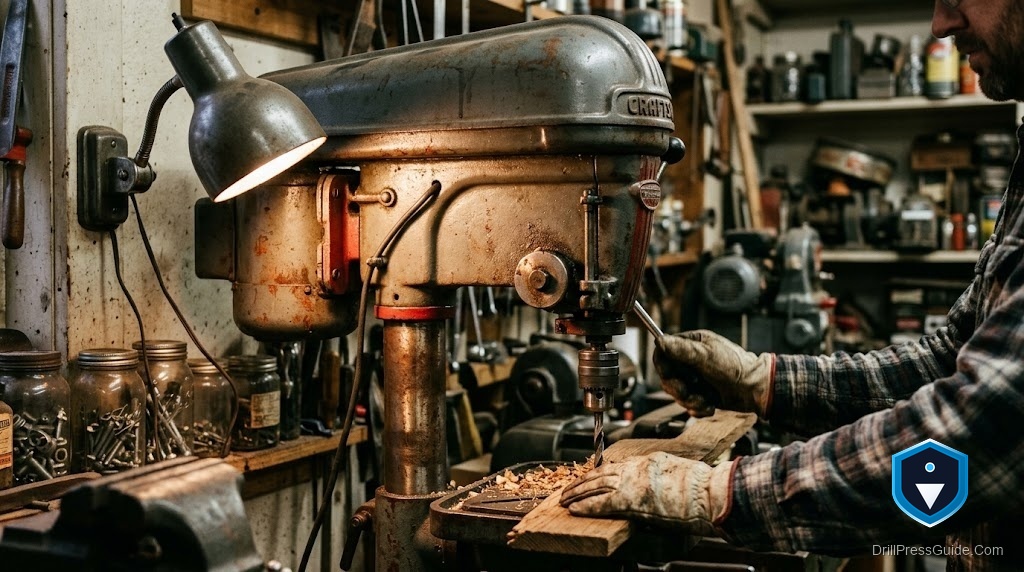
A vintage drill press is a mid-century or older drilling machine from a maker like Delta, Rockwell, Craftsman, Walker-Turner, Atlas, or Powermatic. Their appeal is real: heavy castings, smooth quills, and solid tables that outperform many new benchtop machines. That appeal is also why sound examples hold real value, and why worn or incomplete ones still get listed at optimistic numbers by sellers who do not know the difference.
So what drives vintage drill press value, and what should you inspect before you buy or commit to a restoration? It comes down to castings, completeness, and whether it runs, weighed in that order.
The three factors that set value
Everything about what a vintage drill press is worth flows from three things.
Castings. Sound cast iron is the foundation of value. A machine with crack-free head, base, column, and table castings is worth restoring; one with a cracked head is usually worth only its parts. Nothing else on this list can rescue a cracked main casting.
Completeness. A machine with all its model-specific parts, table, lock handles, pulleys, spindle assembly, and drive, is worth far more than one missing them, because those parts are the hardest to replace. Consumables like belts and bearings do not affect value much, since they are cheap and standard.
Condition and function. A machine that runs, with a smooth spindle and a working motor, commands more than a seized or dead one. But a running machine with cracked castings is still worth less than a sound machine that needs a motor, because function is fixable and castings are not.
The pre-purchase inspection
Before money changes hands, inspect in the order that protects you.
Castings first. Feel and look around every casting for cracks and old brazed repairs, especially near bolt bosses where grime hides them. Let a cracked main casting stop the deal.
Spindle and quill second. Feed the quill through full travel. It should be smooth with minimal play. Grinding points to dried grease or, worse, a scored bore or bad bearings.
Completeness third. Inventory the chuck, table and lock, pulleys and belt, return spring, and motor and switch. Note anything missing, since model-specific gaps cut value sharply.
Function last. Confirm the motor runs or turns freely and the speeds change. A dead motor lowers the price but is not a dealbreaker.
Deciding to buy or restore
With the inspection done, the math is simple. If the castings are sound and the machine is reasonably complete, its restored value comfortably exceeds the cost of consumables and your time, so buy and restore. If it fails on castings or is missing model-specific parts, the restored value may not clear the cost of sourcing those parts, so walk away or offer parts-machine money.
When you do restore, protect the value you bought. Remove rust from hardware and machined surfaces with a chelating remover like Evapo-Rust, which strips rust without harming the parent steel, then guard the cleaned iron with a film of Boeshield T-9 so the table and column do not flash-rust. Careful preservation of the original castings and finish protects resale value; a sloppy grind-and-repaint can lower it. Buff the protective film before setting work down so it will not transfer.
Conclusion
Vintage drill press value is decided by castings, completeness, and function, in that order, not by the age or the name on the head. Inspect the castings for cracks before anything else, inventory the model-specific parts, and confirm the machine runs, then let the math tell you whether to buy, restore, or walk. Sound iron and a complete parts count are what make a vintage press worth real money.
Three takeaways: a cracked main casting kills value no matter what else is right, missing model-specific parts cut value more than any consumable, and preserving original castings protects resale.
Frequently Asked Questions
What determines the value of a vintage drill press? Castings, completeness, and function, weighed in that order. Sound cast iron is the foundation; missing model-specific parts and a dead motor lower the value, though a motor is easily replaced.
Are vintage drill presses worth money? Sound, complete examples are, because they out-drill many new machines and hold their value. Cracked or incomplete ones are worth only their parts, regardless of the badge.
Does age make a vintage drill press more valuable? Not by itself. A newer machine in sound, complete condition is worth more than an older one with cracked castings or missing parts. Condition beats age every time.
What is the biggest value-killer to look for? A cracked main casting, especially the head. It cannot be reliably repaired and drops the machine to parts value no matter how good everything else is.
Does a missing motor ruin the value? No. A dead or missing motor lowers the price but is a straightforward replacement. Sound castings matter far more than the motor.
Does restoring a vintage drill press increase its value? Careful restoration that preserves the original castings and finish protects and can raise value. A rushed grind-and-repaint can lower it, so preserve rather than over-restore.
References
- VintageMachinery.org, manufacturer histories and publication archive. http://vintagemachinery.org
- CRC Industries, Evapo-Rust Rust Remover product information. https://www.crcindustries.com/evapo-rust/