
Bringing an Antique Drill Press Back to Reliable Shop Use
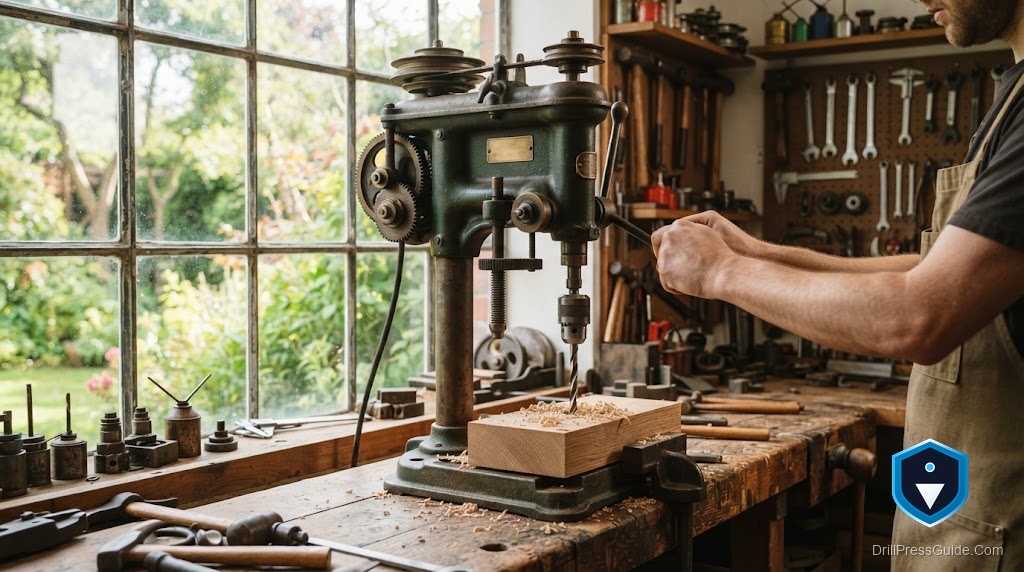
An antique drill press has a presence that a new machine cannot fake. The castings are thick, the paint is worn to bare metal at the wear points, and somewhere on the head is a maker’s name from a company that has not existed for eighty years. People buy them for that presence and then freeze, unsure whether a machine this old can really go back to work. It can. The path from barn find to reliable shop tool is well worn, and it runs through the same handful of steps every time, whatever the brand.
An antique drill press is any drilling machine old enough to predate the modern benchtop era, whether an early electric press from Delta, Walker-Turner, or Atlas, or a human-powered post drill from Buffalo Forge or Champion. What they share is heavy cast-iron construction, simple mechanisms, and the expectation that an owner would maintain them for a lifetime. That design philosophy is exactly why they come back to life so readily.
Will yours run reliably again? If the castings are sound and the moving parts are complete, almost certainly. The work is mostly cleaning, freeing seized parts, and replacing a few consumables, not fabricating rare components.
Start with an honest assessment
Before any tools come out, decide what you have and whether it is complete. Identify the maker and, where a model or serial number exists, the age. For an electric antique, that means the head casting number and, on a Delta, the serial plate that dates it to 1941 or later. For a post drill, it means the maker’s name and the gear and feed style.
Then confirm completeness. The parts diagram in your head should include the spindle assembly, the chuck or drill holder, the drive, the table, and the head casting. On an antique, missing model-specific parts are the real obstacle, so a complete but filthy machine is worth far more than a clean one missing its table or feed parts.
The restoration sequence
Restoring an antique press is a sequence, and following the order keeps you from redoing work.
Disassembly. Take it down to the major assemblies: separate the head, pull the spindle assembly, drive out the chuck and arbor, and free the table from the column. Label and bag hardware, and photograph each step so reassembly is not a puzzle.
Freeing seized parts. Age means stuck. Penetrating oil, patience, and gentle heat free most frozen quills, spindles, and screws without breaking anything. Resist the urge to force a stuck part, since a cracked antique casting is rarely worth repairing.
Cleaning and rust removal. Degrease first, then remove rust. For hardware and small machined parts, a chelating bath is the safest method on old metal. Evapo-Rust pulls rust without attacking the parent steel, so you keep crisp threads and machined faces that an acid dip would eat. Expect a gray film on some steel that buffs off, and dry parts immediately, because bare antique iron flash-rusts within the hour.
Cleaning and buffing the castings. Wire-wheel or hand-sand the castings to sound metal, decide between a careful clean or a repaint, and buff the bare machined surfaces smooth.
Replacing consumables. Fit a fresh belt, replace any ball bearing that stays rough after cleaning, and renew a tired return spring. If the chuck is worn, confirm the taper and seat a fresh one; many antiques use a JT33 taper, so a standard JT33 keyed chuck fits once the old one is driven off, though budget units carry a little runout worth checking.
Protecting and reassembly. Wax or oil the bare iron. A film of Boeshield T-9 keeps the table and column from flash-rusting and lets stock slide, buffed before use so it does not transfer. Then reassemble with fresh grease, set belt tension and spring preload, and test on scrap.
Making it safe and usable
An antique brought back to service still has to be safe by modern standards. Rewire any electric machine with a proper cord and grounding, replace a cracked switch, and add work-holding if the press has none. Freehand drilling near a rotating chuck is dangerous on any press, antique or new, so a solid drill press vise that clamps the workpiece is worth adding from day one. Its bulk is the only real downside, so size it to your machine.
Conclusion
Bringing an antique drill press back to reliable use is less about rare skills and more about a patient sequence: assess and confirm completeness, disassemble, free the seized parts, clean and remove rust without harming the metal, replace the few consumables, protect the iron, and make it safe. The heavy castings that give an antique its presence are the same ones that let it drill straight for another lifetime once the grime is gone.
Three takeaways: a complete filthy machine beats a clean incomplete one, never force a seized antique casting, and add safe work-holding and wiring before you put it to work.
Frequently Asked Questions
Can an antique drill press really be used reliably today? Yes, if the castings are sound and the moving parts are complete. The restoration is mostly cleaning, freeing seized parts, and replacing consumables, not making rare components.
What is the hardest part of restoring an antique drill press? Usually finding model-specific castings or gears if any are missing. That is why completeness matters more than cosmetic condition when you buy.
How do I free a seized quill or spindle? Penetrating oil, time, and gentle heat. Work the part back and forth as it frees, and avoid forcing it, since a cracked antique casting is rarely worth repairing.
Should I repaint or preserve an antique drill press? Both are valid. Preserving the original finish protects value and history; repainting suits a working machine. Sound castings and smooth mechanisms matter more than either.
What chuck fits an antique drill press? Match the arbor taper, commonly JT33 on mid-size machines. Confirm the taper before buying, because the taper, not the brand, decides fit.
Is an antique drill press safe to wire into a modern shop? Only after rewiring with a proper grounded cord and a sound switch. Old wiring and ungrounded motors should be updated before the machine goes back to work.
References
- VintageMachinery.org, manufacturer histories and publication archive. http://vintagemachinery.org
- CRC Industries, Evapo-Rust Rust Remover product information. https://www.crcindustries.com/evapo-rust/
- Jacobs Chuck Manufacturing, Mounting and Removing Chucks. http://www.jacobschuck.com/uploads/ueditor/file/20200604/1591240204146153.pdf


