
Old Delta Drill Press: Dating, Inspecting, and Planning the Restoration
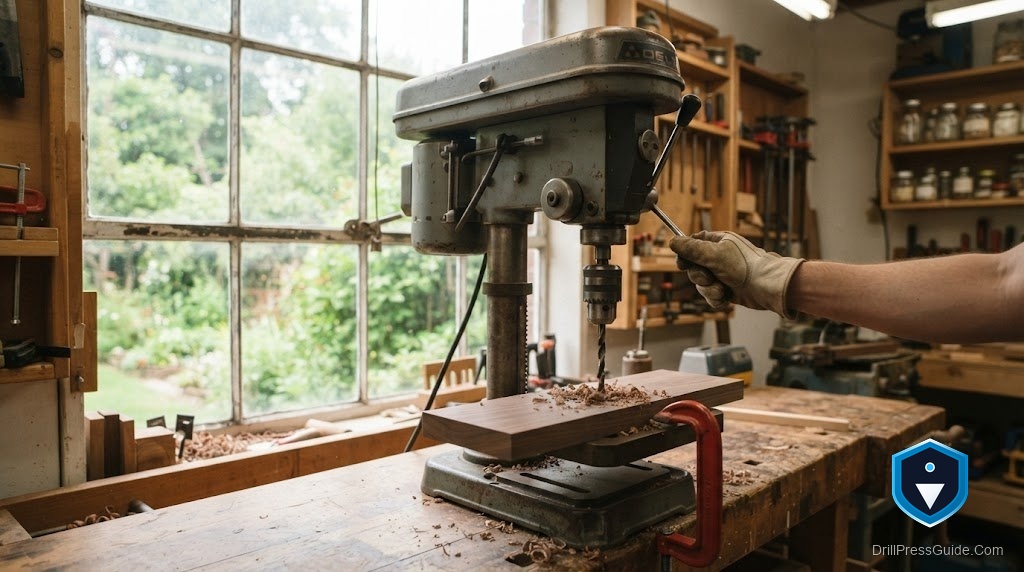
An old Delta drill press has a certain feel the moment you put a hand on the quill. The feed is smooth in a way new benchtop machines rarely match, the table locks with a solid clunk, and the whole head has the heft of a tool built when cast iron was cheap and engineers were generous with it. That feel is why people rescue these. The catch is that a Delta from the 1940s or 1950s arrives with no manual, a mystery age, and decades of grime hiding whatever is actually wrong. Dating it, inspecting it, and planning the work in that order is what turns a gamble into a good machine.
An old Delta drill press is one of the drilling machines built by Delta, later Delta/Rockwell and Rockwell, from the 1930s onward. Delta sold everything from small bench models to the 11-inch Homecraft budget line to heavy floor and radial presses. The good news for a restorer is that Delta documented itself well, and much of that record survives, so an old Delta drill press is one of the easier vintage machines to date and feed with parts.
Can you plan a restoration confidently? Yes, and the plan almost writes itself once you know the age and model. The wear points are the familiar ones, the spindle assembly, the ball bearings, the spindle return spring, and the belt, and the parts either interchange or can be reproduced.
Dating it by serial number
Start with the age, because it shapes everything else. Delta began assigning serial numbers in 1941. That single fact is a quick first filter: if your machine has no serial number plate and no holes where one mounted, it likely predates 1941. If it has a plate, the number places it within a date range using the registries that collectors have built.
The most reliable resource here is the VintageMachinery.org serial number registry and the Delta serial number guide, which breaks the plates into styles and explains the nuances of reading them. Owners routinely date a Delta or Rockwell press to a specific year from its number, for example placing a Homecraft 11-inch in the early 1950s or a Rockwell 15-inch in the late 1950s. Photograph your plate, then match it against the registry before you assume anything about age or model.
Knowing the year also tells you which old Delta drill press models you are dealing with, from the wartime industrial setups to the postwar Homecraft budget line, and that decides which manual and parts list apply.
The inspection walkthrough
With an age and model in hand, inspect in a fixed order so nothing gets missed.
Spindle and quill. Feed the quill through its full stroke. It should be smooth, with no catch and no grinding. Roughness usually means dried grease, but it can mean a scored bore or tired ball bearings. Some old Delta presses have specific bearing callouts, so note the numbers when you open it up.
Spindle return spring. Confirm it returns the quill fully and smartly. A weak or broken spring is common and fixable.
Belt and speeds. Check the V-belt for glazing and cracks, and run through the spindle speeds by moving the belt across the pulley steps. Sticky or seized pulleys need attention.
Table and mechanism. Work the table clamp handle, the table raising handle, the table bracket, and the table alignment pin. On radial and rack models these are where wear and missing parts show up. A table that will not lock is a safety problem, not a cosmetic one.
Motor and wiring. Check the motor specifications on the plate against your supply, confirm the switch toggle works, and inspect the cord. Old presses predate modern grounding, so plan to follow current grounding instructions and avoid undersized extension cords when you rewire.
Castings. Look for cracks around the head, the base, and the column collar. Sound castings are what make the restoration worth doing.
Planning the work
Once you know what you have and what is worn, the plan is straightforward. Order it like this:
First, get it apart and clean. Drive out the chuck and arbor, pull the spindle assembly, and separate the castings. Soak rusty hardware and small parts in a chelating remover. Evapo-Rust is the standard choice because it lifts rust without attacking the good steel underneath, so a forgotten part in the bath overnight is not a disaster. Its honest quirk is a gray film it can leave on some steel, which buffs off. Rinse and dry parts immediately, since bare iron flash-rusts fast.
Second, replace the consumables. Fresh V-belt, any ball bearings that feel rough, and a return spring if the old one is tired. These are the parts that make it run reliably again.
Third, protect and reassemble. Wax or oil the bare table and column. A film of Boeshield T-9 keeps the freshly cleaned iron from flash-rusting and lets the table slide, though you should buff it before setting down finished work so it does not transfer.
Finally, reset. Seat a clean, true chuck on a dry taper, tension the belt, adjust the return spring, and test on scrap.
Conclusion
An old Delta drill press is one of the most satisfying vintage machines to restore because it documents itself. Date it by serial number against the registry, inspect the spindle, spring, belt, table mechanism, and motor in a fixed order, then plan the work from teardown to consumables to protection. The castings that give these presses their feel are almost always sound, and the rest is standard rebuild work.
Three takeaways: date it before you touch it, treat a table that will not lock as a safety issue, and replace bearings and belt rather than nursing them along.
Frequently Asked Questions
How do I date an old Delta drill press? Use the serial number. Delta began numbering machines in 1941, so no serial plate usually means it predates that. Match the number against the VintageMachinery.org Delta registry to place it in a date range.
What are the common old Delta drill press models? They range from small bench presses to the 11-inch Homecraft budget line and heavier Rockwell 15-inch floor and radial models. The serial number and casting markings identify which you have.
Where do I find bearings for an old Delta drill press? Bearings are standard sizes stamped on the parts. Read the numbers and cross-reference them at any bearing supplier rather than paying for branded replacements.
Is an old Delta drill press worth restoring? Usually yes, if the castings are sound. The smooth feed, solid table lock, and heavy head are hard to find in new machines, and parts interchange or can be reproduced.
How do I get a manual for an old Delta drill press? Once you know the model, the VintageMachinery.org publication archive holds many original Delta and Rockwell manuals and parts lists as scanned reprints.
Can I use the original motor? Often, if the windings and bearings are good and the cord is replaced. Check the motor specifications against your supply and follow current grounding practice when rewiring.
References
- VintageMachinery.org, The Delta Vintage Project: Serial Numbers. http://wiki.vintagemachinery.org/DeltaSerialNumbers.ashx
- VintageMachinery.org, Delta / Rockwell publication reprints and serial number registry. http://vintagemachinery.org/mfgindex/detail.aspx?id=1141
- CRC Industries, Evapo-Rust Rust Remover product information. https://www.crcindustries.com/evapo-rust/


