A Practical Buyer's Guide to the Drill Press for Knife Making
Knife making leans on a drill press harder than most woodworking does, because you are drilling hardened and stainless steels, boring clean holes for pins and handle hardware, and often using the machine for tasks like small sanding or spot work. That combination, metal drilling plus precision, points to specific qualities when choosing a press, and to a few honest cautions about using one for jobs it was not built for. This guide walks through what actually matters for knife making so you can choose a machine that suits the work.
A drill press for knife making is a machine used to drill precise holes in knife steel and handle materials, valued for the low speeds and torque that metal drilling needs plus the accuracy to place holes exactly for pins, bolsters, and fittings. The qualities that matter are a suitable low-speed range with real torque, low runout, a solid chuck, a rigid build, and a stable, precise table.
Short answer: for knife making, prioritize a speed range that goes low enough for drilling steel, with the torque and rigidity to do it, plus low runout and a solid chuck for precise, clean holes, on a stable table. Variable speed is a real advantage for moving between steel and handle materials. Power and rigidity matter more here than in woodworking, so choose accordingly.
Low speed, torque, and rigidity for steel
Drilling hardened and stainless knife steel is the defining demand, and it needs low spindle speeds with enough torque to keep cutting without overheating the bit or work-hardening the steel. So look first for a press whose speed range goes genuinely low and that has the motor torque and rigid build to drill metal steadily. A flimsy or underpowered machine will struggle, chatter, or stall in tough steel, dulling bits and spoiling holes. Rigidity matters because metal drilling puts real load on the machine, and any flex shows up as a wandering or angled hole. For knife steel, low-speed capability, torque, and a solid build are the foundation.
Runout, chuck, and hole accuracy
Knife work needs holes placed precisely, for pin holes that must line up through tang and handle, and for clean bores that finish well, so low runout and a chuck that holds bits true matter a great deal. Runout that lets the bit wobble drills oversize, off-location, or rough holes, which shows in a finished knife. Look for a machine known for low runout and fit it with a solid chuck that grips firmly and runs concentric. Because knife makers drill a range of sizes, from small pin holes to larger holes for fittings, a chuck with a good range is useful. Accuracy here is not optional, since a misplaced or rough hole can ruin an otherwise good blade.
Table, capacity, and using it beyond drilling
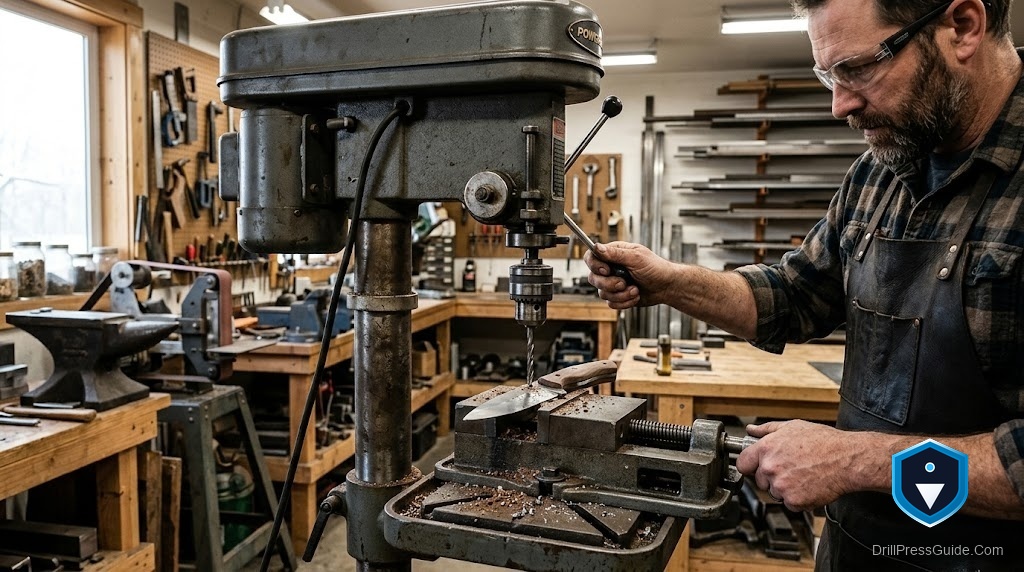
A stable, flat table that adjusts and locks solidly helps place holes accurately and hold work steady, and a table that accepts a vise is valuable, because knife steel should be clamped, never hand-held, when drilling. Consider the throat depth and travel you need for the blades and handles you make. Many knife makers also use a drill press for light sanding with small drums or for related tasks, but here is an honest caution: a drill press spindle and bearings are designed for downward drilling force, not sustained side loads, so heavy side-load sanding can wear the bearings and is not what the machine is built for. Use it gently for such tasks, or use a proper tool, and keep drilling as its main job.
Matching the machine to your work and space
Because knife making needs metal-drilling capability, favor a machine with real low-speed torque and rigidity over a light hobby press, while still fitting your space, a solid benchtop press suits many makers, and a floor model offers more capacity and power if you have room and drill larger or thicker work. Variable speed is genuinely worth having, letting you drop to low speed for steel and raise it for wood or synthetic handle materials without swapping belts. Think about the steels you drill, the hole sizes you need, and whether you want the machine for anything beyond drilling, then choose a press that handles metal accurately and steadily rather than one built only for light wood.
Conclusion
Choosing a drill press for knife making comes down to metal-drilling capability plus precision. Prioritize a speed range that goes low enough for steel with the torque and rigidity to drill it steadily, low runout and a solid chuck for accurately placed, clean holes, and a stable table that takes a vise so steel is clamped, not hand-held. Variable speed is a real advantage for moving between steel and handle materials. Be honest about side-load tasks like sanding, which a drill press is not built for, and keep drilling its main job. Match the machine to the steels and hole sizes you actually work, and it will place clean, precise holes that a good knife depends on.
Frequently asked questions
What matters most in a drill press for knife making? Metal-drilling capability plus precision: a speed range that goes low enough for steel, with torque and rigidity to drill it, plus low runout and a solid chuck for accurately placed, clean holes.
Why does low speed matter for knife steel? Because hardened and stainless steels need low spindle speeds with torque to cut without overheating the bit or work-hardening the steel. A press whose range goes genuinely low suits knife work.
Is variable speed worth it for knife making? Yes. It lets you drop to low speed for drilling steel and raise it for wood or synthetic handle materials without swapping belts, which is genuinely convenient across the materials knife making uses.
Can I use a drill press for sanding blades? Gently at most. A drill press spindle and bearings are built for downward drilling force, not sustained side loads, so heavy side-load sanding wears the bearings. Use a proper tool for serious sanding.
Should knife steel be clamped when drilling? Yes, always, in a vise or clamp, never hand-held, because the bit can grab and spin the steel, which is dangerous and ruins the hole. Look for a table that accepts a vise.
Benchtop or floor model for knife making? A solid benchtop press with real low-speed torque suits many makers. A floor model offers more capacity and power for larger or thicker work if you have the room.
References
- OSHA, Machine Guarding eTool: Drill Presses, osha.gov
- Vintage Machinery, machine tool references, vintagemachinery.org