
Drill Press Mobile Base Plans: A Build Plan Focused on Accuracy
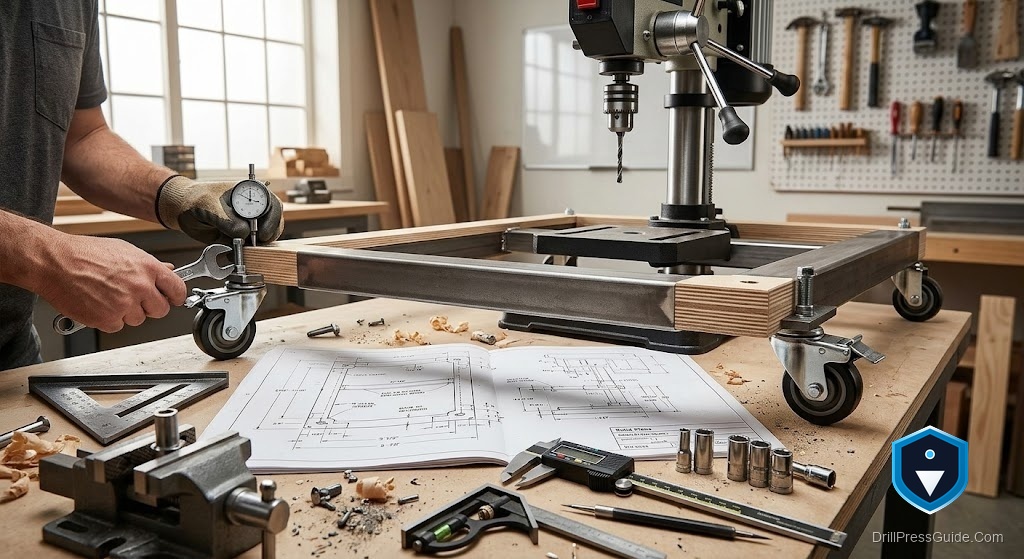
A mobile base makes a floor-standing drill press easy to move, but it also puts the machine up on wheels, and wheels are the enemy of the rock-solid footing accurate drilling needs. The whole art of a good mobile base is resolving that tension: roll freely, then lock down so firmly that the machine drills as if bolted to the floor. Accuracy-focused plans are built around that resolution, and this guide explains what such plans should show so you can build a base that gives mobility without giving up precision.
Drill press mobile base plans are a set of dimensions, materials, and steps for building a wheeled platform a drill press sits on, so it can be rolled and then locked in place. Accuracy-focused plans specify a footprint at least as wide as the machine, a rigid frame, locking casters or caster-and-foot arrangement, solid attachment of the machine, and a stable, level lockdown when parked.
Short answer: the plans should build a rigid frame at least as wide as the machine’s base, fit locking casters or fixed feet so it immobilizes fully, bolt the machine down solidly, and ensure the base sits level and rock solid when locked. Because a top-heavy machine on wheels can tip and flex, the plans must protect a wide footprint, rigidity, and a firm, level lockdown, which are the accuracy essentials.
Footprint and frame: the accuracy foundation
Accuracy starts with a footprint and frame that keep a top-heavy machine steady, so the plans should show a base at least as wide as the machine’s base, and ideally a little wider, with the machine centered on it. The frame should be built stiff, from stout lumber or welded steel with braced joints, so it does not flex or rack under drilling force, because a springy base moves under load and spoils holes. The plans should place the wheels at the corners for the widest stance. A wide footprint and a rigid frame are the foundation everything else rests on, so accuracy-focused plans detail these first rather than treating the base as a simple cart.
Casters and locks: mobility that becomes stability
The plans must specify casters rated well above the machine’s weight and, crucially, a way to fully immobilize the base, since the whole accuracy question turns on how solidly it parks. Look for locking casters, ideally total-lock types that stop both rolling and swiveling, or a design that drops the base onto fixed feet so the wheels are unloaded when parked. Plain unlocked casters are the common failure, because a base that can roll or swivel while running is inaccurate and unsafe. Good plans choose hardware that goes decisively from free rolling to firmly locked, so the base is genuinely steady, not merely braked, when the machine is in use.
Attaching the machine and getting level
How the plans attach the machine and get it level decides whether accuracy survives. The drill press should bolt to the base through its base holes so it cannot shift or walk, never held by friction or its own weight. The plans should show the base sitting level and solid when locked, with adjustable feet or provision for shims so an uneven shop floor does not leave it rocking, because a base that rocks is a base that drills crooked. A machine bolted solidly to a rigid base that locks level and steady drills just as accurately as one fixed to the floor, so the plans should treat solid attachment and leveling as core accuracy steps.
Verifying and using it
Good plans finish by verifying and using the base safely. Once built, lock it, lean on the machine hard to confirm nothing rolls, flexes, or rocks, then square the table and drill a test hole to confirm accuracy. In use, always lock the base before drilling, move the machine slowly with the head low and the chuck retracted to keep the center of gravity down, and re-check the mounting bolts and locks over time. Plans that include this verification and safe-use guidance ensure the finished base actually delivers the accuracy the design aimed for, rather than leaving you to discover a wobble mid-cut.
Conclusion
Accuracy-focused drill press mobile base plans resolve the tension between rolling freely and standing rock solid. They specify a footprint at least as wide as the machine with a rigid, braced frame, quality locking casters or fixed feet that fully immobilize the base, the machine bolted down solidly, and a level, steady lockdown when parked, then verify it holds under load. Understand why each element is shaped the way it is and you can adapt any plan to your machine and floor, ending with a base that lets you position the drill press anywhere in the shop and still trust it to drill exactly as accurately as if it were bolted to the ground.
Frequently asked questions
What should accuracy-focused mobile base plans specify? A footprint at least as wide as the machine, a rigid braced frame, locking casters or fixed feet that fully immobilize the base, solid bolting of the machine, and a level, steady lockdown when parked.
How wide should the base be? At least as wide as the machine’s base, and ideally a little wider, with the machine centered and casters at the corners, so a top-heavy drill press resists tipping while rolling.
What casters do the plans need? Casters rated well above the machine’s weight and a way to fully immobilize the base, ideally total-lock casters or a design that parks on fixed feet, not plain unlocked casters.
How is the machine attached? Bolted to the base through its base holes so it cannot shift or walk. Friction or the machine’s weight alone lets it move under drilling force and drill inaccurately.
How do the plans keep it accurate on an uneven floor? By providing adjustable feet or shims so the locked base sits level and solid rather than rocking, since a base that rocks drills crooked no matter how good the casters are.
Do the plans include a verification step? Yes. Lock the base, lean on the machine to confirm nothing rolls, flexes, or rocks, square the table, drill a test hole, and re-check bolts and locks over time.
References
- OSHA, Machine Guarding eTool: Drill Presses, osha.gov
- Forest Products Laboratory, wood construction references, fpl.fs.usda.gov


