Direct Drive Benchtop Drill Press: What It Means and Whether It Fits You
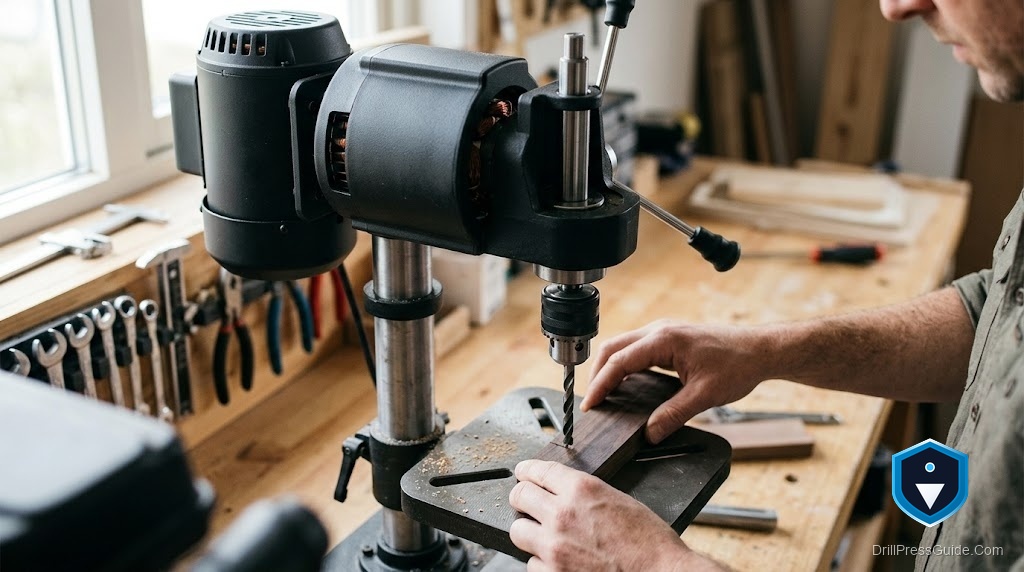
Most benchtop drill presses hide a set of stepped pulleys and a belt under the head cover, and changing speed means popping that cover and moving the belt by hand. A direct drive machine works differently, and the term shows up often enough in tool descriptions that it is worth understanding what it actually means and whether it is an advantage for the way you drill. Like most design choices, direct drive is not simply better or worse; it is a set of tradeoffs that suit some users and not others.
A direct drive benchtop drill press is a compact bench-mounted drilling machine in which the motor drives the spindle directly, or through a fixed geared connection, rather than through the adjustable belt-and-pulley system of a conventional press. That direct connection changes how the machine delivers power and how, or whether, you change its speed.
Short answer: direct drive gives a simpler, more compact drivetrain with efficient power transfer and no belt to slip or replace, but it usually offers fewer or no easy speed changes compared with a belt-driven or variable-speed press. It fits you if you value simplicity and steady power at a set speed range; it fits you less if you constantly switch between materials and bit sizes that each want a different RPM.
What direct drive actually changes
In a belt-driven press, the motor spins a set of pulleys and a belt carries that motion to the spindle, and you change speed by moving the belt between pulley steps. A direct drive machine couples the motor to the spindle directly or through fixed gearing, so power transfers with fewer moving parts in between. The practical effects are a more compact head, efficient and immediate power delivery, and nothing to slip or wear like a belt. The catch is that without the pulley steps, changing speed is not as simple; the machine runs in whatever speed the drive provides unless it includes separate electronic speed control.
The upsides in daily use
The appeal of direct drive is simplicity and directness. With fewer parts between motor and spindle, there is less to maintain, no belt to tension, replace, or watch for slip, and power reaches the bit efficiently. The head can be more compact, which suits a tight bench. For someone who tends to drill at a consistent speed range, in a single material, or who simply wants to switch the machine on and work without fiddling under a cover, a direct drive press is refreshingly uncomplicated. It removes the most common small chore of a belt machine and gives steady, immediate power.
The tradeoffs to weigh
The cost of that simplicity is usually speed flexibility. Different jobs genuinely want different speeds, small bits and metal favor slower speeds, larger bits and some materials favor faster, and a stepped-pulley or variable-speed machine makes those changes easy. A basic direct drive machine may lock you into one speed range unless it pairs the direct drive with electronic variable-speed control. So the key question before buying is how much your work varies: if you drill a wide range of bit sizes and materials, limited speed choice is a real drawback; if your drilling is consistent, it barely matters. Do not buy for the drivetrain name; buy for whether its speed behavior fits your work.
Choosing the right press for your work
Decide by looking at what you drill. If you want the least maintenance and mostly drill within one speed range, a direct drive machine, especially one with added electronic speed control, is a clean, simple choice. If you frequently move between wood, metal, and widely different bit sizes, prioritize easy speed changes, whether that is a well-designed step-pulley machine or a true variable-speed press, over the direct drive label. Whichever you choose, still weigh the fundamentals: swing, spindle travel, chuck capacity, quill quality, and a flat, adjustable table. The drivetrain is one factor among several, and those core specs decide accuracy and capacity regardless of how the spindle is driven.
Conclusion
A direct drive benchtop drill press connects motor to spindle directly, trading the adjustable belt-and-pulley system for a simpler, more compact, low-maintenance drivetrain with efficient power and no belt to slip. The tradeoff is speed flexibility, since without pulley steps or electronic control your speed choices are limited. That makes direct drive a good fit for consistent drilling and a poorer one for work that constantly changes materials and bit sizes. Decide by how much your drilling varies, and do not let the drivetrain name outweigh the core specs, swing, travel, chuck, quill, and table, that actually determine how well any benchtop press performs.
Frequently asked questions
What does direct drive mean on a drill press? The motor drives the spindle directly or through fixed gearing rather than through an adjustable belt-and-pulley system, giving a simpler, more compact drivetrain with efficient power transfer.
Is direct drive better than belt drive? Neither is simply better. Direct drive means less maintenance and no belt to slip, but usually fewer easy speed changes. Belt or variable-speed machines make changing speed simpler.
Can I change speeds on a direct drive drill press? Only easily if it includes electronic variable-speed control. A basic direct drive machine tends to run in a set speed range without the pulley steps a belt machine uses.
Who should choose direct drive? Someone who values simplicity and low maintenance and mostly drills within one speed range or a single material, rather than constantly switching between very different bits and materials.
Does direct drive affect accuracy? Not directly. Accuracy comes from the spindle, quill, and table quality. The drivetrain affects power delivery and speed changing, not inherent precision.
What else should I compare besides the drivetrain? Swing, spindle travel, chuck capacity, quill quality, and a flat, adjustable table. These core specs determine capacity and accuracy no matter how the spindle is driven.
References
- OSHA, Machine Guarding eTool: Drill Presses, osha.gov
- WEN Products, benchtop drill press documentation, wenproducts.com