
Buying a Benchtop Drill Press at Home Depot: How to Shop Smart
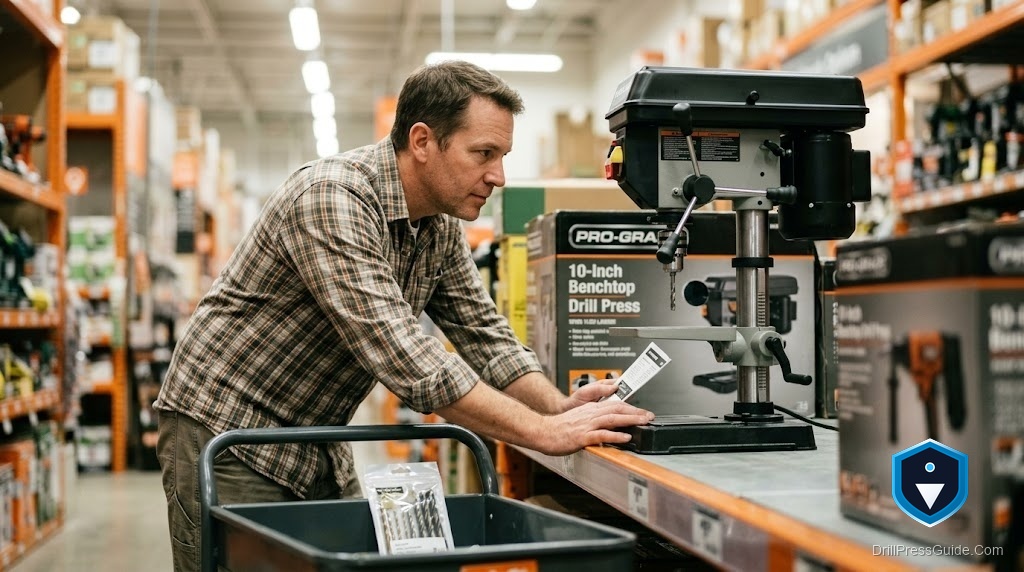
For a lot of people, the drill press search starts and ends at the same place: the tool aisle at Home Depot, or its website late at night. It is convenient, the selection is right in front of you, and you can often walk out with the machine the same day. The risk is buying on brand recognition and shelf position rather than on the few specs that actually decide whether the machine will serve you. A little know-how before you go turns that convenience into a genuinely good buy.
A benchtop drill press is a compact stationary drilling machine that mounts on a workbench, and at a retailer like Home Depot you will typically find a range of them across familiar tool brands, sized for home shops, hobby work, and light professional use. Shopping there is about knowing which specs to compare across the models on offer, rather than defaulting to the cheapest or the most prominent.
Short answer: to shop smart, compare swing, spindle travel, speed range, chuck capacity, and quill and table quality across the benchtop models, then match those to your actual work rather than to price alone. The convenience of buying at a big retailer is real; just let the specs, not the shelf, pick the machine.
The specs that actually matter
Five numbers separate a good benchtop press from a frustrating one. Swing, twice the distance from column to spindle, sets how wide a workpiece you can center a hole in. Spindle travel is how deep a single plunge goes, which decides the thickest stock you can drill cleanly in one pass. The speed range and how easily you change speeds matter because wood, metal, and large bits all want different RPM. Chuck capacity sets the largest bit shank you can hold. And quill and table quality, minimal spindle play and a flat, adjustable table, separate a precise machine from a wobbly one. Compare these across the models on the shelf and the right choice usually becomes obvious.
Variable speed versus step pulleys
One meaningful split among benchtop presses is how they change speed. Step-pulley machines require you to open the head and move a belt between pulleys, which is simple, reliable, and common on affordable models. Variable-speed machines let you dial RPM with a handle while running, which is far more convenient if you switch between materials and bit sizes often. Neither is wrong; a step-pulley machine is perfectly good if you rarely change speeds, while variable speed earns its extra outlay for anyone constantly moving between wood, metal, and big bits. Decide based on how often you realistically change speeds, not on the feature list alone.
Models you will commonly see
Home Depot carries several well-known bench drill press options. The WEN 4208T 8-inch five-speed benchtop drill press is a compact, genuinely small-footprint machine that suits hobby work and tight benches, with the honest limit of modest swing and travel. Stepping up in capability, the WEN 4214T 12-inch variable-speed drill press adds dial-in speed control and a work light, which is the one to look at if you change materials often. And the Genesis GDP1005A 10-inch five-speed drill press is a middle-ground benchtop machine with a common 10-inch swing. The tradeoff across them runs from smallest and simplest to more capacity and convenience; match that to your bench space and how varied your drilling is.
Buying and getting it home
Whichever you pick, plan for the practical side. A benchtop press is heavy for its size, so check the weight and how you will lift and mount it, and make sure your bench is sturdy and the machine can be bolted down, because a press that rocks will never drill accurately. Confirm the swing clears your typical work and the travel handles your usual thickness. If buying online for pickup or delivery, read the assembly notes, since these ship partly knocked down. Once home, mount it solidly, square the table to the spindle, and run a test hole before trusting it on real work.
Conclusion
Buying a benchtop drill press at a big retailer is convenient, and it becomes a smart buy when you shop the specs instead of the sticker. Compare swing, spindle travel, speed range, chuck capacity, and quill and table quality, and decide between step-pulley simplicity and variable-speed convenience based on how often you change materials. Among common options, the small WEN 4208T suits tight benches, the WEN 4214T adds variable speed for varied work, and the Genesis GDP1005A offers a middle-ground 10-inch swing. Mount whatever you choose solidly, square it, and test it, and the aisle-bought machine will serve your shop for years.
Frequently asked questions
What specs matter most on a benchtop drill press? Swing, spindle travel, speed range, chuck capacity, and quill and table quality. These decide how wide, how deep, and how precisely you can drill, far more than price does.
Is variable speed worth it over step pulleys? If you frequently switch between wood, metal, and bit sizes, yes, because you dial RPM without opening the head. If you rarely change speeds, a step-pulley machine is simpler and perfectly good.
What size benchtop drill press should I get? Match swing to the widest workpiece you center holes in and travel to your usual stock thickness. Small 8-inch machines suit hobby work; 10 to 12-inch models handle more.
Do I have to bolt a benchtop press down? Yes, for accuracy and safety. Mount it to a sturdy bench so it cannot rock or tip, since a machine that moves will never drill true.
Can I buy one online and assemble it myself? Yes. These ship partly knocked down, so read the assembly notes. Setup is straightforward: mount the head, fit the table and handles, then square and test it.
What is swing on a drill press? Swing is twice the distance from the column to the spindle center, so a 10-inch swing lets you drill to the center of a 10-inch-wide piece. It sets your width capacity.
References
- WEN Products, benchtop drill press documentation, wenproducts.com
- Genesis Power Tools, drill press documentation, genesispowertools.com


