
Benchtop Drill Press Made in USA: What to Look For Before You Buy
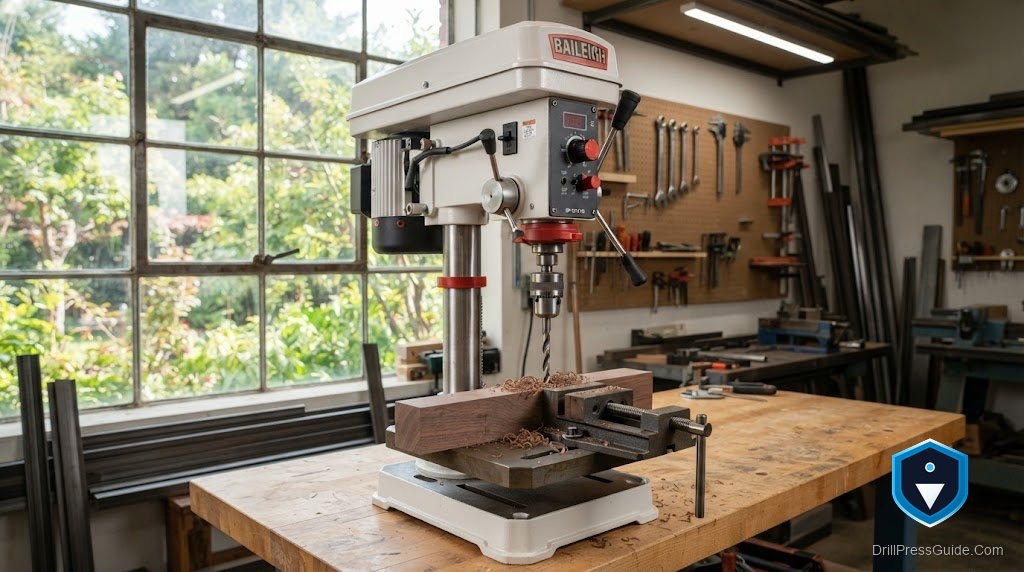
Search for a benchtop drill press made in the USA and you quickly run into an uncomfortable truth. Most benchtop drill presses on the market today, across nearly every familiar brand, are built overseas, mainly in Taiwan and China, and then sold under American names. That does not mean a good machine is out of reach, and it does not mean the search is pointless. It means you have to know the difference between a brand headquartered in America, a machine assembled in America, and a machine actually manufactured here, because the marketing blurs all three on purpose.
A benchtop drill press made in the USA is a bench-mounted drilling machine whose manufacturing, the casting, machining, and assembly, happens in the United States, rather than simply being a brand that is American-owned or a machine that is imported and boxed here. The distinction matters because country-of-origin claims are often written to sound stronger than they are.
Here is the short, honest answer. Genuinely made-in-USA benchtop drill presses are rare, and most brands you recognize import their bench machines. If domestic manufacturing is a firm requirement, verify the specific model’s country of origin with the manufacturer directly, look toward industrial and specialty makers rather than mass-market brands, and be ready to consider a quality used American-made machine, because many of the best domestic drill presses were built decades ago.
Why “made in USA” is so slippery here
Three different claims hide behind the same phrase. “American brand” means the company is based here, while the machine may be fully imported. “Assembled in USA” means imported parts are put together here, which is not the same as manufactured. “Made in USA” should mean the machine is substantially built here, but it is applied loosely. On top of that, model lines change sourcing over time, so a brand that once built a machine domestically may now import the same model number. This is why a general brand reputation tells you almost nothing, and only the specific model, checked directly, gives you the real answer.
Where domestic and industrial machines still live
The honest place to look is not the consumer power-tool aisle. Industrial and specialty tool makers are far more likely to manufacture, or at least substantially machine and assemble, in the United States, though these are typically heavier, pricier machines aimed at professional and institutional buyers rather than hobby benches. Vintage American iron is the other real source. Many prized domestic drill presses were built by American manufacturers in the mid-twentieth century, and a well-kept used machine can be a better made-in-USA buy than anything currently sold new at the consumer level. That is a genuine tradeoff: you get real domestic manufacturing and heavy castings, but you take on an old machine that may need parts and tuning.
How to verify a specific model, not a brand
Do not trust a badge or a listing headline. Ask the manufacturer directly about the exact model number’s country of origin, because the answer often differs from the brand’s image and can change between production runs. Read the fine print on the box and the manual, which sometimes states origin more plainly than the marketing. And treat a machine that cannot or will not confirm domestic manufacturing as imported, because a maker that genuinely builds here usually says so clearly. The model number is the unit of truth here, not the brand name on the head.
What actually makes a benchtop drill press good, regardless of origin
It is worth separating the origin question from the quality question, because they are not the same. A good benchtop machine has a stout induction motor judged by amperage, adequate spindle travel for your work, a chuck capacity that fits your bits, a flat cast iron table that raises and bevels smoothly, and a column with no play. Plenty of well-built imported machines nail all of that. So if domestic manufacturing is a preference rather than a hard rule, judge the machine on these fundamentals first, and let origin be a tiebreaker rather than the only filter, because an imported machine that runs true beats a domestic badge on a machine that wobbles.
Conclusion
A benchtop drill press made in the USA is a real but narrow category, and the search rewards precision over brand loyalty. Recognize that most familiar names import their bench machines, that “American brand” and “assembled here” are not the same as “made here,” and that model sourcing shifts over time. If domestic manufacturing is non-negotiable, verify the exact model with the maker, look to industrial and specialty makers, and seriously weigh a quality vintage American machine. If it is a preference, judge any machine on motor, travel, chuck, and table first. Buy the truth, not the badge, and you will not overpay for a flag sticker on an imported casting.
Frequently asked questions
Are any benchtop drill presses actually made in the USA? Genuinely made-in-USA benchtop machines exist but are rare, and they tend to come from industrial or specialty makers rather than mass-market brands. Verify the specific model directly.
Does an American brand mean the drill press is made in America? No. An American-owned brand often imports its machines. “American brand,” “assembled in USA,” and “made in USA” are three different claims.
How can I confirm where a drill press is made? Ask the manufacturer about the exact model number’s country of origin, and check the box and manual. Sourcing can change between production runs, so verify the specific model.
Is a vintage American drill press a good made-in-USA option? Often yes. Many of the best domestic drill presses were built decades ago, and a well-kept used machine can be a stronger domestic buy than new consumer models, if you accept parts and tuning.
Are imported drill presses lower quality? Not necessarily. Many imported machines are well built. Judge quality by motor amperage, spindle travel, chuck capacity, and table and column quality rather than origin alone.
Why do sourcing claims change over time? Manufacturers move production between countries to manage cost, so the same model number may be domestic in one run and imported in another. That is why the model, not the brand, is what you verify.
References
- U.S. Federal Trade Commission, Made in USA labeling standard, ftc.gov
- OSHA, Machine Guarding eTool: Drill Presses, osha.gov


