
Small Drill Press Harbor Freight: A Practical Guide for the Workshop
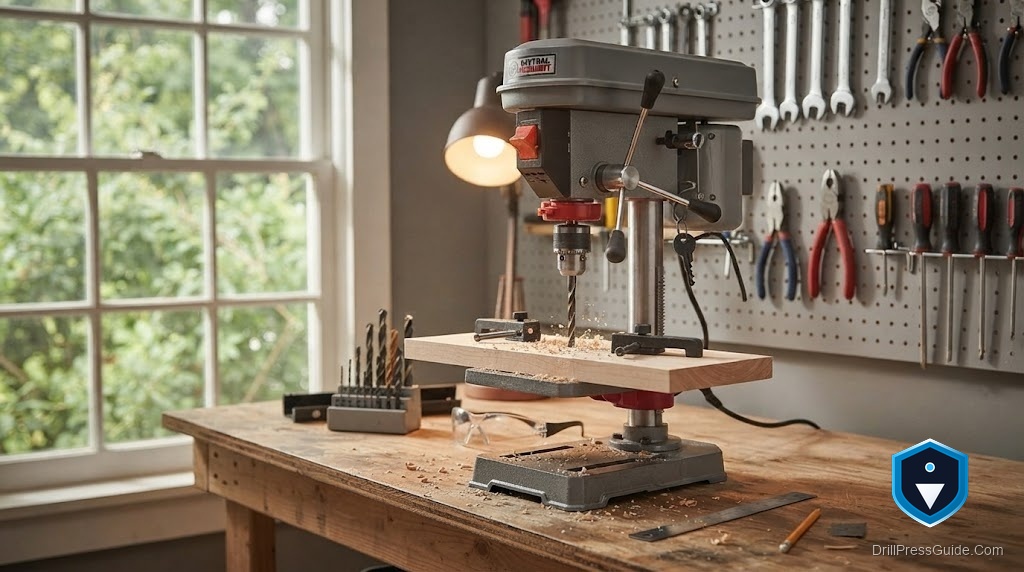
Harbor Freight is the first stop for many home shop owners who need a small drill press without spending much. The store sells benchtop presses under the Bauer and Central Machinery brands, and the smallest machine in their line is the Bauer eight-inch five-speed model. That is a real benchtop press, not a micro or mini machine, but it is the smallest footprint you will find at Harbor Freight. If you are looking for a small drill press for a tight shop or light work, this is where the conversation starts.
I have used Harbor Freight benchtop presses in small garages, basement workshops, and temporary setups where the goal was to get a machine running quickly without waiting for shipping. The advantage is immediacy. You can see the machine in the store, load it into your truck, and set it up the same afternoon. The disadvantage is that the selection is limited to what Harbor Freight stocks. If you need a smaller or more specialized machine, you will need to look elsewhere.
What Harbor Freight Actually Offers
The Bauer eight-inch five-speed benchtop drill press is the smallest machine in the Harbor Freight line. It has a two-thirds horsepower motor, five speeds from seven hundred forty to three thousand one hundred forty RPM, and a cast-iron base and table. The table is six and a half inches square, tilts forty-five degrees, and the base is heavy enough to keep the machine from walking under load. The chuck is half-inch capacity, which is standard for this class.
The Central Machinery eight-inch five-speed is the older equivalent. It has a simpler motor, fewer features, and a lower price. The build quality is similar at the core, but the Bauer has a smoother motor, a better housing, and the LED work light that the Central Machinery lacks. For most buyers, the Bauer is worth the slight premium if the budget allows.
Neither machine is a mini or micro press. Both are full-size benchtop tools designed for general home shop work. If you need a machine for jewelry, model making, or electronics, these are too large and too powerful. For wood, plastic, and light metal work in a small shop, they are the right size.
The Motor: Quiet Enough for Small Shops
The Bauer motor is a 6.2-amp induction type, which runs quieter than a universal motor. That matters in a small shop, a shared space, or a garage attached to the house. The motor is not whisper-quiet, but it is smooth enough that you can have a conversation while it runs. The Central Machinery motor is slightly louder and rougher, but it is still acceptable for home use.
The power is adequate for the size. Two-thirds horsepower is enough for wood and plastic, and it handles light metal work at the lower speeds. It will bog down if you push a large Forstner bit too fast or drill thick steel without cutting fluid, but for small to medium work, it is sufficient. If you routinely drill large holes in hardwood or work with steel, you need a larger press with a bigger motor.
Speed and the Stepped Pulley
Five speeds is the standard for this class. The range from seven hundred forty to three thousand one hundred forty RPM covers most home shop work. The lower speeds are for metal and large bits. The higher speeds are for wood and small bits. Changing speed means opening the belt cover, shifting the belt to a different pulley step, and closing the cover. It takes about thirty seconds.
The stepped pulley is reliable and hard to break. It is not as convenient as variable speed, but it is simpler and cheaper to maintain. If you run batches of similar work, you set the speed once and drill. If you switch between materials constantly, the belt changes get tedious. For the price, the five-speed system is a reasonable trade-off.
The Table and Base
The table is six and a half inches square, which is small for a benchtop press but adequate for the work this machine handles. It is cast iron, which is the right material. A cast-iron table does not flex under load and absorbs vibration. The table tilts forty-five degrees for angled drilling, which is standard but useful. The base is also cast iron, which keeps the machine stable and prevents walking.
The flaw is the table size. For larger panels or assemblies, the six and a half inch table is too small. You will need to clamp the workpiece to the table or use an auxiliary support. A small table is the trade-off for a compact machine. If you routinely work with large panels, a ten-inch or twelve-inch press is a better fit.
Setting Up for Accurate Work
The first step is to square the table to the spindle. Loosen the table tilt mechanism, set it to zero degrees, and lock it. Check with a square. If the table is not square, the hole will be drilled at an angle. Most tables can be adjusted by loosening the clamp bolts and tapping the table into alignment. Take the time to get it right. It is a five-minute adjustment that affects every hole you drill.
Next, set the belt tension. The motor sits on a sliding plate that lets you adjust the distance between the motor and spindle pulleys. Loosen the bolts, push the motor away from the spindle until the belt is snug, and tighten the bolts. The belt should deflect about a half inch when pressed firmly. If it is too tight, the bearings will wear. If it is too loose, the belt will slip. Check the alignment of the pulleys with a straightedge. A misaligned belt will slip even at the correct tension.
Check the chuck runout by installing a bit and lowering it close to the table. Rotate the chuck by hand and watch the bit. If it wobbles, remove the chuck, clean the taper, and reinstall it. If the wobble persists, the chuck may need replacement. The stock chuck is functional but not precise. Upgrading it is the single best improvement you can make for accuracy.
Using the Press Safely
Always clamp the workpiece. A small press does not have the mass to resist the torque of a large bit grabbing in the work. If the workpiece is not clamped, it will spin. That is dangerous and ruins the work. Use clamps, hold-downs, or a vise. Never hold the workpiece by hand.
Use the right speed for the bit and material. Small bits in wood can run at high speed. Large bits in any material need slow speed. Metal needs slow speed and cutting fluid. When in doubt, start slower and speed up if the cutting is clean. A burning smell means the bit is dull, the speed is too high, or you are feeding too slowly. Stop and figure out which.
Let the bit do the work. Do not force the feed handle. The bit will cut at its own pace. Forcing it causes overheating, dulling, and wandering. A steady, moderate pressure produces the cleanest hole and the longest bit life.
Long-Term Durability
In a home shop with weekly use, the Bauer eight-inch should last five to seven years. The bearings are the usual wear point. If the press starts to hum or rattle, the bearings are developing play. They are standard sizes and replaceable, but the process requires disassembling the headstock. For a machine at this price, some owners replace the whole press rather than repair it. That is a valid choice, but if you are handy, a bearing replacement costs less than twenty dollars and takes an afternoon.
The table rack-and-pinion mechanism can also wear. Keep it clean and lightly greased. The pinion gear is a softer metal, and aggressive cranking can wear the teeth. Raise and lower the table with steady pressure, not force.
Who Should Buy the Bauer Eight-Inch
The Bauer eight-inch is for the homeowner with a small shop who needs a compact drill press for wood, plastic, and occasional metal. It is for the DIYer who is building a shop and wants a machine that does not take up much bench space. It is for the beginner who wants to learn speed selection, table alignment, and depth control without the pressure of a high-end machine.
Skip it if you need to drill large holes in thick hardwood, work with steel regularly, or handle workpieces wider than sixteen inches. It is also not the right machine for jewelry, model making, or electronics. Those users need a mini press or a rotary tool work station, not a benchtop press.
The Verdict
The Bauer eight-inch five-speed benchtop drill press is the smallest machine Harbor Freight sells, and it is a honest tool for honest money. It gives you a stable platform, a smooth motor, and enough accuracy for most home work. The weaknesses are the table size, the chuck, and the long-term bearing life. All three are fixable or tolerable if you know what you are getting into. If you buy one, plan to spend an extra hour on setup. Check the table for square, set the belt tension by feel, and verify the chuck runout. Do that, and the machine will serve you well for years. Skip the setup, and you will fight it every time you turn it on.


