
Choosing and Using a Small Precision Drill Press
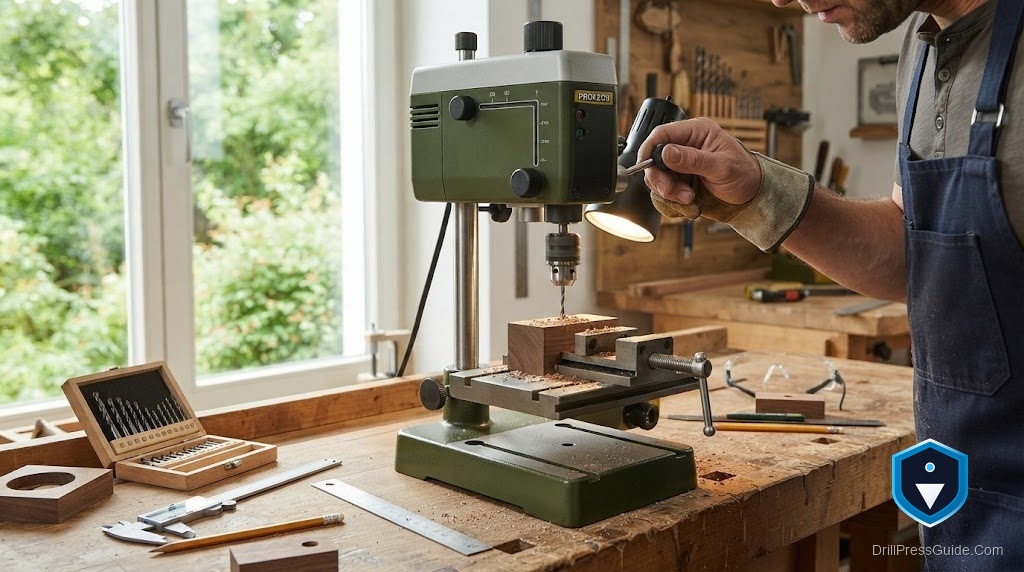
A small precision drill press is not a scaled-down version of a standard benchtop machine. It is a different category of tool built for a different kind of work. The holes are measured in millimeters, not inches. The speeds are measured in thousands of RPM, not hundreds. The runout is measured in thousandths of an inch, not sixteenths. If you have ever tried to drill a 0.5-millimeter hole through a brass watch plate with a hand drill, you already know why these machines exist.
A small precision drill press is a compact, bench-mounted drilling machine designed for accuracy on small parts. These machines typically have a swing of 6 to 8 inches, a small collet or chuck system, and a high-speed motor suited for jewelry, electronics, model building, and light metalwork. Unlike full-size benchtop presses, precision drill presses prioritize accuracy and speed control over brute capacity.
The question is whether a small precision drill press is the right tool for your work, or whether a standard benchtop press will do. The answer depends on the scale of your projects. If you drill holes smaller than 1/8 inch, work with delicate materials, or need repeatable accuracy for production runs, a precision drill press is essential. If you drill standard hardware holes in wood and metal, a standard benchtop press is the better choice.
What Makes a Precision Drill Press Different
Runout is the critical difference. Runout is the amount of wobble in the spindle as it rotates. A standard benchtop press might have 0.005 inches of runout, which is fine for a 1/4-inch bit in wood. A precision drill press has 0.001 inches or less, which is necessary for a 1/32-inch bit in brass or a 0.5-millimeter bit in a circuit board. At high speed, any wobble magnifies, and the bit snaps or wanders off center.
Speed is the second difference. Standard benchtop presses run from 500 to 3,000 RPM. Precision drill presses run from 2,000 to 10,000 RPM or higher. Small bits need high speed to cut properly. A 1/32-inch bit at 500 RPM will grab and break. The same bit at 5,000 RPM cuts cleanly.
The chuck system is the third difference. Standard presses use a keyed or keyless Jacobs chuck with three jaws. Precision presses often use collets, which grip the bit around its entire circumference. Collets reduce runout and provide better grip for small bits. Some precision presses also use tapered spindles with precision chucks designed for small tool holders.
Our Top Picks for Small Precision Drill Presses
PROXXON 38128 TBM 115 Precision Bench Drill Press
The PROXXON TBM 115 is the gold standard for small precision drill presses. It is a German-made machine with a cast iron base, a steel column, and a machined aluminum head. The three-step pulley system gives you speeds of 2,800, 5,500, and 8,500 RPM. The chuck is a 3/8-inch keyed type, and the included collet set lets you hold bits down to 1/64 inch.
What makes the TBM 115 exceptional is the runout. Owners consistently report near-zero runout, which is critical for micro-drilling. The bearings are quality, the spindle is ground true, and the belt drive provides smooth power transmission without the vibration of a direct-drive motor. For jewelry, watchmaking, electronics, and model building, this is the machine most professionals reach for.
The quill travel is about 1-1/2 inches, which is small but sufficient for the scale of work this machine handles. The depth stop is a simple collar with a scale, and it works well for repeatable holes in thin material. The table is small but adjustable, and the overall footprint is minimal.
The flaw is the price. The TBM 115 costs more than some full-size benchtop drill presses. You are paying for precision machining, not capacity. For a hobbyist who drills the occasional model part, the price is hard to justify. For a jeweler or electronics builder who drills precision holes daily, the accuracy pays for itself in broken bits and ruined workpieces.
Who should skip it: woodworkers and general DIYers who need to drill holes larger than 1/4 inch in thick material. The PROXXON is too small and too slow for that work. It is also over


