Understanding 8-Inch Benchtop Drill Press Before You Buy or Set One Up
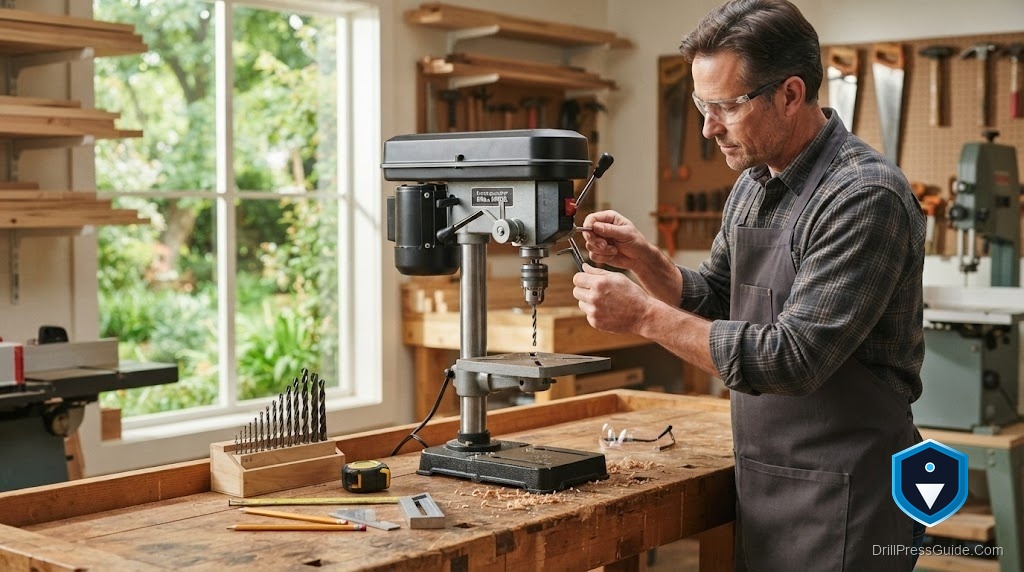
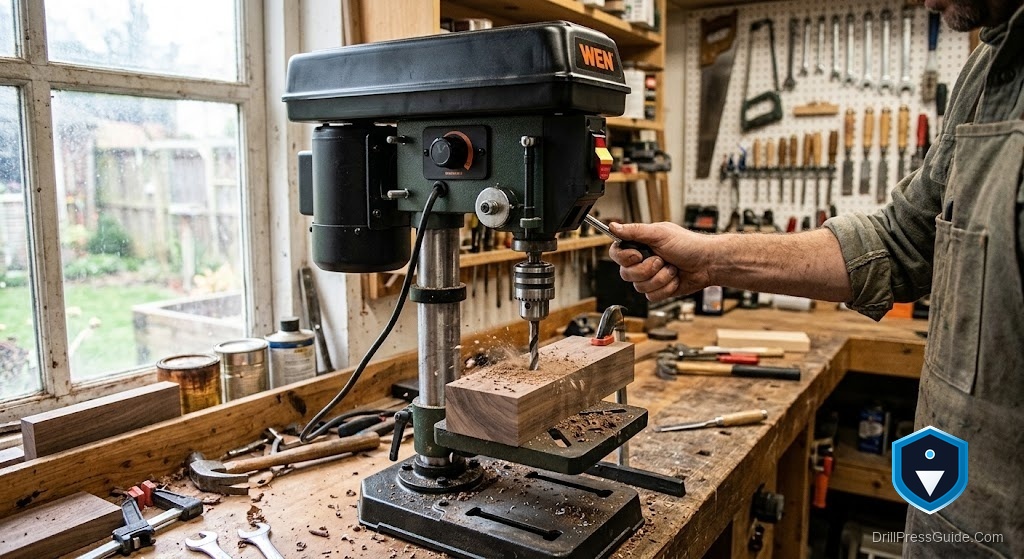
An 8-inch benchtop drill press is the smallest machine most people consider a real drill press. It is not a Dremel workstation or a precision jeweler’s tool. It is a bench-mounted machine with an induction motor, a keyed chuck, and a cast iron table that tilts. For a beginner, a hobbyist with limited space, or a woodworker who only drills small parts, the 8-inch class is where most people start.
An 8-inch benchtop drill press is a compact drilling machine with an 8-inch swing, meaning it can drill to the center of an 8-inch-wide workpiece. These machines typically have 1/3 to 1/2 horsepower motors, five fixed speeds, and a quill travel of about 2 inches. They are designed for wood, plastic, and light metalwork, and they sit on a workbench rather than taking up floor space.
The question is whether an 8-inch drill press is enough for your work, or whether you should step up to a 10-inch or 12-inch model. The answer depends on the size of your projects and the depth of the holes you need to drill. If you build small boxes, turn pens, or drill hardware holes in cabinet parts, an 8-inch press is enough. If you build furniture, drill deep mortises, or work with thick hardwood, you need more capacity.
What an 8-Inch Drill Press Can and Cannot Do
The 8-inch swing is the defining limit. You can drill to the center of an 8-inch-wide board, which means you can handle stock up to 16 inches wide by flipping it end for end. For most small projects, this is plenty. For a full-size cabinet door or a wide tabletop, it is not.
The 2-inch quill travel is the other limit. Two inches is enough for drilling through 1-1/2-inch stock with a standard bit, or through 3/4-inch stock with a Forstner bit that needs extra clearance. It is not enough for deep mortising, drilling through 4x4 posts, or using long auger bits. If your work involves deep holes, you need a machine with 3 inches or more of spindle travel.
The 1/3 to 1/2 HP motor is sufficient for wood and plastic. It will handle a 1-inch Forstner bit in softwood without complaining. It will struggle with a 1-1/2-inch hole saw in hardwood or a large spade bit in thick stock. For metal, the 8-inch press is limited to thin sheet stock and small bits. It is not a metalworking machine, though it can handle occasional light metal tasks with patience and cutting fluid.
Our Top Picks for 8-Inch Benchtop Drill Presses
WEN 4208T 8-Inch 5-Speed Benchtop Drill Press
The WEN 4208T is the benchmark entry-level 8-inch drill press. It has a 2.3-amp induction motor, five speeds from 740 to 3,140 RPM, and a 1/2-inch keyed chuck. The cast iron table tilts 45 degrees and rotates 360 degrees, and the base has pre-drilled holes for bench mounting.
What makes the 4208T the default choice is the price-to-capability ratio. It is inexpensive enough that you are not risking much if you end up drilling less than you expected, and capable enough that you can build real projects with it. The 2-inch quill travel is standard for the class, and the five-speed range covers the materials most beginners work with.
The honest flaw is the runout. At this price, the chuck and spindle are not precision-ground to the same standard as larger machines. For drilling holes in wood and plastic, the runout is not noticeable. For metalwork or precision joinery, it matters. If you need to drill brass fittings or align small mechanical parts, the 4208T may frustrate you.
Who should skip it: anyone who needs to drill large workpieces or deep holes. The 8-inch swing and 2-inch quill travel are hard limits. If you build furniture, drill mortises, or work with thick stock, the 4208T is the wrong machine. Step up to a 10-inch or 12-inch model instead.
Check out the WEN 4208T on Amazon
Woodskil 8-Inch 5-Speed Benchtop Drill Press
The Woodskil 8-inch drill press is a direct competitor to the WEN 4208T, with nearly identical specifications. It has a 2.3-amp motor, five speeds, a 1/2-inch keyed chuck, and a cast iron table with laser guide. The overall size and weight are comparable to the WEN, and the performance is similar in most respects.
What distinguishes the Woodskil is the laser guide and the work light. The laser is a crosshair pattern that projects onto the workpiece, which helps with quick alignment. The LED work light is a small but useful addition in a dim garage. These features are not essential, but they are convenient for a beginner who is still learning to align the bit with a layout mark.
The flaw is the long-term durability. The Woodskil is a newer brand with less of a track record than WEN, and the customer support network is not as established. If a switch fails or a bearing wears out, finding replacement parts may be more difficult. The machine works well out of the box, but the five-year picture is less certain.
Who should skip it: buyers who prioritize long-term support over initial features. The WEN 4208T has been on the market longer, has more documented user experience, and has better parts availability. For a machine you plan to keep for a decade, the WEN is the safer bet.
Check out the Woodskil 8-Inch Drill Press on Amazon
VEVOR 8-Inch 5-Speed Benchtop Drill Press
The VEVOR 8-inch benchtop drill press is another entry in the crowded 8-inch market, with a 2.5-amp motor and five speeds from 750 to 3,200 RPM. The table tilts 45 degrees, and the machine includes a laser guide and a work light. The cast iron base and headstock are standard for the class.
What makes the VEVOR interesting is the slightly higher motor rating. The 2.5-amp motor is nominally more powerful than the 2.3-amp motors in the WEN and Woodskil, though in practice the difference is small. The laser guide is also included, which is a feature some competitors charge extra for or omit entirely.
The flaw is the build quality and consistency. VEVOR machines are manufactured in China to a price point, and quality control can vary between production runs. Some users report smooth, accurate machines. Others report higher runout, stiff table racks, or premature bearing wear. The warranty and support are adequate, but the experience is less predictable than with established brands.
Who should skip it: buyers who want predictable, long-term reliability. The VEVOR is a good value if you get a good machine, but the variance in quality makes it a gamble compared to the WEN 4208T.
Check out the VEVOR 8-Inch Drill Press on Amazon
Comparison: 8-Inch Drill Presses
| Feature | WEN 4208T | Woodskil 8-Inch | VEVOR 8-Inch |
|---|---|---|---|
| Motor | 2.3A | 2.3A | 2.5A |
| Speeds | 5 (740-3,140 RPM) | 5 (750-3,200 RPM) | 5 (750-3,200 RPM) |
| Chuck | 1/2-in keyed | 1/2-in keyed | 1/2-in keyed |
| Quill travel | 2 in | 2 in | 2 in |
| Table | Cast iron, tilts 45° | Cast iron, tilts 45° | Cast iron, tilts 45° |
| Laser guide | No | Yes | Yes |
| Work light | No | Yes | Yes |
| Weight | ~30 lb | ~32 lb | ~31 lb |
The WEN 4208T is the proven choice with the longest track record. The Woodskil adds convenience features at a similar price. The VEVOR offers a slightly more powerful motor but with less predictable quality control. For most buyers, the WEN is the safe default.
Setup and Use Tips for 8-Inch Drill Presses
Bolt the machine to a plywood base plate. The machine is light enough to shift under load if it is not secured. A 3/4-inch plywood base, screwed to the bench, with the drill press bolted to the plywood, gives you a stable platform and the ability to remove the machine when you need the bench space.
Check the table for perpendicularity before your first project. Use a carpenter’s square or a machinist’s square to verify that the table is at 90 degrees to the spindle when the tilt is set to zero. An angled table produces angled holes, which is the most common frustration for new drill press owners.
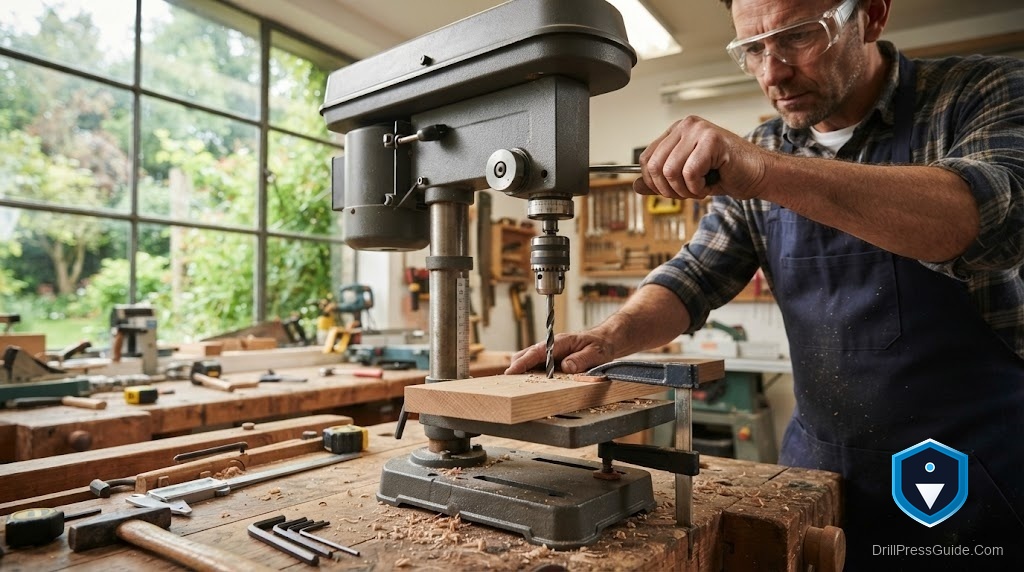
Use a backer board. When drilling through thin material, place a scrap piece of wood underneath. This prevents tear-out on the back side and gives the bit a clean exit. It also protects the table surface from the bit, which extends the life of the table finish.
FAQ
Q: Can an 8-inch drill press drill through a 4x4 post?
A: Not in one pass. The 2-inch quill travel is not enough to drill through a 3-1/2-inch 4x4. You can drill from both sides, using the first hole as a guide, or use a hand drill to finish the hole after starting it with the drill press.
Q: What is the largest bit an 8-inch drill press can handle?
A: The 1/2-inch chuck accepts bits up to 1/2 inch in diameter. For larger holes, use a hole saw or Forstner bit with a 1/2-inch shank. The motor can handle up to about 2-inch diameter hole saws in softwood, but it will bog down in hardwood or metal.
Q: Can I use an 8-inch drill press for metalwork?
A: Yes, for thin sheet metal and small holes. Use a slow speed, cutting fluid, and a sharp bit. The 8-inch press is not built for heavy metalwork, and it will struggle with thick steel or large-diameter bits.
Q: Is an 8-inch drill press enough for woodworking?
A: For small to medium projects, yes. If you build boxes, small furniture, turn pens, or drill hardware holes, an 8-inch press is sufficient. For large furniture, cabinets, or deep mortising, you need a larger machine with more swing and quill travel.
Q: What speed should I use for different materials?
A: Use high speeds for wood and plastic, medium speeds for aluminum, and low speeds for steel. The exact RPM depends on the bit diameter. Small bits can run faster than large bits. The speed chart in your drill press manual is a good starting point.
Q: Do I need a drill press vise for an 8-inch machine?
A: A vise is recommended for metalwork and precision drilling. For woodworking, clamps or a hold-down are usually sufficient. A drill press vise keeps the workpiece from spinning if the bit catches, which is a safety issue as much as an accuracy issue.
References
- WEN Products. 4208T 8-Inch 5-Speed Drill Press Specifications. https://wenproducts.com/
- Woodskil. 8-Inch Drill Press Instruction Manual. Check on Amazon
SEO Metadata: