Shopping for a Baileigh Drill Press? Start With Size, Speed, and Support
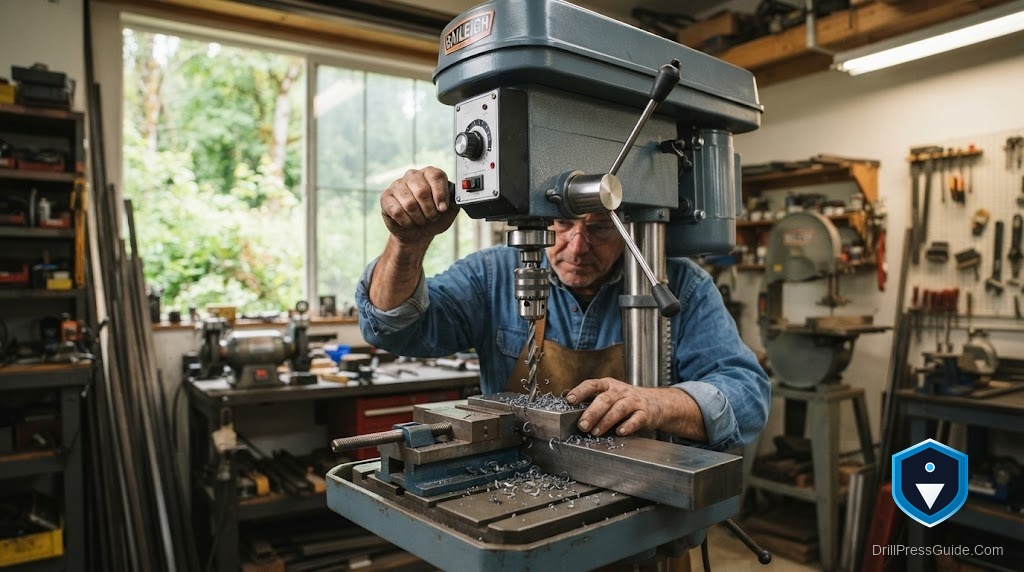
Baileigh Industrial is a name you meet when your work gets serious about metal. They build heavy machinery for fabrication shops, and their drill presses reflect that: bigger, stronger, and more capable than the machines aimed at casual home use. If you are shopping for a Baileigh drill press, the range runs from benchtop units to floor models to radial machines, and the right choice depends on your work far more than on the badge. Here is how to sort through the lineup by size, speed, and support.
What Baileigh drill presses are
Baileigh makes drill presses for metalworking and heavy shop use, spanning several formats:
- Benchtop models. Compact machines for smaller shops that still want Baileigh’s build quality.
- Floor models. Larger presses like the gear-head and variable-speed units (the DP-1000G and DP-1000VS families, among others) built for heavier drilling with more swing, travel, and power.
- Radial models. Presses with a head that slides along an arm to reach holes far from the column, useful for large or awkward stock.
What they share is a metalworking focus: heavier castings, stronger motors, Morse taper spindles, and features like tapping capability on some models. These are tools built to drill metal accurately and repeatedly, not just to punch pilot holes in wood.
Gear-head versus variable-speed
Two of the letters in Baileigh model names tell you a lot. A gear-head press (the G models) changes speed through a gearbox, giving positive, no-slip power transfer that holds torque when driving large bits through steel. A variable-speed press (the VS models) lets you adjust speed steplessly, which is convenient when you move between materials and bit sizes often. If your work is heavy and repetitive, the gear-head’s solid power delivery is the draw; if you value the flexibility of dialing in any speed, the variable-speed model makes its case. Match the drive type to how you actually work.
Tapping and other capabilities
One feature worth calling out is tapping. Some Baileigh presses can run in a tapping mode, reversing the spindle to cut threads, which turns the machine into a two-in-one tool for metal fabrication. If you thread holes regularly, this capability alone can justify choosing a Baileigh over a simpler press. As always, confirm the specific model’s capabilities against its manual, since the range spans very different machines.
What to check and how to support it
Because these are heavier machines, a few checks matter. Confirm the power requirement, since larger models often need 220-volt supply. Verify the spindle taper (commonly a Morse taper) so your tooling fits, and check the swing and spindle travel against your typical work. For support, Baileigh publishes manuals and parts information, and the everyday wear items are standard. Keep the model number handy and use Baileigh’s documentation for anything specific to the gearbox or variable-speed mechanism.
Tooling and accessories
A metalworking press earns its keep with the right tooling. Fit a quality keyed drill chuck with the matching Morse taper arbor, add a heavy drill press machine vise rated for metal, and keep metal cutting and tapping fluid on hand for clean holes and threads. A set of metal twist drill bits suits the machine’s capacity. Confirm the taper before ordering an arbor.
The verdict
A Baileigh drill press is the right choice when your work is genuinely metal-focused and a light home-shop press keeps holding you back. Start by matching the format to your work: benchtop for a smaller metal shop, a floor model (gear-head for heavy repetitive drilling, variable-speed for flexibility) for serious capacity, or a radial for reach. Confirm the power requirement, spindle taper, swing, and travel, and check whether a tapping mode fits your needs. Back the machine with a good chuck, a heavy vise, and cutting fluid, and it will drill and thread metal accurately for years. For casual woodworking, though, it is more machine than you need, so buy a lighter press instead.
Takeaways:
- Baileigh builds metalworking drill presses across benchtop, floor, and radial formats.
- Gear-head (G) models give positive no-slip power; variable-speed (VS) models give stepless flexibility.
- Some models add a tapping mode for cutting threads, a real bonus for metal fabrication.
- Confirm power (often 220V), spindle taper, swing, and travel, and match the format to your work.
FAQ
What kinds of drill presses does Baileigh make? Benchtop, floor, and radial models, spanning gear-head and variable-speed drives, all with a metalworking focus and heavier build than casual home presses.
What is the difference between the DP-1000G and DP-1000VS? The G is a gear-head machine with positive, no-slip power transfer for heavy drilling; the VS is variable-speed for stepless flexibility across materials. Choose by how you work.
Can a Baileigh drill press tap threads? Some models offer a tapping mode that reverses the spindle to cut threads. Confirm the specific model’s capability in its manual.
Do Baileigh drill presses need 220-volt power? Many of the larger floor models do. Confirm the power requirement before buying, and plan the electrical supply and floor space.
Are Baileigh presses good for woodworking? They can drill wood, but they are built for metal. For casual woodworking, a lighter press is a better fit.
What spindle taper do they use? Commonly a Morse taper. Confirm the exact size before ordering a chuck or arbor.
Where do I get parts and manuals? Baileigh publishes manuals and parts information; wear items are standard. Keep the model number handy for gearbox or variable-speed parts.
References
- Baileigh Industrial, drill press product line (benchtop, floor, radial): https://www.baileigh.com/metalworking/drilling/drill-presses
- Baileigh Industrial, drill press manuals and documentation: https://www.baileigh.com/customer-service/manuals
- Baileigh Industrial, gear-head and variable-speed drill press specifications: https://www.baileigh.com/drill-press-dp-1000vs