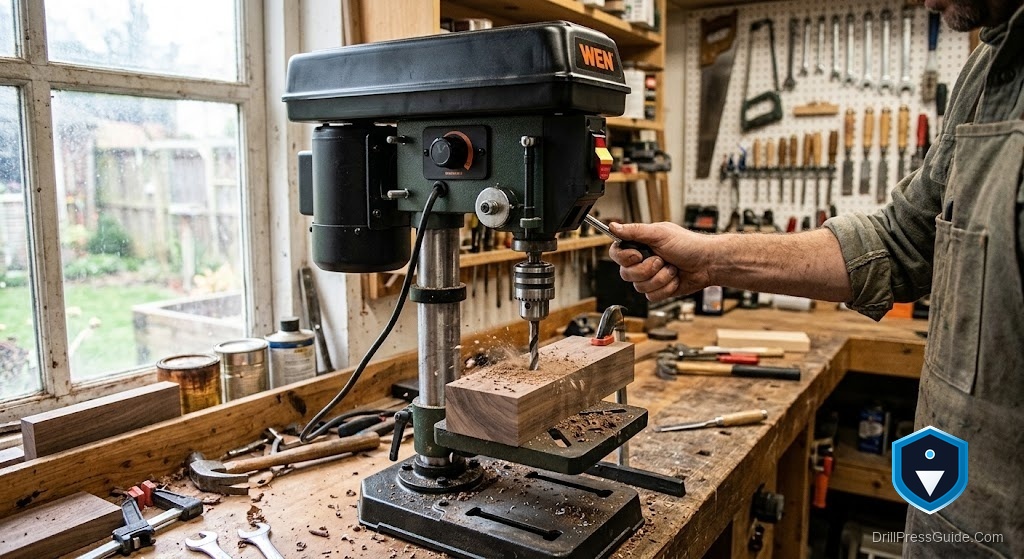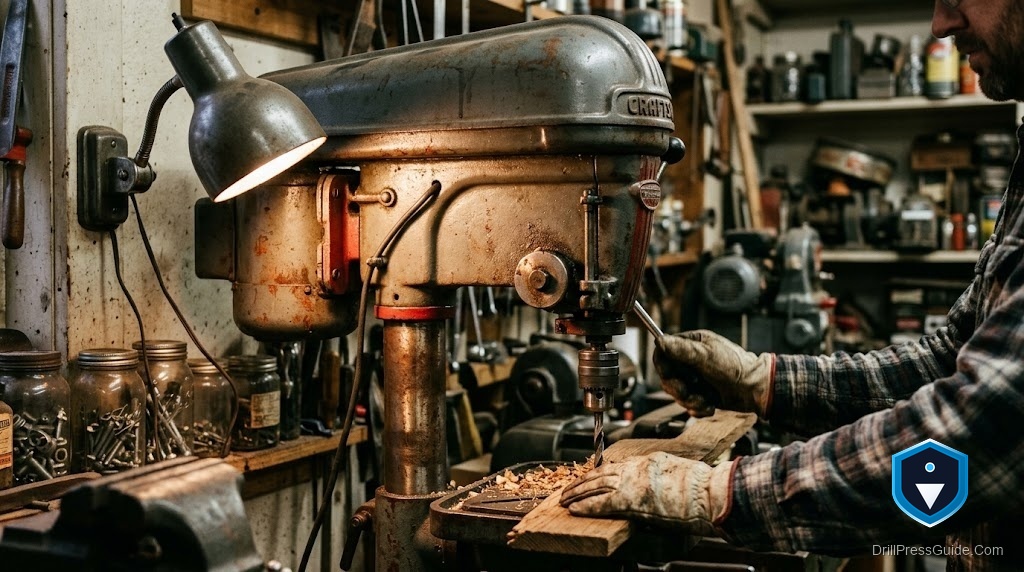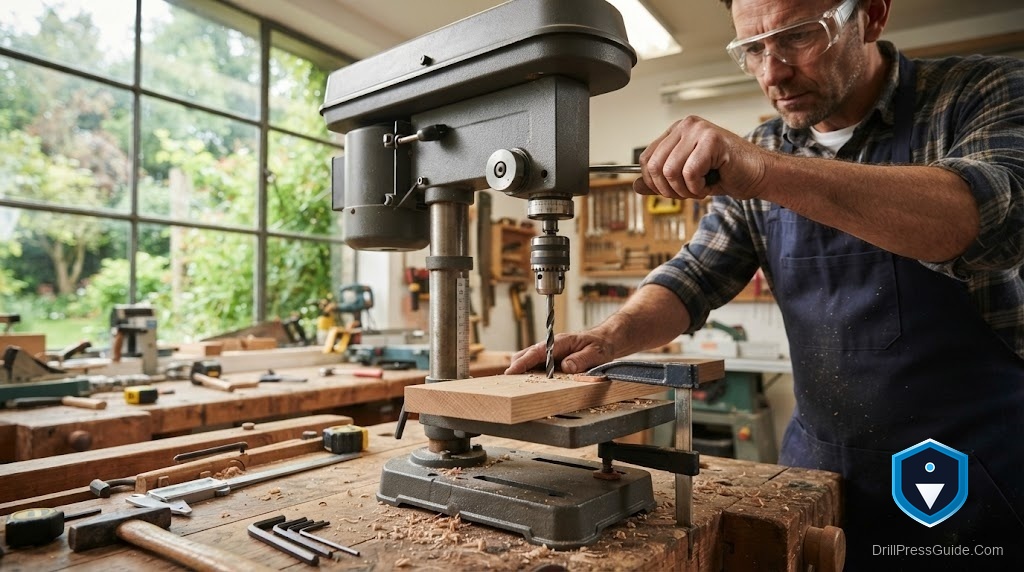
Which Drill Press for 80 Lower Fits Your Work, Space, and Budget?
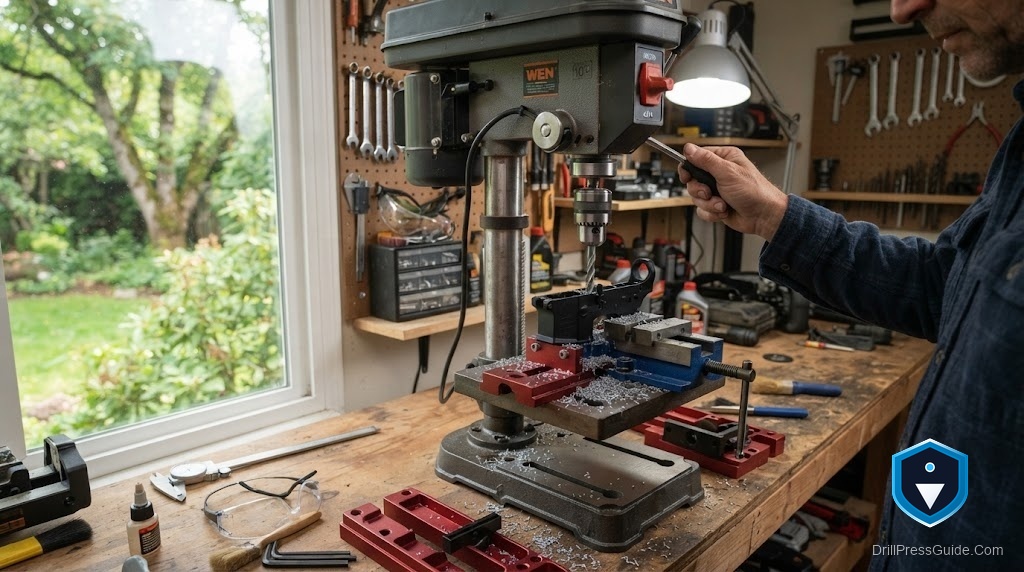
You have an 80 percent lower receiver sitting on your workbench and a jig kit ready to go. The next step is drilling precise holes in aluminum or polymer without ruining the part. A handheld drill is a gamble. A drill press gives you the vertical control and repeatability you need, but not every benchtop press is stiff enough for this work.
I have worked with drill presses in small shops and talked with builders who have finished dozens of lowers. The right machine for an 80 lower build is not necessarily the most expensive one. It is the one that runs true, holds speed, and gives you enough control to follow a jig plate without wandering.
An 80 percent lower receiver is a partially completed firearm frame that requires drilling of trigger pin holes, hammer pin holes, and safety selector holes, plus milling or routing of the fire control pocket. A drill press is used for the straight holes. The fire control pocket is usually completed with a router or milling setup, but some jigs use the drill press for initial material removal. The drill press must hold tight tolerances because the holes must align with the trigger group and safety parts.
The best drill press for an 80 lower build is a rigid benchtop model with a solid table, adjustable speed, and a chuck that does not wobble. You need at least a 1/2-inch chuck capacity to hold the drill bits and end mills used in common jig kits. A spindle travel of 2 inches or more is helpful for clearing tall jig sides. Variable speed is valuable because aluminum drills best at slower speeds than wood, and small pin holes need higher RPM for clean entry.
What to Look for in a Drill Press for 80 Lower Work
Rigidity is the first priority. A flimsy press will flex when you plunge into aluminum, especially with the larger bits used for the trigger hole. Look for cast-iron construction in the head and table. Stamped steel tables vibrate and can cause the bit to walk off the jig plate mark.
Speed control matters more than raw horsepower. A 3-amp to 5-amp motor is enough for aluminum lowers if you can slow it down to 500 to 1000 RPM for the larger holes. If the press only runs at high speed, you will burn bits and gall the aluminum. Either a variable speed dial or a multi-speed belt system with a low range works.
Table size and adjustability are practical concerns. Jig kits clamp to the table or sit in a vise. You need enough table area to support the jig without overhang. A table that tilts is not critical for this work, but a table that raises and lowers smoothly is, because lower receivers come in different heights depending on the model and jig setup.
Runout is the enemy of clean holes. Before you commit to a press, check reviews for runout complaints. If the chuck wobbles, your holes will be oversized and the pins will be loose. A keyed chuck with quality jaws is usually more accurate than a keyless chuck in this price range.
Top Picks for 80 Lower Builds
WEN 4212T 10-Inch Variable Speed Drill Press
The WEN 4212T is a 5-amp benchtop drill press with a 10-inch swing and 2-inch spindle travel. Its mechanical variable speed runs from 530 to 3100 RPM, and the digital readout shows the actual speed. The cast-iron table tilts 45 degrees left and right, and the base is heavy enough to stay steady under light milling loads.
What makes this press work for 80 lowers is the variable speed control and the 1/2-inch keyed chuck. You can slow down for the large trigger hole and speed up for the small 1/8-inch pin holes. The table is large enough for most router jigs or drill press jigs, and the rack-and-pinion height adjustment lets you dial in the clearance without shimming.
The honest flaw is the depth stop. It works for woodworking but can shift under the repeated plunging needed for milling-like cuts in aluminum. If you use this press for anything beyond straight drilling, check the depth stop every few passes and tighten it firmly. Also, the 2-inch travel is enough for most lower jigs but tight if you stack thick jig plates. Builders who plan to do multiple lowers should consider a press with longer travel.
Skip the WEN 4212T if you need to mill full fire control pockets with a drill press. It is not a mill, and the quill is not designed for side loads. For straight hole drilling through a quality jig, it is a practical choice that fits most budgets.
SKIL 6.2 Amp 10-Inch 5-Speed Benchtop Drill Press
The SKIL DP9505-00 is a newer benchtop press with a 6.2-amp motor and five fixed speeds from 610 to 2800 RPM. It includes a laser crosshair alignment system and an LED work light. The 10-inch swing and 2-inch travel match the WEN, and the cast-iron construction is solid for the class.
This press is a good fit for builders who want a simple, reliable machine with a bit more motor power than the WEN. The 6.2-amp motor bogs down less when drilling larger holes in aluminum. The laser alignment is helpful for lining up the first hole in a jig plate, though you should still verify alignment with the jig’s own drill bushings.
The flaw is the fixed five-speed system. You are limited to the factory speed steps, and the lowest speed of 610 RPM is still a bit fast for large-diameter aluminum holes. You will need to use sharp bits, plenty of cutting fluid, and light feed pressure. Also, the table is slightly smaller than the WEN, so large router-style jigs may overhang.
Skip this model if you want the dialing precision of true variable speed. It is a strong choice if you prefer a simpler machine with more motor grunt and modern alignment aids.
Check the SKIL DP9505-00 on Amazon
WEN 4214T 12-Inch Variable Speed Drill Press
The WEN 4214T steps up to a 12-inch swing and 3-1/8-inch spindle travel. It keeps the same 5-amp motor and variable speed range but adds a work table roller extension and a larger base. The extra travel is the headline feature here.
For 80 lower builds, the longer travel means you can handle taller jig setups and deeper plunge cuts without resetting the table height. The larger table is also easier to clamp a vise or jig fixture to. The variable speed and digital readout are the same as the 4212T, so you get the same speed control benefits.
The flaw is weight. At 85 pounds, this press is less portable and needs a sturdier bench. The larger footprint may also be too much for a cramped apartment workshop. Also, the roller extension is more useful for woodworking than for lower builds, so you are paying for a feature you may not use.
Skip the 4214T if you have limited bench space or plan to move the press between storage and work. Buy it if you want maximum travel and table size in a benchtop package.
JET JDP-15B 15-Inch Benchtop Drill Press
The JET JDP-15B is a 3/4-horsepower, 16-speed benchtop press with a 15-inch swing and 3-1/8-inch travel. It uses a poly-V belt drive, a large cast-iron table with T-slots, and a built-in Xacta-X laser system. The depth stop is repeatable and the quill is smooth.
This is the upgrade pick for builders who want the most rigid benchtop machine available. The 3/4-horsepower motor does not slow down in aluminum, and the 16 speeds give you a low end around 210 RPM. That slow speed is ideal for large holes and drilling steel if you ever branch into other projects. The table is large enough for any jig or fixture.
The flaw is size and cost. This is a 165-pound machine that needs a dedicated bench. It is also overkill if you only plan to finish one or two lowers. The depth stop is excellent but the machine is priced for serious woodworkers and metalworkers, not casual builders.
Skip the JET if you are on a tight budget or have a small bench. It is the best benchtop press in this guide for rigidity and precision, but the investment only makes sense for active shops.
Check the JET JDP-15B on Amazon
Ironton 8-Inch 5-Speed Benchtop Drill Press
The Ironton 8-inch benchtop press is a compact, 1/3-horsepower machine with five speeds and a 2-inch stroke. It is the smallest and lightest option in this guide, and it fits on a narrow workbench or shelf.
This press works for 80 lower builds only if you have a simple jig and small lowers. The 1/3-horsepower motor will struggle with large aluminum holes, and the 8-inch swing limits how you position the work. The fixed speeds run high for aluminum, so you must use small cuts and sharp bits.
The flaw is power. The motor simply does not have the torque for aggressive drilling in metal. You will need to take many light passes and let the motor cool between holes. The table is also small, so clamping a full-size jig can be awkward.
Skip the Ironton unless you are doing polymer lowers or very light-duty work and have no space for a larger machine. It is the last resort, not the first choice.
Check the Ironton 8-Inch Drill Press on Amazon
Setup Tips for 80 Lower Drilling
Use a drill press vise or clamps to secure the jig to the table. Never hold the lower by hand. A vise with a swivel base is ideal because you can align the jig without unclamping. Use sharp, quality drill bits. Dull bits walk, wander, and grab in aluminum. A brad-point or stub-length bit is better than a long twist bit for pin holes. Use cutting fluid. Aluminum galls and builds up on bits. A drop of tapping fluid or even WD-40 keeps the cut clean and the bit cool. Drill in stages. For the large trigger hole, start with a pilot and step up in two or three sizes. Plunging a 3/8-inch bit straight in is hard on the press and risky for the lower. Check alignment before every hole. The jig is your guide, but if the press table is not square to the chuck, the hole will be angled. Use a square to check table alignment before you start.
Frequently Asked Questions
Do I need a mill instead of a drill press for an 80 lower? A mill is ideal for the fire control pocket, but many jigs let you complete the straight holes with a drill press. For the pocket itself, a router jig or a milling attachment is standard. A drill press alone is enough for the pin holes and some initial pocket work if the jig is designed for it.
What speed should I use for drilling aluminum lowers? For small pin holes, 2000 to 3000 RPM works. For larger holes, slow down to 500 to 1000 RPM. Use cutting fluid and a steady feed rate. Do not let the bit spin without cutting.
Can I use a keyless chuck for this work? A keyed chuck is more secure and typically more accurate than a keyless chuck in this price range. Keyless chucks can slip under the side loads of jig drilling.
What size drill press do I need for an AR-15 lower? A 10-inch swing is enough for most AR-15 lower jigs