
Porter Cable 10-Inch Drill Press Review: What to Check Before You Buy
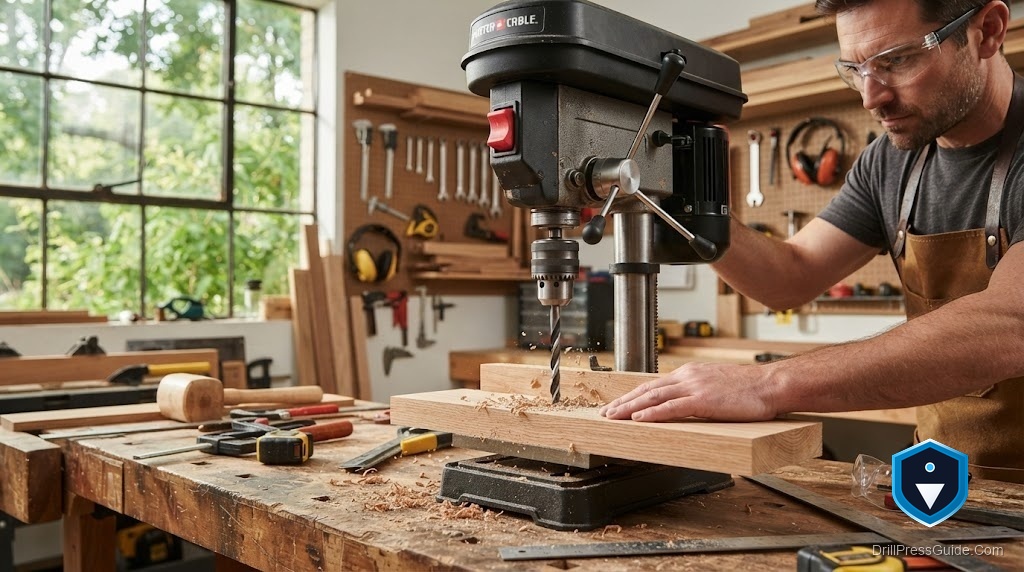
You walk into a garage sale and spot a cast-iron benchtop drill press with a red and black badge that says Porter Cable. The table looks solid, the motor hums when the owner plugs it in, and the price seems fair. But is this the right machine for your shop, or will you wish you had kept looking?
I have spent years working with benchtop drill presses in small shops and home garages. The Porter Cable 10-inch benchtop drill press, model PCXB620DP, is one of those tools that shows up in used listings, estate sales, and occasionally at select retailers. It is worth understanding before you hand over cash.
A drill press is a stationary drilling machine that holds a motor, quill, and chuck in a vertical column above a fixed work table. Unlike a handheld drill, it drills straight, repeatable holes at controlled depths and speeds. The Porter Cable 10-inch model fits this definition with a 10-inch swing, meaning it can drill a hole in the center of a workpiece up to 10 inches in diameter.
This model features a 3.2-amp induction motor, five belt-driven speeds from 610 to 2800 RPM, and a cast-iron head, table, and base. The 1/2-inch keyed chuck provides 2 inches of spindle travel, and the rack-and-pinion table elevation system lets you raise or lower the table without unclamping your work. The table tilts 45 degrees left and right for angled drilling, and a small LED light under the head illuminates the work area.
The short answer is that the Porter Cable 10-inch drill press is a competent entry-level machine for light woodworking and occasional metal drilling. It is not a precision instrument, and it will frustrate anyone who needs to drill large holes in steel or bore deep mortises. But for a hobbyist building shelves, drilling peg holes, or doing light DIY work, it does the job if the price is right and the machine is in good condition.
Build Quality and Real-World Performance
The cast-iron head and base are the strongest parts of this machine. They add weight and dampen vibration better than stamped steel frames on the cheapest benchtop presses. The table is also cast iron, which is a step up from aluminum tables that dent and scratch easily. At around 50 to 55 pounds, the press is light enough to move but heavy enough to stay put during normal use.
The five-speed belt system is standard for this class. You change speeds by opening the head, moving the belt between pulleys, and retensioning. The speed range of 610 to 2800 RPM covers most wood drilling and some light metal work. The low end is slow enough for larger Forstner bits in hardwood, and the high end works for small twist drills in softwood.
The 2-inch spindle travel is a limitation. That is the distance the chuck can move downward in one stroke. For most drilling tasks, 2 inches is enough. But if you plan to use a mortising attachment or need to drill deep holes in thick stock, you will run out of travel quickly. Many competing 10-inch presses offer the same 2-inch travel, so this is not a unique flaw, but it is a real constraint.
The rack-and-pinion table height adjustment works well when the mechanism is clean. Over time, sawdust and grime can clog the rack, making the crank stiff. The table tilt mechanism uses a simple bolt-and-trunnion setup. It holds angle adequately for wood but can shift under heavy side loads in metal.
Owner reports from garage forums and woodworking communities show a consistent pattern. Users praise the machine for basic reliability. It drills holes where you aim it, the motor does not overheat in light duty, and the assembly is straightforward. Common complaints include runout that is acceptable for wood but noticeable for metal, a work light that is dim compared to modern LED systems, and the fact that the 610 RPM minimum is not slow enough for large-diameter metal drilling without frequent bit changes or cooling pauses.
What to Inspect on a Used Porter Cable Drill Press
If you are buying used, check the chuck runout first. Mount a straight drill bit and spin the chuck by hand. If the bit wobbles visibly, the bearings may be worn or the chuck may be damaged. A small wobble is normal on budget presses, but a large wobble means poor hole quality and premature bit wear.
Check the table elevation crank. It should turn smoothly without grinding or skipping. If the rack is damaged, replacement parts are difficult to find because this model is no longer in regular production. Inspect the belt for cracking and the pulleys for rust or grooves. Test the motor under load by pressing a block of wood against a spinning bit. The motor should maintain speed without smoking or squealing.
Look at the depth stop rod. It should thread smoothly and lock in place. If it is bent or stripped, repetitive hole depths will be hard to achieve. Finally, make sure the chuck key is included. A missing key is a minor inconvenience, but it tells you the previous owner may have lost other accessories too.
Who Should Buy This and Who Should Skip It
This machine is for the hobbyist who needs a benchtop drill press for occasional woodworking, light metal work, and general home repairs. It is also a reasonable first machine for a beginner who is not sure how much they will use a drill press. If you find one in good condition for a fair used price, it is a solid entry point.
Skip it if you need precision metalworking, deep mortising, or large-diameter hole drilling. The 2-inch travel and modest motor will hold you back. Also skip it if you cannot find one in good condition, because replacement parts and warranty support are limited now that the model is not widely stocked. If you need a new machine with full warranty and support, look at current production models instead.
How It Compares to Current Alternatives
The SKIL 6.2 Amp 10-inch 5-speed benchtop drill press, model DP9505-00, is a modern alternative with similar capacity. It adds a laser alignment system and a brighter LED work light, and it is available new with full warranty coverage. The WEN 4212T 10-inch variable speed drill press offers mechanical variable speed control, a digital RPM readout, and a wider speed range, making it more flexible for mixed materials. The WEN 4214T 12-inch model steps up to a larger swing and 3-1/8-inch travel, which is worth considering if you have the bench space and budget.
The Grizzly G7943 14-inch benchtop drill press is a heavier machine with a 3/4-horsepower motor and 3-1/4-inch travel. It is a significant upgrade in rigidity and capacity but takes up more space and weight. The Ironton 8-inch benchtop drill press is smaller and lighter, suitable for very tight shops or mobile work, but the 1/3-horsepower motor and 8-inch swing limit its usefulness for larger projects.
For most buyers today, I would recommend the WEN 4212T or the SKIL DP9505-00 as a new purchase because they are readily available, well-supported, and offer more modern features. The Porter Cable PCXB620DP is a viable used purchase if the price is low and the condition is good, but it is not a machine I would chase at premium prices.
Maintenance Tips That Keep It Running
Keep the rack and pinion clean. Blow out sawdust after each session and lightly grease the rack every few months. Check the belt tension monthly. A loose belt causes slipping and overheating. Lubricate the quill return spring lightly with machine oil so the chuck retracts smoothly after each hole. Do not overtighten the chuck. Excessive force warps the jaws and increases runout. Use the correct speed for each bit size and material. Large bits in hardwood need the slowest speed. Small bits in softwood can run at the highest speed.
Frequently Asked Questions
What is the swing on the Porter Cable 10-inch drill press? The swing is 10 inches, meaning it can drill a hole in the center of a workpiece up to 10 inches in diameter.
Does the Porter Cable 10-inch drill press have variable speed? It has five fixed speeds selected by moving the belt between pulleys: 610, 1150, 1720, 2340, and 2800 RPM.
Can the table tilt for angled drilling? Yes, the cast-iron table tilts 45 degrees left and right.
Is the Porter Cable 10-inch drill press good for metal? It can handle light metal drilling in thin stock with the correct bits and cutting fluid. It is not suitable for heavy metal work or large-diameter holes in steel.
What is the spindle travel? The spindle travel is 2 inches, which is standard for many 10-inch benchtop models but limits deep-hole drilling.
How much does the Porter Cable 10-inch drill press weigh? It weighs approximately 50 to 55 pounds, depending on the exact configuration and accessories.
Is this drill press still manufactured? The PCXB620DP is no longer widely stocked by major retailers, though it may appear in used listings or at select outlets. Availability of new units is limited.
Can I use a mortising attachment with this drill press? The 2-inch spindle travel is generally too short for effective mortising. A dedicated mortiser or a drill press with longer travel is a better choice.
What is the chuck capacity? The 1/2-inch keyed chuck accepts bits from 1/16 inch to 1/2 inch.
Does it come with a work light? Yes, a small LED light is mounted under the head to illuminate the table area. It is functional but not as bright as lights on newer models.
References
- Porter Cable PCXB620DP Instruction Manual (Lowe’s product documentation)
- Garage Journal Forum: Owner discussions and long-term reliability reports.
- Sawmill Creek Woodworking Community: Community feedback on runout and metalworking limits.
- WoodLogger: “Porter Cable Drill Press Review & Assembly” Assembly guide and performance notes.
- Fine Woodworking: Drill press buyer’s guides and benchtop comparison standards.
SEO Metadata


