Central Machinery 13-Inch Drill Press: An Evidence-Led Buying Review
The Central Machinery brand is the house label for Harbor Freight, a retailer known for budget tools that range from surprisingly decent to disappointingly flimsy. The Central Machinery 13-inch drill press, sold under model numbers 38142 and 38144, is one of the most affordable benchtop and floor drill presses on the market. For less than the cost of a premium benchtop model, you get a 16-speed press with a cast iron head and base. That sounds like a deal. But Harbor Freight tools are notorious for inconsistent quality control, and drill presses are machines where accuracy matters. A wobbling column or a warped table turns a precision tool into a paperweight. The question is whether the Central Machinery 13-inch press is a hidden gem or a false economy.
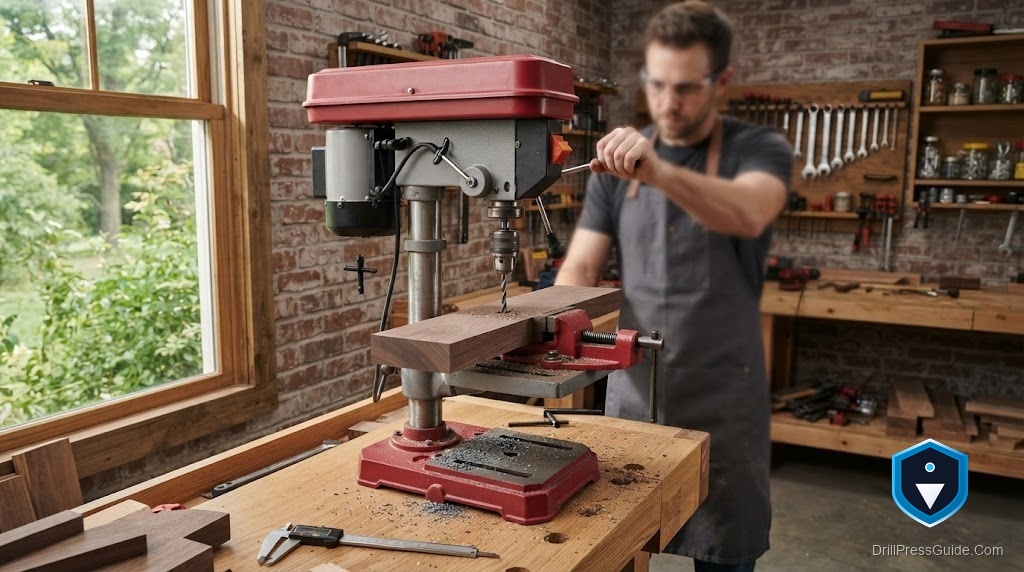
The Central Machinery 13-inch drill press is a benchtop or floor-standing machine with a 13-inch swing, a 16-speed belt drive, and a cast iron head and base. It includes a 5/8-inch keyed chuck, a tilting table, and a laser guide. The benchtop model is approximately 33 inches tall, while the floor model stands around 63 inches. It is sold exclusively at Harbor Freight under the Central Machinery label. The model numbers 38142 and 38144 refer to variants of the same basic machine, with the 38142 typically being the benchtop version and the 38144 being the floor model. Both are positioned as entry-level machines for hobbyists and home workshops.
The Central Machinery 13-inch drill press is a functional entry-level machine for hobbyists who need a basic drill press for occasional woodworking and light DIY tasks. It has a decent speed range, a cast iron construction that is better than some ultra-budget alternatives, and a price that is hard to beat. However, it is not a machine for serious woodworkers, metalworkers, or anyone who needs precision and reliability. The quality control is inconsistent, the motor is underpowered for heavy work, and the long-term durability is uncertain. For beginners who want to experiment with a drill press without a large investment, it is acceptable. For anyone who plans to use the machine regularly, there are better options from WEN and SKIL at slightly higher prices.
Motor and Power
The Central Machinery 13-inch drill press uses a 2.5-amp or 3.2-amp induction motor depending on the exact model variant. This is adequate for drilling holes in pine, plywood, and soft hardwoods with twist bits up to about 1/2 inch. For larger Forstner bits or hole saws, the motor struggles. In hardwood, a 1-1/2-inch Forstner bit will stall the motor unless you feed very slowly and clear chips frequently. The motor is an induction type, which is quieter than universal motors, but it lacks the torque reserve of the WEN 4214T or any 1/2-horsepower machine.
The honest flaw is the motor power. Some owners report that the Central Machinery bench press is underpowered for its size, stalling on small holes in hard materials or bogging down when the bit grabs. The 13-inch swing suggests a larger capacity than the motor can actually deliver. The motor is also mounted in a way that produces more vibration than premium brands, which can affect accuracy and comfort during long sessions.
Who should skip it: anyone who needs to drill large holes in hardwood, work with metal regularly, or use the machine for production work. The motor is a light-duty unit, and the 13-inch swing is misleading given the actual power output.
Speed Range and Belt Changes
The 16-speed range is controlled by belt repositioning on a stepped pulley system. The speeds cover a wide range from approximately 220 to 3200 RPM, which is a genuine strength for a budget machine. The low end is suitable for large bits and light metal work, while the high end handles small twist bits in wood. The belt changes are done by opening the head, loosening the motor, and shifting the belt across pulleys. This is standard for budget presses, but it is slower than variable-speed systems.
The flaw is that the pulley system is not precisely machined. Some owners report that the belt alignment is off out of the box, requiring adjustment during assembly. The belt tension is also tricky to set correctly. Too loose, and the belt slips under load. Too tight, and the bearings wear prematurely. This is a common issue with budget machines, but it is more pronounced on the Central Machinery press than on the WEN or SKIL equivalents.
Who should skip it: anyone who wants quick, convenient speed changes or who needs precise speed control for metalwork. The belt system is functional but frustrating compared to variable-speed machines.
Table, Column, and Build Quality
The table is cast iron, tilts 45 degrees, and rotates 360 degrees. The column is approximately 2-1/2 inches in diameter, which is adequate for light work but flexes under heavy feed pressure. The table crank is functional but can feel rough and imprecise. The paint is decent, but the castings are not as clean as on WEN or SKIL models. Some units ship with rough edges, paint runs, or minor casting defects that are cosmetic but suggest lower quality control.
The honest flaw is the quality control inconsistency. Some owners report perfectly flat tables and smooth operation. Others receive units with significant table wobble, rough rack-and-pinion mechanisms, or columns that are not perfectly straight. The most common complaint is the table locking collar,