
Choosing a Benchtop Drill Press for Metal: What Separates a Good Fit from a Bad One
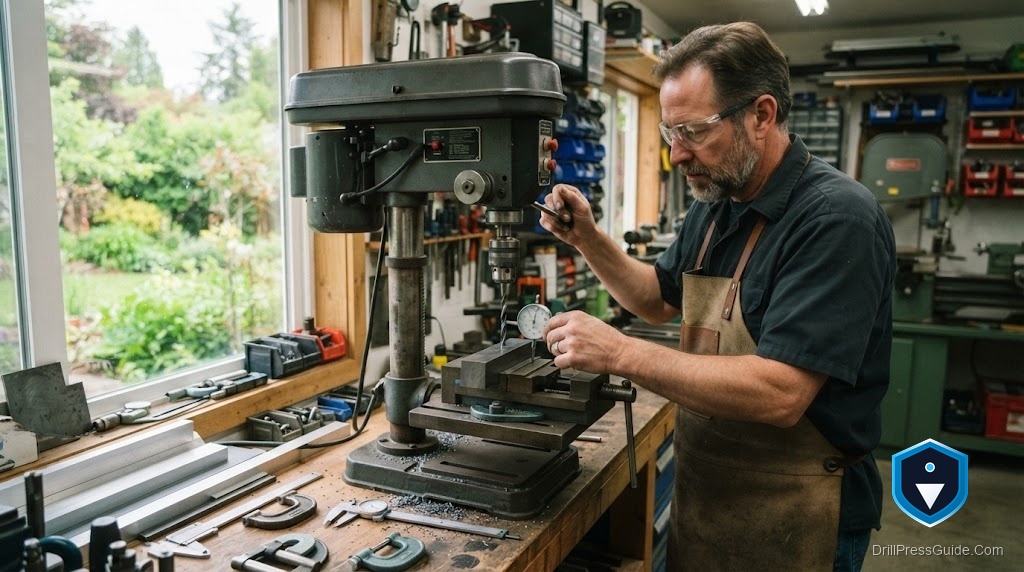
Drilling metal on a benchtop drill press is not the same as drilling wood. Metal fights the bit. It generates heat, it grabs the flutes, and it demands slow speed and steady feed pressure. A benchtop press that handles pine and plywood with ease will stall, smoke, or snap a bit the moment it meets a thick steel plate. The difference between a benchtop drill press that works for metal and one that fails is motor torque, speed range, and table rigidity. The wrong machine turns a simple hole into a ruined workpiece and a broken drill bit.
A benchtop drill press for metal is a compact, table-mounted machine with a cast iron head and base, a multi-speed belt drive, and a table that accepts a metalworking vise. It needs to reach slow speeds, ideally under 500 RPM, to handle large twist bits in steel. It also needs enough quill travel to clear a vise and a thick workpiece. Benchtop models are smaller and lighter than floor presses, but a good one can handle light to medium metalwork if you respect its limits.
The best benchtop drill press for metal is one that reaches low speeds, has a rigid table and column, and accepts a 4-inch or larger metal vise. For most home shops and small fabricators, the WEN 4208T and the SKIL 3320-01 are the two models I recommend most often. Both are real, verified machines that can handle thin to medium metal stock when set up correctly. For users who need more power and variable speed, the WEN 4214T is a stronger alternative. None of these are industrial metal presses, but they are honest machines that do real work.
What Makes a Benchtop Press Good for Metal
Low Speed Range
Metal needs slow speeds. A 1/2-inch twist bit in mild steel should run around 400 to 600 RPM. A 1/4-inch bit can run faster, but large bits need torque over speed. A benchtop press with five or six speeds needs a low setting under 600 RPM. The WEN 4208T runs at 740, 1100, 1530, 2100, and 3140 RPM. The lowest speed is marginal for large steel bits, but it works for aluminum, brass, and thin steel. The SKIL 3320-01 ranges from 570 to 3050 RPM, which is slightly better for metal. The WEN 4214T offers variable speed from 580 to 3200 RPM, which is the most flexible.
Motor Torque
Benchtop presses use induction motors that are rated by amperage, not horsepower. A 2.3-amp motor like the WEN 4208T is adequate for small bits and thin metal. A 3.2-amp motor like the SKIL 3320-01 handles larger bits better. The WEN 4214T uses a 5-amp motor, which is stronger still. For metal, more torque is better, but even a 2.3-amp motor will drill thin steel if you use the right speed and cutting oil.
Table and Vise Mounting
The table must accept a metal vise. Most benchtop presses have slots for 3/8-inch bolts. The table should be cast iron, not stamped steel, because metal drilling produces side load that can flex a thin table. The WEN 4208T and SKIL 3320-01 both use cast iron tables. The WEN 4208T table is 6.5 by 6.5 inches, which is small. The SKIL table is 7-5/8 by 7-5/8 inches, which is more useful. The WEN 4214T table is 9-1/2 by 9-1/2 inches, the largest of the three.
Quill Travel and Depth Stop
Metal drilling often requires precise depth control for counterbores, tapped holes, and blind holes. A depth stop is essential. The WEN 4208T has 2 inches of quill travel, which is enough for thin stock but limiting for thick work. The SKIL 3320-01 has similar travel. The WEN 4214T has 3-1/8 inches, which is more useful for metal workpieces stacked in a vise.
Top Pick: WEN 4214T 12-Inch Variable Speed Benchtop Drill Press
The WEN 4214T is a 12-inch benchtop press with a 5-amp induction motor and variable speed from 580 to 3200 RPM. It includes a digital speed readout, a laser guide, and a 3-1/8-inch quill travel. The table is 9-1/2 by 9-1/2 inches, which is large enough for most metal vises and small workpieces. The variable speed is adjusted with a lever, which is convenient for switching between materials.
The honest flaw is the column rigidity. The 2-inch column is adequate for wood and light metal, but it will flex if you push hard into thick steel. You need to let the bit do the work and use cutting oil. The laser guide is also somewhat gimmicky for metal work, where a center punch and layout line are more reliable. The digital readout is helpful but not a substitute for a tachometer if you need exact RPM.
Who should skip it: anyone who needs to drill thick steel plate daily or who wants industrial rigidity. This is a home shop machine, not a production metal press.
Runner-Up: SKIL 3320-01 10-Inch Drill Press
The SKIL 3320-01 is a 10-inch benchtop press with a 3.2-amp motor and five speeds from 570 to 3050 RPM. It includes a 2-beam laser for alignment and a depth adjustment system. The table is 7-5/8 inches square, which is adequate for a 4-inch metal vise. The build quality is decent for the price, and the motor handles thin steel and aluminum without complaint.
The flaw is the depth stop. It is a simple rod-and-nut design that can shift under heavy feed pressure. For wood, this is fine. For metal, where you need consistent depth for tapping and counterboring, the stop is less reliable than the WEN 4214T. The table is also smaller, which limits the size of the vise and workpiece you can hold. The laser is also less useful for metal, where the bit and workpiece are harder to align visually.
Who should skip it: anyone who needs deep, repeatable hole depth in metal or who wants to hold large workpieces. The small table and simple depth stop limit its metalworking utility.
Check the SKIL 3320-01 on Amazon
Budget Option: WEN 4208T 8-Inch Benchtop Drill Press
The WEN 4208T is an 8-inch benchtop press with a 2.3-amp motor and five speeds from 740 to 3140 RPM. It is the smallest and least powerful of the three, but it is also the most affordable. It can handle thin aluminum, brass, and small steel parts with the right bit and cutting oil. The table is 6.5 by 6.5 inches, which is tight but usable with a small vise.
The flaw is the motor. A 2.3-amp motor stalls easily on steel thicker than 1/8 inch with a 1/2-inch bit. You must use small bits, slow feed, and plenty of cutting fluid. The table is also too small for a large vise, which limits the size of the workpiece. The 2-inch quill travel is marginal for metal workpieces clamped in a vise.
Who should skip it: anyone who needs to drill thick or large metal workpieces. This is a light-duty machine for occasional metal work, not a regular metal shop tool.
Comparison Table
| Feature | WEN 4214T | SKIL 3320-01 | WEN 4208T |
|---|---|---|---|
| Motor | 5A | 3.2A | 2.3A |
| Speed range | 580-3200 RPM | 570-3050 RPM | 740-3140 RPM |
| Swing | 12 in | 10 in | 8 in |
| Table | 9.5 x 9.5 in | 7.625 x 7.625 in | 6.5 x 6.5 in |
| Quill travel | 3-1/8 in | 2 in | 2 in |
| Best for | Light-medium metal | Light metal, hobby | Occasional thin metal |
Setup Tips for Metal Drilling
Use a metal vise, not hand-holding. Clamp the workpiece to the table, not just the vise. Use cutting oil on steel and aluminum. Run at the slowest speed the bit and material allow. Let the bit cut. Do not force the feed. Use a backing plate under thin stock to prevent burrs. Wear safety glasses. Metal chips are hot and sharp.
Final Verdict
For most home shops that need a benchtop press for metal, the WEN 4214T is the best choice. It has the power, speed range, and table size to handle light to medium metal work. The SKIL 3320-01 is a good alternative for lighter duty and smaller budgets. The WEN 4208T is acceptable for occasional thin metal work, but it is not a metal shop machine. Match the press to your material thickness and frequency of use, not to your fantasy project list.
FAQ
Can a benchtop drill press handle steel? Yes, for thin steel and small bits. Use slow speeds, cutting oil, and a metal vise. Thick steel needs a floor press.
What speed should I use for metal? Slow. A 1/4-inch bit in steel should run around 1000 RPM. A 1/2-inch bit should run under 600 RPM. The larger the bit, the slower the speed.
Do I need a special vise for metal? Yes. A metal vise with hardened jaws and a slotted base is safer and more accurate than a woodworking vise.
Is variable speed better for metal? Yes, because it lets you fine-tune the speed for the bit size and material. Stepped speed presses work, but variable speed is more convenient.
What is the thickest steel a benchtop press can drill? With a 5-amp motor and slow speed, 1/4-inch steel is realistic. With a 2.3-amp motor, 1/8 inch is the practical limit.
Should I use a backing plate? Yes, under thin stock. It prevents burrs and tearout on the exit side.
Can I drill stainless steel with a benchtop press? Only with very slow speeds, sharp bits, and cutting oil. Stainless work-hardens quickly and is harder than mild steel.
Is the laser guide useful for metal? Not really. A center punch and layout line are more reliable for metal alignment.
References
- WEN Products. “4214T 12-Inch Variable Speed Drill Press.” Product specifications. Accessed via manufacturer listing.
- SKIL. “3320-01 10-Inch Drill Press.” Product specifications. Accessed via manufacturer listing.
- WEN Products. “4208T 8-Inch Benchtop Drill Press.” Product specifications. Accessed via manufacturer listing.
- The Hobby-Machinist Forum. “Decent drill press for metal.” Community discussion on speed and torque requirements.
SEO Metadata


