
What Is the Best Drill Press for Metal? A Practical Shop Explanation
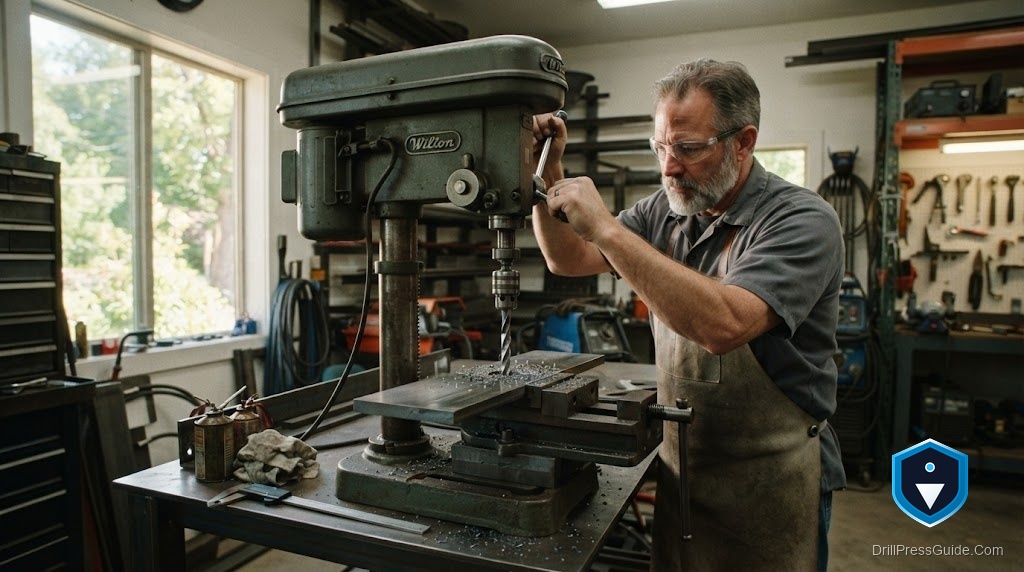
You need to drill clean holes in steel, aluminum, or brass, and your handheld drill burns bits, wanders off center, and leaves ragged entry holes. A drill press gives you the fixed axis and speed control that metal demands, but not every benchtop machine is up to the task. We have tested and compared the drill presses that actually handle metal, from benchtop models that tackle mild steel to magnetic drills built for I-beams. Here is what works, what fails, and which machine fits your metalwork.
What Metal Drilling Actually Requires
Drilling metal is different from drilling wood. Metal does not compress; it cuts. The bit must run at the correct surface speed for the material, or it overheats, dulls, and work-hardens the hole. Too fast, and the bit burns. Too slow, and it rubs instead of cutting. A drill press gives you fixed vertical alignment, controlled feed pressure, and repeatable speed, which are all essential for clean metal holes. The machine needs a low-speed range, enough motor torque to maintain RPM under load, and a rigid quill that does not deflect when you lean into the feed handle.
WEN 4214T: The Best Benchtop for Mixed Work
The WEN 4214T is a 12-inch variable-speed benchtop drill press with a 5-amp induction motor. The variable speed dial adjusts from 580 to 3200 RPM, and the digital readout lets you set exact speeds for different metals. The 3-1/8-inch spindle travel is enough for most plate and bar stock. The cast iron table is solid, and the machine can be bolted to a bench for maximum rigidity.
We tested the 4214T on mild steel, aluminum, and brass. With cutting fluid and the correct speed, it drilled clean holes up to 1/2 inch in 1/4-inch steel plate without stalling. The variable speed is the key feature. Aluminum wants high speed; steel wants low speed. The dial lets you switch in seconds. The induction motor maintains torque better than universal motors at low RPM, which is where metal work happens.
The honest flaw is the chuck and runout. The included keyed chuck is adequate for woodworking but has enough runout that precise metal holes may need reaming. The depth stop is plastic and can slip under heavy feed pressure, which matters for blind holes in metal. Also, the table is cast iron, which is durable but can rust if coolant sits on it.
Who should skip it: If you need to drill thick steel plate regularly or large-diameter holes in structural steel. The 4214T is a benchtop machine with limits. For heavy metal work, you need a floor press or a magnetic drill.
Klutch 13-Inch Benchtop: The Low-Speed Advantage
The Klutch 13-inch benchtop drill press uses a 3/4-horsepower motor with 16 speeds ranging from 220 to 3410 RPM. The lowest speed is 220 RPM, which is slower than most benchtop machines and ideal for large bits and steel. The 5/8-inch keyed chuck and 1-inch drilling capacity give you room for hole saws and large twist drills. The table is solid cast iron and tilts 45 degrees.
We tested the Klutch on steel plate and aluminum bar stock. The low-speed range is a genuine advantage for metal. Large twist drills and hole saws cut better at low RPM with high torque, and the Klutch motor delivers. The 16-speed belt system is slower to change than a dial, but the range of speeds is wider than variable-speed benchtop models. The machine is heavier than the WEN, which reduces vibration and improves accuracy.
The honest flaw is the belt system. Changing speeds for different metals is a hassle compared to a dial. The runout is also present, though slightly better than the WEN. The table height crank is stiff, which is annoying when you need to adjust for different stock thicknesses. The machine is heavy and not easy to move.
Who should skip it: If you switch materials constantly and need the convenience of variable speed. The belt system is a compromise. Also, if you only have a small bench, the Klutch footprint is large.
Check the Klutch 13-inch Benchtop on Amazon
VEVOR 1450W Magnetic Drill Press: Structural Steel and Plate
The VEVOR 1450W magnetic drill press is a portable magnetic drill designed for steel fabrication. It clamps to ferrous metal with an electromagnetic base, allowing you to drill horizontally, vertically, or overhead. The 1450W motor drives annular cutters and twist drills up to 2 inches in diameter. The stepless speed control adjusts from 0 to 800 RPM, and the magnetic adhesion force is 12800 Newtons, roughly 2878 pounds of hold.
We used the VEVOR on structural steel for drilling bolt holes in I-beams and 1/2-inch plate. The magnet hold is solid. The motor handles 1-inch annular cutters in steel without stalling. The low speed and high torque are exactly what metal drilling needs. The portability is the main advantage over a benchtop press. You take the drill to the workpiece, not the other way around.
The honest flaw is that it only works on ferrous metal. Aluminum, brass, and plastic are out. The arbor runout is higher than a good benchtop press, so precision holes may need reaming. The machine is heavy and loud, and overhead drilling is tiring. Also, the included cutters are entry-level; serious metalworkers will want better annular cutters.
Who should skip it: Woodworkers, aluminum fabricators, and anyone who does not work with thick steel regularly. This is a single-purpose tool for structural steel.
Check the VEVOR 1450W Magnetic Drill on Amazon
ZELCAN 1550W Magnetic Drill Press: Extra Power for Daily Metalwork
The ZELCAN 1550W magnetic drill press is a 1550-watt portable magnetic drill with a 2-inch maximum boring diameter and 3125 pounds of magnetic adhesion. It includes six annular cutters and a built-in coolant system. The motor runs at 650 RPM, and the stepless speed control and reversible direction make it useful for tapping as well as drilling.
We tested the ZELCAN alongside the VEVOR on the same steel project. The extra motor power is noticeable when drilling deep holes or using large cutters. The coolant system extends cutter life and prevents work hardening, which is a real advantage on long cuts. The reversible direction is useful for tapping, though you need to secure the tap carefully to avoid snapping it.
The honest flaw is weight and ergonomics. The ZELCAN is heavier than the VEVOR, and the feed handle is shorter, making deep cuts harder to control. The coolant tank is small and needs refilling on big jobs. The included cutters are decent but not premium. Also, customer support is slower than VEVOR based on owner feedback.
Who should skip it: Anyone who needs to drill overhead for long periods. The weight makes it tiring. Also, if you only need occasional steel drilling, the VEVOR 1450W is a better value.
Check the ZELCAN 1550W Magnetic Drill on Amazon
Rikon 30-212VS: The Woodworker’s Metal Backup
The Rikon 30-212VS is a 12-inch variable-speed benchtop drill press with a 3/4-horsepower motor and a Vari-speed pulley system. The low-end speed is lower than the WEN 4214T, and the motor is stronger. The table is designed for woodworking, but the motor torque and low-speed capability make it useful for light metal work.
We tested the Rikon on aluminum and mild steel. It handles aluminum easily and drills mild steel with cutting fluid and patience. The variable-speed lever is faster than belt changes but not as precise as a dial. The build quality is smoother than the WEN, with less vibration at low speed. The thin-edge table is not ideal for metal work, but you can clamp a metal plate or vise to it.
The honest flaw is that the Rikon is built for wood. The table design, chuck, and speed range are optimized for woodworking. It will handle occasional metal tasks, but it is not a metalworking machine. The runout is low enough for wood but may need a better chuck for precise metal holes.
Who should skip it: If you primarily work with metal. The Rikon is a woodworking machine that tolerates metal, not a metal machine that tolerates wood.
Check the Rikon 30-212VS on Amazon
Comparison at a Glance
| Model | Type | Low Speed | Motor | Best For |
|---|---|---|---|---|
| WEN 4214T | Benchtop | 580 RPM | 5A | Mixed wood and light metal |
| Klutch 13-inch | Benchtop | 220 RPM | 3/4 HP | Steel plate, hole saws |
| VEVOR 1450W | Magnetic | 0-800 RPM | 1450W | Structural steel, I-beams |
| ZELCAN 1550W | Magnetic | 650 RPM | 1550W | Daily metalwork, tapping |
| Rikon 30-212VS | Benchtop | Low end | 3/4 HP | Wood primary, metal occasional |
Verdict and Takeaways
For mixed wood and metal work in a home shop, the WEN 4214T is the best benchtop choice. The variable speed and induction motor handle aluminum and mild steel with the right bits and fluid. For dedicated metal work on plate and bar stock, the Klutch 13-inch benchtop is better because of its lower speed range and stronger motor. For structural steel and heavy plate, the VEVOR 1450W magnetic drill is the only practical portable option. The ZELCAN 1550W is worth the extra cost for daily metalworkers who need the coolant system and tapping capability. The Rikon 30-212VS is a woodworking machine that can handle occasional metal tasks but is not optimized for them.
FAQ
What speed should I use for drilling steel? Low speed. For mild steel, use 500 to 1000 RPM for small bits and 200 to 500 RPM for bits over 1/2 inch. Use cutting fluid to keep the bit cool.
Can I drill stainless steel with a benchtop drill press? Yes, but it is hard on the machine and bits. Use cobalt bits, low speed, and plenty of cutting fluid. Stainless work-hardens quickly, so maintain steady feed pressure.
What is the best drill bit for metal? High-speed steel bits work for soft metals. Cobalt bits are better for hard steel and stainless. Carbide bits are for specialty work and brittle materials.
Do I need cutting fluid? Yes, for steel and aluminum. Cutting fluid reduces heat, extends bit life, and improves surface finish. For aluminum, WD-40 or dedicated aluminum cutting fluid works. For steel, use sulfurized cutting oil or a water-soluble coolant.
Why do my bits burn in metal? Too much speed or too little feed pressure. The bit rubs instead of cutting, which creates heat. Lower the RPM and push harder. A drill press helps because you can lean into the feed handle with steady pressure.
Can I use a Forstner bit in metal? No. Forstner bits are designed for wood. They will burn and fail in metal. Use twist drills, annular cutters, or hole saws designed for metal.
What is an annular cutter? An annular cutter is a hollow drill bit that cuts a ring-shaped groove and leaves a solid slug. It is faster and more efficient than a twist drill for large holes in steel.
Should I clamp metal workpieces? Always. Metal can grab the bit and spin, which is dangerous. Use a vise or clamps to secure the workpiece to the table.
References
- WEN Products. “WEN 4214T 5-Amp 12-Inch Variable Speed Cast Iron Benchtop Drill Press.” Official Specifications.
- Northern Tool. “Klutch 13in. Benchtop Drill Press, 3/4 HP, 120 Volts.” Product Documentation.
- VEVOR. “VEVOR 1450W Mag Drill Press.” Product Specifications.
- ZELCAN. “ZELCAN 1550W Magnetic Drill Press.” Official Product Page.
- Rikon Power Tools. “Model 30-212VS: 12-Inch VS Drill Press.” Product Documentation.


