
Shopping for a Cal Hawk Drill Press? Start With Size, Speed, and Support
Cal Hawk is one of those brands you meet at a swap meet, a tool outlet, or a marketplace listing rather than a showroom. It is an import label that has put its name on light-duty benchtop drill presses over the years, and that makes it a slightly different buying decision from a mainstream brand. You are not really choosing “a Cal Hawk”; you are choosing a specific import press wearing that badge, and the smart approach is to judge it by size, speed, and how well you can support it later. Here is how to do that.
What a Cal Hawk drill press is
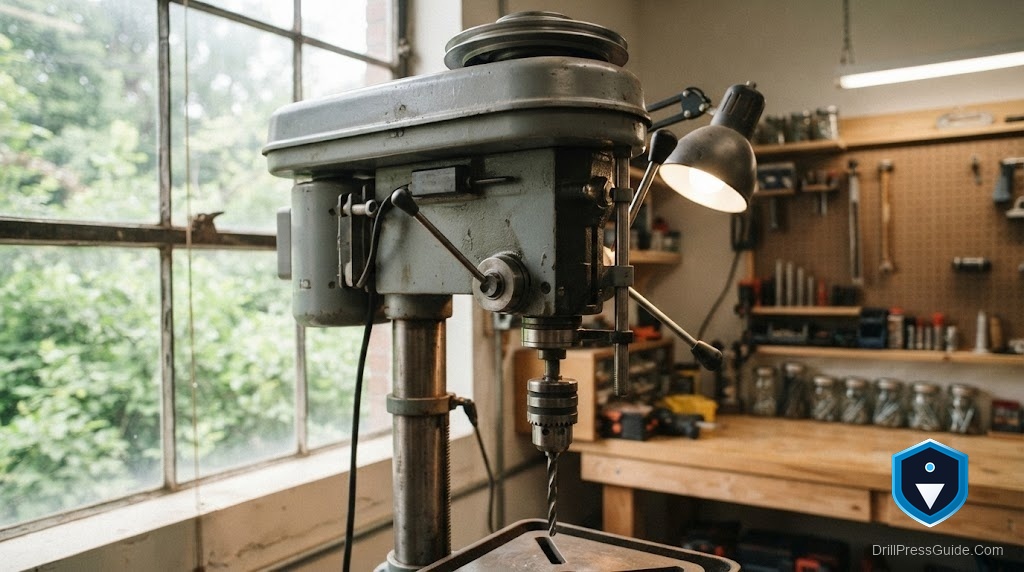
Cal Hawk drill presses are light-duty benchtop machines, typically sold as 5-speed, 12-speed, or 16-speed models depending on the run. They use the familiar layout of any small press: a motor driving a stepped-pulley belt, a spindle with a keyed chuck, and a small cast table that tilts for angled work. Because the brand is an importer rather than a long-standing manufacturer, the exact specs vary from one production run to the next, so the model in front of you matters more than the name on it.
The practical takeaway: treat a Cal Hawk like any unbranded import press. It can be a perfectly serviceable light-duty tool for pilot holes, dowels, and small work, as long as you go in with clear expectations and a plan for parts.
Judge it by size and speed
Since the brand does not guarantee a consistent spec, judge the actual machine:
- Swing. Measure from the spindle centerline to the column and double it. That tells you the widest workpiece you can reach the center of, usually 8 to 13 inches on these presses.
- Speed count and range. A 5-speed covers basic work; 12- and 16-speed models give finer control for matching wood and metal. Note the RPM range, since a lower bottom speed helps larger bits.
- Spindle travel. More quill travel drills deeper in one stroke.
- Chuck and taper. Note the chuck capacity (often 1/2 inch) and the arbor taper so replacement tooling fits.
- Build. Heft it. Heavier castings and a tight quill drill straighter than a light, loose machine.
The real question: support and parts
Here is the honest concern with any minor import brand. Model-specific parts and manuals can be hard to find, because the importer may not stock spares for older runs. The good news is that the parts that actually wear out are generic. A worn chuck, a stretched belt, a lost key, and a tired vise are all standard drill-press consumables you can replace without a Cal Hawk label. Before buying, note the model and any numbers on the machine, and accept that you may become your own parts department for anything proprietary. If that is fine with you, the machine can serve well; if you want guaranteed long-term support, a mainstream brand is the safer path.
Tooling and replacement parts
Most of what keeps a Cal Hawk running is off-the-shelf. Fit a quality keyed drill chuck with the matching arbor if the original loosens, keep a fresh drill press V-belt on the shelf, and replace the ever-missing key with a spare drill press chuck key. Add a drill press vise for safe work-holding. Confirm the taper by dropping the chuck before ordering an arbor, since import runs vary.
The verdict
A Cal Hawk drill press is worth considering as a light-duty machine when you find a complete, smooth-running example and you judge it on size, speed, and build rather than the badge. It can handle small drilling and sanding perfectly well, and its wear parts are all generic and easy to replace. The one real caveat is support: as a minor import brand, model-specific spares and manuals can be scarce, so be ready to source parts by measurement. Note the model number, fit a good chuck and belt, and match it to light work, and a Cal Hawk earns its bench space. If long-term parts support matters most to you, choose a mainstream brand instead.
Takeaways:
- Cal Hawk is an import badge on light-duty benchtop drill presses, sold as 5-, 12-, or 16-speed models.
- Judge the specific machine by swing, speed range, spindle travel, chuck, and build, not the brand.
- Model-specific parts and manuals can be scarce; wear parts (chuck, belt, key) are generic.
- Note the model number and be ready to match parts by measurement.
FAQ
Is a Cal Hawk drill press any good? As a light-duty benchtop press for pilot holes, dowels, and small work, a complete, smooth-running example can serve well. Judge the specific machine by size, speed, and build.
How many speeds does a Cal Hawk drill press have? Depending on the run, they are sold as 5-speed, 12-speed, or 16-speed machines. More speeds give finer control for matching wood and metal.
Where do I get Cal Hawk drill press parts? Model-specific spares can be hard to find. The parts that wear out (chuck, belt, key, vise) are generic and easy to match by measurement.
What chuck does it use? Usually a keyed chuck, often 1/2-inch capacity. Confirm the arbor taper by removing the chuck before ordering a replacement.
Is there a manual for a Cal Hawk drill press? Manuals for older runs can be scarce. Note the model number and use general drill-press setup guidance, since these machines follow the standard benchtop layout.
Cal Hawk or a mainstream brand? A Cal Hawk can work for light-duty use at a value, but a mainstream brand offers more reliable long-term parts and manual support.
What should I check before buying a used one? Smooth spindle rotation, minimal quill play, acceptable runout, a table that tilts and locks, and all major parts present.
References
- Sears PartsDirect, generic drill press parts and diagrams for matching consumables: https://www.searspartsdirect.com/
- WEN Products, benchtop drill press setup and specification reference: https://wenproducts.com/collections/drill-presses
- OWWM.org, import and badge-engineered machine identification forums: https://owwm.org/


