Which Small Drill Press Fits Your Work, Space, and Budget?
Not every shop has room for a floor-standing drill press with a twenty-inch swing and a motor that sounds like a lathe. Sometimes you are working on a folding table in a spare room, or you need a second press for a specific task, or you just want something that stores on a shelf when you are done. A small drill press can be the right tool for the right job. But small does not mean you have to accept wobbly tables and motors that bog down in pine.
I have used compact presses in cramped workshops, on job sites, and in shared maker spaces where floor space is counted by the square foot. The best ones feel like shrunken versions of their bigger brothers. The worst ones feel like toys with a power cord. Here is how to tell the difference.
What Small Actually Means
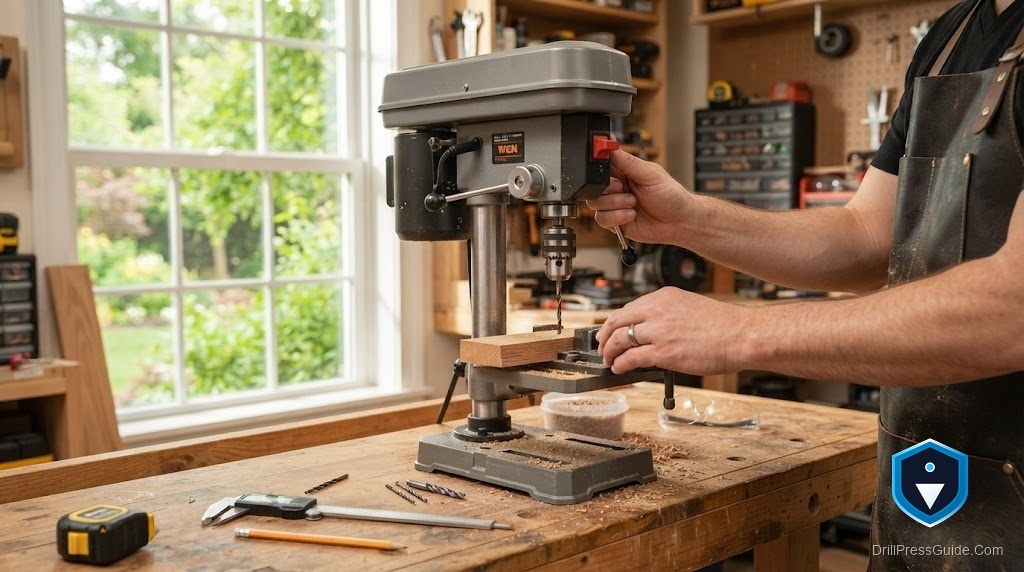
Small drill presses fall into two categories. Benchtop models are the larger of the two. They sit on a workbench, have a swing between eight and ten inches, and run motors from one-quarter to two-thirds horsepower. They are still small enough to move around, but they give you real capacity for most home projects.
The second category is micro or mini drill presses. These are truly compact machines, sometimes with a swing of six inches or less, often with motors under one-quarter horsepower. They are designed for jewelry, model making, electronics, and light craft work. They are not for drilling half-inch holes in oak, but they excel at precise, small-scale work.
Know which category you need before you start shopping. A benchtop press is the right default for a general home shop. A micro press is the right choice if your workpieces are measured in inches, not feet.
The Motor: Small but Not Weak
A small press does not need a massive motor, but it does need a motor that holds speed under load. The worst compact presses use universal motors that scream at high RPM and stall when you push a large bit. The better ones use induction motors that run cooler, quieter, and with steadier torque.
For a benchtop press, look for at least a two-amp motor. That is roughly one-third to one-half horsepower, which is enough for wood, plastic, and light metal work. For a micro press, the motor is smaller by necessity, but it should still be smooth at the speed you need. If the motor chatters or vibrates at idle, it will chatter more under load.
Speed and Control
Small presses usually have fewer speed options than large ones. A five-speed stepped pulley is common. That is enough for most work if the range spans from roughly seven hundred to three thousand RPM. If you drill mostly metal, you want a press that can reach down to five hundred RPM or lower. If you only drill wood and plastic, the low end is less critical.
Variable speed is a luxury on small presses, but it is a nice one. Some benchtop models offer mechanical variable speed with a dial. That saves you from opening the belt cover every time you switch from a small brad-point bit to a large spade bit. On a micro press, variable speed is usually electronic, and it is essential because you are often working with tiny bits that need very high RPM.
The Table and Base
A small press needs a heavy base to stay put. Cast iron is ideal. Steel is acceptable if it is thick enough. Aluminum or stamped thin steel is a red flag. The press will walk across the table under load, and the vibration will make every hole slightly oversized.
The table itself should be large enough for the work you do. A six-inch square table is the minimum for a benchtop press. It should tilt at least forty-five degrees for angled holes. Micro presses often have fixed tables or very small tilt ranges, which is acceptable for their intended use but limiting if you try to push them beyond it.
Two Small Presses That Punch Above Their Weight
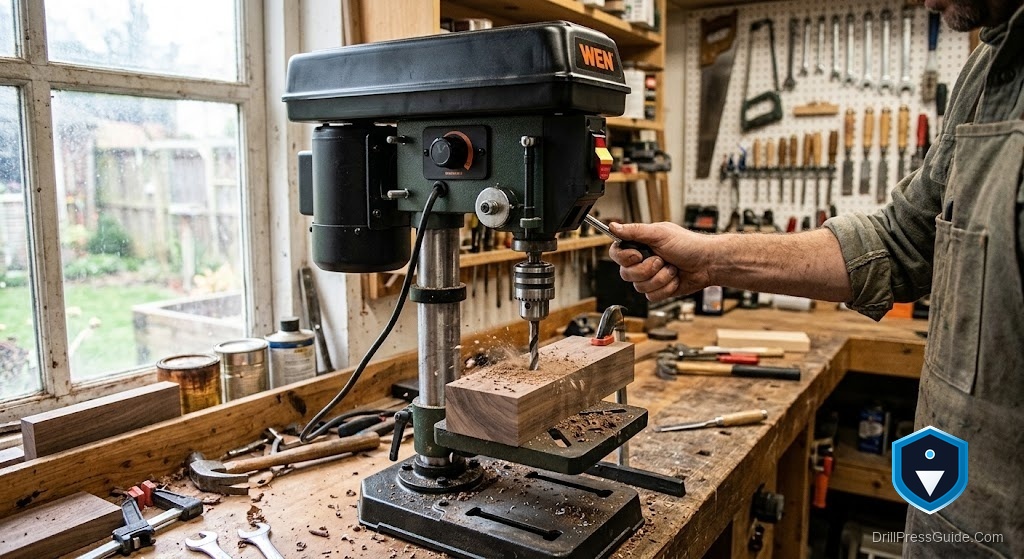
WEN 4208T 8-Inch 5-Speed Benchtop Drill Press
This is the smallest benchtop press I would recommend for general shop use. It has an eight-inch swing, five speeds from seven hundred forty to three thousand one hundred forty RPM, and a 2.3-amp induction motor. The table is six and a half inches square, tilts forty-five degrees, and the base is cast iron. WEN 4208T on Amazon
The honest flaw is the limited capacity. The eight-inch swing means you cannot drill the center of a workpiece wider than sixteen inches. The two-inch spindle travel is also tight for deep holes. If you build large furniture or drill thick timbers, this press will frustrate you. But for a home shop where most work is under twelve inches wide, it is accurate, stable, and easy to store.
Dremel 220-01 Work Station Drill Press
For micro work, the Dremel Work Station is a clever hybrid. It turns a rotary tool into a drill press with a small table, a depth stop, and a flex-shaft holder. The swing is tiny, but the precision is real. It is ideal for circuit boards, jewelry, and small craft projects where a full-size press would be overkill. Dremel Work Station on Amazon
The flaw is that it is not a drill press in the traditional sense. It relies on your Dremel tool for power, so the speed and torque are limited by the tool you already own. It is also not built for force. You cannot lean on it the way you would a benchtop press. It is a precision instrument, not a workhorse.
Who Should Skip the Small Press
If you drill large holes in thick hardwood, work with steel regularly, or need to handle workpieces wider than twenty inches, a small press will feel like a constraint. A floor-standing press or a larger benchtop model with a twelve-inch swing is the better investment. A small press is for the shop that values space over capacity, or for the woodworker who already owns a large press and needs a second machine for detail work.
The Verdict
A small drill press can be the most useful tool in a compact shop if you match it to the work you actually do. The WEN 4208T is the right choice for general home projects in a tight space. The Dremel Work Station is the right choice for precision micro work. Both are honest tools that know their limits. Respect those limits, and they will serve you well. Push them too hard, and you will learn why size matters.
FAQ
What is the smallest drill press worth buying? The WEN 4208T is the smallest benchtop press I recommend for general use. Below that, you are into micro territory, which is great for crafts but not for furniture or construction.
Can a small drill press handle metal? Light metal, yes. Steel and aluminum up to quarter-inch thickness are fine with a sharp bit and slow speed. Thick steel or large holes will stall the motor. Use cutting oil and let the bit do the work.
Do small drill presses vibrate more? They can, because the mass is lower. A cast-iron base helps. So does bolting the press to a solid bench. A rubber mat under the base is not enough. You need mechanical stability, not cushioning.
What is the best small drill press for a beginner? The WEN 4208T. It is simple, reliable, and affordable. It teaches you the basics of speed selection, table alignment, and depth control without overwhelming you with features you do not need yet.
**