
The Budget Drill Press Buyer's Decision Framework
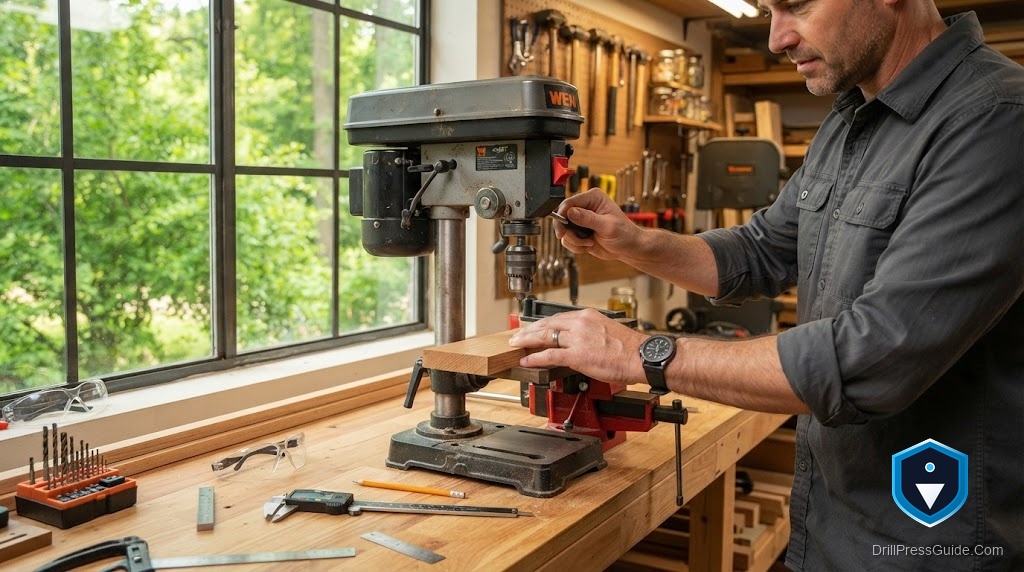
Most budget drill press guides hand you a list of machines and leave you to guess which one fits. That is backwards. The machine should be the last thing you decide, not the first. Before you look at a single model, four questions settle what you actually need, and once you have answered them the right budget press picks itself. This is a decision framework rather than a ranked list, a short path from your work to your machine, so that whatever you buy is the one your projects call for and not the one an ad pushed. Walk the four steps and the choice is made.
A budget drill press is an entry-tier, value-priced machine for general drilling. Choosing one well is a decision process: define your material, your bit sizes, your space, and your accuracy needs, and the framework points to the machine that fits rather than the one marketed hardest.
The short answer: decide your material, your largest bit, your available space, and your accuracy needs first, then match those answers to a machine, and the right budget press falls out of the framework. The steps below walk you from work to machine.
Step one: define your material
The first question drives everything: what will you drill most, and the honest answer is usually wood, metal, or a mix. Wood cuts easily and wants a speed range that reaches high for small bits and low for large Forstners, so a budget press with a usable range covers it. Metal, even light metal, wants the low end of the speed range and enough rigidity to resist chatter, which pushes you toward the sturdier budget machines. A mix wants versatility, a machine that reaches both ends of the speed range. Answering this first narrows the field immediately, because a press that cannot reach your material’s speeds is out regardless of its other virtues. Material sets the speed requirement, and speed is the fundamental a budget machine most often gets wrong, so start here.
Step two: size your bits and your work
The second question is how big your holes and your workpieces get. Small bits and small work, shelf pins, dowels, pilot holes, sit comfortably within any budget bench press, so a compact machine suffices. Large bits, big Forstners, hole saws, or wide stock ask for more swing, more spindle travel, and more mass to stay steady, which points up the budget range toward the larger machines. Deep holes specifically need spindle travel, a spec budget buyers often overlook until a hole runs out of stroke. Answering this tells you the size class you need: a small budget press for small work, a 12-inch or larger one for bigger bits and stock. Undershoot here and you outgrow the machine fast; oversize and you pay for capacity you will not use.
Step three: measure your space and mounting
The third question is where the press will live, and it is the one buyers skip and regret. A benchtop press needs a sturdy bench with clearance above for the handle and head, and you must confirm you have both before buying, since a big benchtop machine on a flimsy bench is unsafe and inaccurate. A floor press needs floor space and headroom but frees your bench. Storage and portability matter too if the shop is shared or the press moves. Answering this can override the earlier steps: if space is tight, a compact machine may be the only realistic choice even for larger work, and you adapt the projects to fit. Measure the space before you shop, because the best machine for your work is useless if it does not fit your shop.
Step four: set your accuracy bar and pick the machine
The fourth question is how accurate your work must be, which sets how hard you protect runout. General drilling tolerates the modest runout common in budget machines, so you can buy toward the lower end. Precise work, doweling that must line up, holes that must be truly round and on-size, demands better runout, pushing you toward the budget machines known for running true and away from the cheapest. With all four answers in hand, the machine picks itself: a light, compact, budget press for small, light, general work; the WEN 4208T 8-inch for compact joinery with reasonable runout, flawed by modest travel; the SKIL 10-inch for general light work with a locking table, flawed by limited capacity; the Genesis GDP1005A for the lowest outlay on basics, flawed by more runout; or the WEN 4214T 12-inch for a mix of materials, bigger bits, and better accuracy, flawed only by a basic stock table. Match your four answers to these and the choice is settled.
Walking the framework: an example
It helps to see the framework run once. Say you mostly build furniture, occasionally drill a steel bracket, use bits up to a large Forstner, have a solid bench with headroom, and want holes that line up for doweling. Step one, a wood-and-light-metal mix, calls for a wide speed range. Step two, large Forstners and furniture stock, calls for real swing and travel. Step three, a solid bench, allows a full-size benchtop machine. Step four, doweling accuracy, demands good runout. Every step points the same way, to a 12-inch variable-speed machine with low runout, and the WEN 4214T falls out as the answer, with a table upgrade to finish it. Run the same four steps on your own work and your machine emerges just as clearly, which is the whole point of a framework over a list.
Deciding well
The best budget drill press is the one your own answers select, not the one a guide ranks first. Define your material to set the speed range, size your bits and work to set the capacity, measure your space to set the form and limits, and set your accuracy bar to decide how hard you protect runout. Then match those four answers to a machine, the compact WEN 4208T or SKIL for light work, the Genesis for the lowest outlay, or the WEN 4214T for a versatile, accurate mix. Walk the framework instead of guessing from a list, and whatever budget press you buy is the one your work actually called for.
- Decide the machine last: material, bit and work size, space, and accuracy come first.
- Material sets the speed range, the fundamental budget machines most often get wrong.
- Space can override the other steps; measure the bench and headroom before shopping.
- Match all four answers to a machine and the right budget press picks itself.
A list makes you guess which machine fits; a framework makes the machine fall out of your own answers. Walk the four steps, and the right budget press is the one left standing.
Frequently asked questions
How do I choose a budget drill press? Work through four questions before looking at machines: what material you drill, how big your bits and work are, how much space you have, and how accurate your work must be. Those answers set the speed range, capacity, form, and runout you need, and the right machine falls out.
What is the most important thing in a budget drill press? A speed range that fits your material, since that is the fundamental budget machines most often get wrong. After that, enough capacity for your bits and work, a table that locks, and runout matched to your accuracy needs. Features like lasers matter far less.
What is the best budget drill press for mixed wood and metal? The WEN 4214T, whose wide variable-speed range reaches the high speeds wood wants and the low speeds light metal needs, with low runout and real capacity. It is the machine the framework points to for a versatile mix, finished with a wooden auxiliary table.
Do I need to measure my space before buying a drill press? Yes, and buyers who skip it regret it. A benchtop press needs a sturdy bench and clearance above for the head and handle; a floor press needs floor space and headroom. Confirm the fit before buying, since space can override which machine your work otherwise calls for.
How much spindle travel does a budget drill press need? Enough for your deepest hole in one stroke, a spec budget buyers often overlook. Small work needs little, but large bits and deep holes need more travel, which points toward a 12-inch or larger machine. Match the travel to your deepest intended hole.
Is a compact budget drill press enough? For small, light, general work, yes, and it saves space and money. It falls short for large bits, wide stock, or deep holes, which need more swing and travel. The framework’s bit-and-work step tells you whether compact suffices or you need a bigger machine.
References
- Fine Woodworking, drill bit speed chart (PDF): https://images.finewoodworking.com/app/uploads/2020/01/22111726/drill-bit-speed-chart.pdf
- WOOD Magazine, drill press reviews and setup: https://www.woodmagazine.com/woodworking-tools/reviews/drill/drill-press-tables
- OSHA, machine guarding and point-of-operation safety: https://www.osha.gov/machine-guarding


