Before Paying for a Drill Press, Compare These Cost Drivers
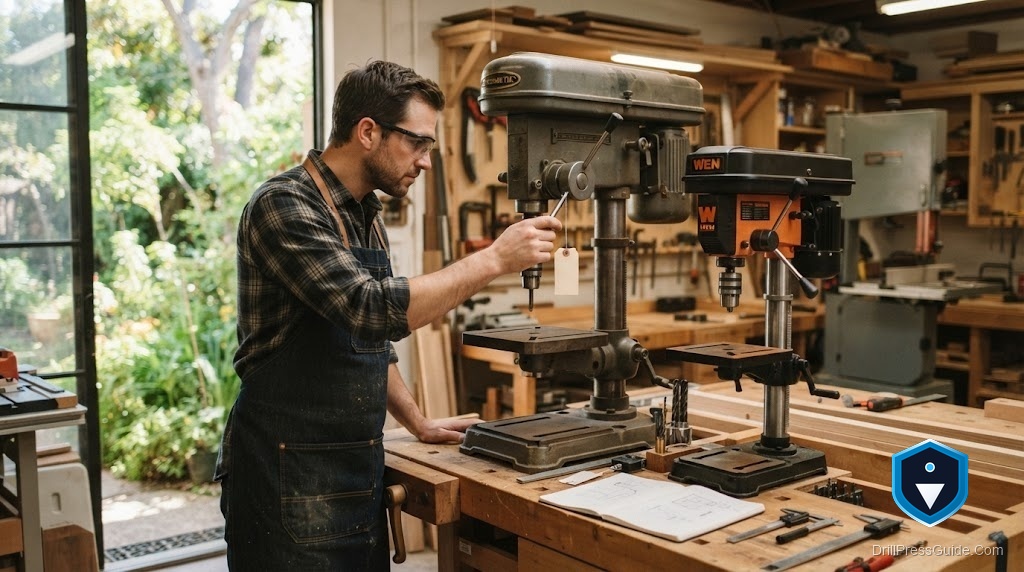
Two drill presses can sit side by side on a shelf looking nearly identical, and one asks for twice what the other does. The buyer’s real question is not which is cheaper but what the extra actually buys, because sometimes it buys capability you need and sometimes it buys polish you do not. Understanding what drives a drill press up or down the price scale lets you pay for the things that matter to your work and refuse to pay for the things that do not. Here are the cost drivers to compare before you hand over your card.
The cost drivers of a drill press are the features and qualities that raise or lower what it asks: size and mass, motor and speed system, build and runout quality, and brand and support. Understanding them lets you match your money to the capability your work needs rather than paying for extras it does not.
The short answer: a drill press costs more for genuine reasons, more mass, a wider or variable speed system, better runout and build, and stronger support, and less when those are trimmed. Pay up only for the drivers that serve your work, and treat the rest as savings.
Size, mass, and the biggest cost jump
The single largest cost driver is the machine’s size and mass, and it is also the one most tied to real capability. A small benchtop press asks little because it uses less iron, a smaller motor, and a shorter column. A large floor press asks far more because it carries the cast-iron mass, longer travel, and bigger motor that heavy and precise work needs. This jump is worth paying for when your work genuinely needs the mass, since a heavy machine stays steady where a light one chatters, but it is money wasted when your work never strains a bench machine. So the first cost question is honest: does your work need the mass, or are you paying for steadiness you will not use. Answer that and you have settled the biggest driver.
Motor and speed system
The second driver is how the machine makes and changes speed. A basic stepped-pulley press, where you move a belt across pulleys to change speed, costs less because the mechanism is simple. A variable-speed machine with a dial and a digital readout costs more because it adds a mechanism and electronics, buying the convenience of changing speed without opening a cover. Motor size plays in too, though less than buyers expect, since a home shop rarely needs a large motor. The value question here is whether you change speeds often enough to want a dial: a woodworker switching between big and small bits benefits from variable speed, while someone who sets a speed and leaves it saves money with a stepped-pulley machine that reaches the same speeds.
Build quality, runout, and support
The third and fourth drivers are quieter but real. Build quality and runout separate machines that look alike: a press with better bearings, a truer spindle, and a table that locks square costs more to make and drills more accurately, while a cheaper machine may save exactly there and wobble. This is the driver most worth paying for, since runout is felt on every hole. Brand and support is the fourth: an established brand with a broad parts and service network asks more partly for that backing, while a house brand or lesser name asks less but ties you to a narrower support channel. Whether that is worth paying for depends on how much you value easy parts and service down the road. Together these two explain much of the price gap between look-alike machines.
The picks along the cost scale
Lowest driver stack: Genesis GDP1005A 10-inch. The Genesis GDP1005A trims size, speed system, and refinement to the basics. Its honest flaw is more runout and less polish. Who should skip it: precision or heavy-work users.
Mid stack with variable speed: WEN 4214T. The WEN 4214T 12-inch adds a variable-speed system and low runout, the drivers most worth paying for, at a value price. Its honest flaw is a basic stock table. Who should skip it: heavy-steel shops needing floor mass.
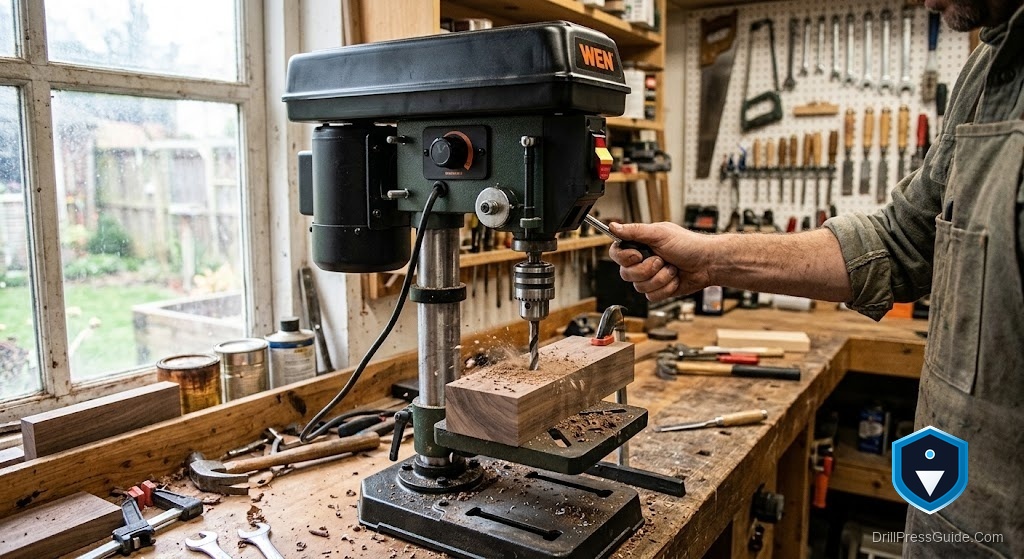
High mass driver: WEN 4227T floor. The WEN 4227T floor press pays the mass-and-size driver for steadiness and a low speed. Its honest flaw is belt-change speed adjustment. Who should skip it: bench-only shops.
Build-and-support driver: JET JWDP-12. The JET JWDP-12 pays the build, runout, and support drivers for fit and accuracy. Its honest flaw is the price. Who should skip it: anyone a value press satisfies.
Matching your money to the drivers
The practical move is to run your own work against the four drivers and decide which you will pay for. If your work needs mass, pay the size driver and buy a floor machine; if it does not, save it. If you switch speeds often, pay the speed-system driver for variable speed; if not, take a stepped-pulley machine. Always pay the build-and-runout driver as far as your budget allows, since it is felt on every hole, and pay the support driver if easy parts and service matter to you. A drill press is not expensive or cheap in the abstract; it is a stack of these drivers, and buying well means paying for the ones your work uses and refusing the ones it does not.
What you’re paying for
Before paying for a drill press, compare the four cost drivers, size and mass, motor and speed system, build and runout, and brand and support, and match your money to the ones your work needs. The Genesis trims the stack to basics, the WEN 4214T pays the speed-and-runout drivers that matter most, the WEN 4227T pays for mass, and the JET pays for build and support. Decide which drivers serve your work, pay for those, and treat the rest as honest savings. That way you never overpay for polish or underbuy the capability you actually need.
- A drill press’s cost is a stack of drivers: size and mass, speed system, build and runout, brand and support.
- Size and mass is the biggest driver; pay it only if your work needs the steadiness.
- Variable speed is worth paying for if you switch speeds often, not if you set and leave it.
- Always pay for build and runout as far as budget allows, since it is felt on every hole.
Look-alike machines differ in the drivers you cannot see on the shelf. Compare them, pay for what your work uses, and the money lands where it counts.
Frequently asked questions
What makes one drill press cost more than another? Four cost drivers: size and mass, the motor and speed system, build and runout quality, and brand and support. A pricier machine usually pays for more mass, variable speed, better accuracy, or a stronger support network. Match your money to the drivers your work actually needs.
Is a more expensive drill press worth it? Only if it pays for drivers your work uses. Extra money buying mass you need, variable speed you will use, or better runout is worth it; extra money for polish and features you will not use is not. Run your work against the drivers to decide.
Why do floor drill presses cost more than benchtop ones? Mainly the size-and-mass driver: a floor press carries more cast iron, a longer column and travel, and usually a bigger motor, all of which cost more to make and buy real steadiness for heavy work. It is worth the jump only if your work needs that mass.
Is variable speed worth paying extra for? If you switch speeds often, yes, since it lets you match speed to bit and material without moving a belt. If you set one speed and leave it, a stepped-pulley machine reaches the same speeds for less, so the variable-speed driver is a convenience you can decline.
Does a pricier drill press drill more accurately? Often, because build quality and runout are a real cost driver, and better bearings and a truer spindle cost more to make. This is the driver most worth paying for, since runout is felt on every hole. But confirm accuracy in owner reports rather than assuming price guarantees it.
How much should I spend on a drill press? Enough to pay for the drivers your work needs and no more. Buy mass if your work needs steadiness, variable speed if you switch often, and as much build and runout quality as your budget allows, while skipping features and polish you will not use. Match the spend to the work.
References
- Fine Woodworking, drill bit speed chart (PDF): https://images.finewoodworking.com/app/uploads/2020/01/22111726/drill-bit-speed-chart.pdf
- Norseman Drill and Tool, drilling feeds and speeds chart: http://www.norsemandrill.com/feeds-speeds-drill.php
- OSHA, machine guarding and point-of-operation safety: https://www.osha.gov/machine-guarding