
Choosing an Inexpensive Drill Press: What Separates a Good Fit from a Bad One
An inexpensive drill press can be one of the best tool buys you make or a machine you resent within a month, and the deciding factor is not the price tag. It is whether the machine you chose fits the work you actually do. A light press that a hobbyist loves for shelf pins is the same machine a fabricator curses for chattering in steel. Inexpensive is not the problem; mismatch is. Here is how to tell a good inexpensive fit from a bad one before you buy, so the low outlay turns into a tool you keep rather than one you replace.
An inexpensive drill press is an entry-level, value-priced machine that covers general drilling without premium build or features. Whether it is a good buy depends entirely on the match between its speed range, capacity, and rigidity and the work you intend to do.
The short answer: an inexpensive press is a good fit for light and moderate work in wood and soft metal, and a bad fit for heavy steel, big bits, or precision jobs that need mass and low runout. Match the machine’s real limits to your work, and inexpensive becomes smart rather than cheap.
Where an inexpensive press fits well
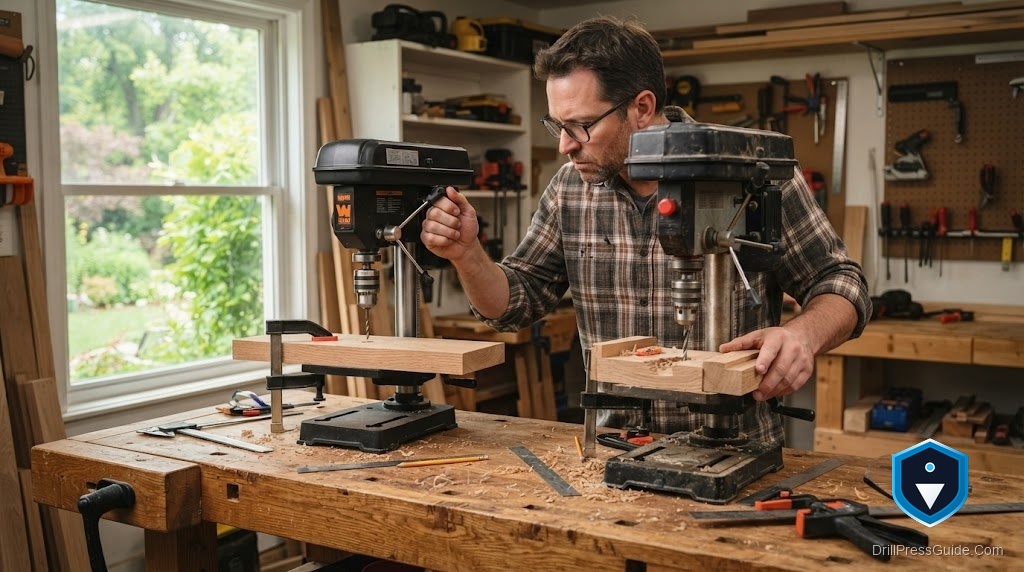
A value machine shines in a clear zone. Light woodworking, dowels, shelf pins, joinery, sits well within what an inexpensive bench press does, since wood cuts easily and the work rarely strains a light machine. Small and occasional metal drilling in soft metal or thin stock is fine too, as long as you keep bits modest and speeds sensible. General household and hobby drilling, the everyday holes a homeowner or maker needs, is exactly the job these machines were built for. In this zone an inexpensive press is not a compromise; it is the right tool, and spending more buys refinement and capacity you would not use. Recognize your work in this zone and a value machine is a genuinely good fit.
Where an inexpensive press fits badly
The same machine fails outside its zone, and knowing the edges saves you the regret. Heavy steel work is the clearest mismatch: an inexpensive press lacks the mass to stay steady and often cannot reach a low enough speed for big bits in steel, so it chatters, wanders, and cooks bits. Large-diameter bits of any kind strain a light machine that flexes under the load. Precision work suffers if the press has the runout common at the low end, since a wobbling spindle drills oversized, off-mark holes. And production or daily heavy use wears a light machine faster than an occasional-use one. If your work lives here, an inexpensive press is a false economy that pushes you toward a second purchase, and the money is better spent once on the right machine.
The inexpensive picks that fit well
Best all-rounder: SKIL 10-inch. The SKIL 10-inch benchtop press covers light drilling with a usable speed range and a locking table in a tidy footprint. Its honest flaw is limited capacity and travel. Who should skip it: anyone drilling large or heavy stock.
Best compact: WEN 4208T 8-inch. The WEN 4208T suits small joinery and light work with reasonable runout. Its honest flaw is modest travel and a small table. Who should skip it: those boring deep holes or wide stock.
Best entry: Genesis GDP1005A 10-inch. The Genesis GDP1005A is the lowest-outlay pick that still covers basic drilling. Its honest flaw is more runout and less refinement. Who should skip it: precision-focused users.
Best fit to grow into: WEN 4214T variable speed. For a little more, the WEN 4214T 12-inch adds a wide variable-speed range and low runout that stretch the good-fit zone. Its honest flaw is a basic stock table. Who should skip it: anyone needing the absolute lowest outlay.
Matching the machine to the work
The whole decision reduces to an honest look at your projects against the machine’s zone. List the work you actually do most, not the work you imagine doing, and check it against where inexpensive presses fit: light wood, small metal, general holes. If your real work lives there, buy the value machine with confidence and put the savings elsewhere. If your work regularly crosses into heavy steel, big bits, or precision, either step up now or accept that the inexpensive press is a stopgap you will outgrow. The bad fit is never about the price; it is about buying a light machine for heavy work, and the good fit is simply matching honest work to honest limits.
Where I’d put the money
An inexpensive drill press is a good fit or a bad one depending on whether its limits match your work, not on the price itself. For light wood, small metal, and general drilling, the SKIL, WEN 4208T, or Genesis is the right, economical tool, and the WEN 4214T stretches the zone for a little more. For heavy steel, big bits, or precision, an inexpensive press is a false economy, and the money belongs in a heavier machine bought once. Match the work to the limits honestly, and an inexpensive press earns its place instead of becoming the machine you replace.
- Inexpensive is not the problem; mismatch between the machine’s limits and your work is.
- Value presses fit light wood, small metal, and general drilling well.
- They fit badly for heavy steel, large bits, precision work, and daily heavy use.
- The SKIL, WEN 4208T, and Genesis suit the good-fit zone; the WEN 4214T stretches it.
Buy an inexpensive press for the work it is good at and it is a smart tool. Buy it for work it cannot do and the low price becomes the most expensive kind.
Frequently asked questions
Is an inexpensive drill press worth buying? Yes, if your work matches its limits. For light woodworking, small metal drilling, and general holes, a value press like the SKIL or WEN 4208T is the right tool, and spending more buys capacity you would not use. It is a bad buy only for heavy or precision work.
What work is an inexpensive drill press good for? Light woodworking, dowels and shelf pins, small or occasional metal drilling in soft or thin stock, and general household and hobby holes. These jobs sit well within what a value bench press does, so an inexpensive machine is a genuine fit rather than a compromise.
When should I avoid an inexpensive drill press? When your work involves heavy steel, large-diameter bits, precision holes, or daily heavy use. Light machines lack the mass, low speed, and runout control those jobs need, so an inexpensive press becomes a false economy that pushes you toward a second purchase.
What is the cheapest drill press that is still usable? The Genesis GDP1005A is a common lowest-outlay pick that still covers basic drilling, with more runout and less refinement as the trade. It is usable for light general work; step up to the SKIL or WEN if you need better accuracy or more capacity.
Do inexpensive drill presses have accuracy problems? Some do, mostly from runout, the spindle wobbling off true, which is more common at the low end. It varies by machine and unit, so read owner reports for wobble and check the chuck on setup. A value press with acceptable runout drills accurately enough for general work.
Should I buy the cheapest press or spend a little more? Often a little more is the smarter buy. Stepping up from rock-bottom to a machine like the WEN 4214T keeps the fundamentals and stretches the range of work it fits, avoiding the outgrow that forces a second purchase. Match the spend to the work you actually do.
References
- Fine Woodworking, drill bit speed chart (PDF): https://images.finewoodworking.com/app/uploads/2020/01/22111726/drill-bit-speed-chart.pdf
- Norseman Drill and Tool, drilling feeds and speeds chart: http://www.norsemandrill.com/feeds-speeds-drill.php
- OSHA, machine guarding and point-of-operation safety: https://www.osha.gov/machine-guarding


