Finding the Right Benchtop Drill Press for Woodworking Without Paying for the Wrong Features
A woodworker shopping for a benchtop drill press faces a market designed to sell the wrong things. The listings lead with laser crosshairs, big chuck numbers, and motor horsepower, none of which is what woodworking actually rewards. What wood needs from a bench press is specific and cheap to get: a speed range that drops low for large bits, a flat table you can back and fence, and a spindle that runs true. Pay for those and skip the rest, and a value machine drills furniture-grade holes. Here is how to buy the right one without overpaying for features wood does not use.
The best benchtop drill press for woodworking is a bench-mounted machine with a wide, low-reaching speed range and a flat, fence-ready table, running true enough for clean holes. For wood, speed flexibility and table quality matter far more than horsepower, lasers, or chuck-capacity numbers.
The short answer: buy a wide variable-speed range and plan to add a wooden top and fence, and ignore the horsepower and laser marketing, since wood cuts easily and needs speed control and backing, not brute force. A value variable-speed bench press set up right is all most woodworkers ever need.
What woodworking asks of a bench press
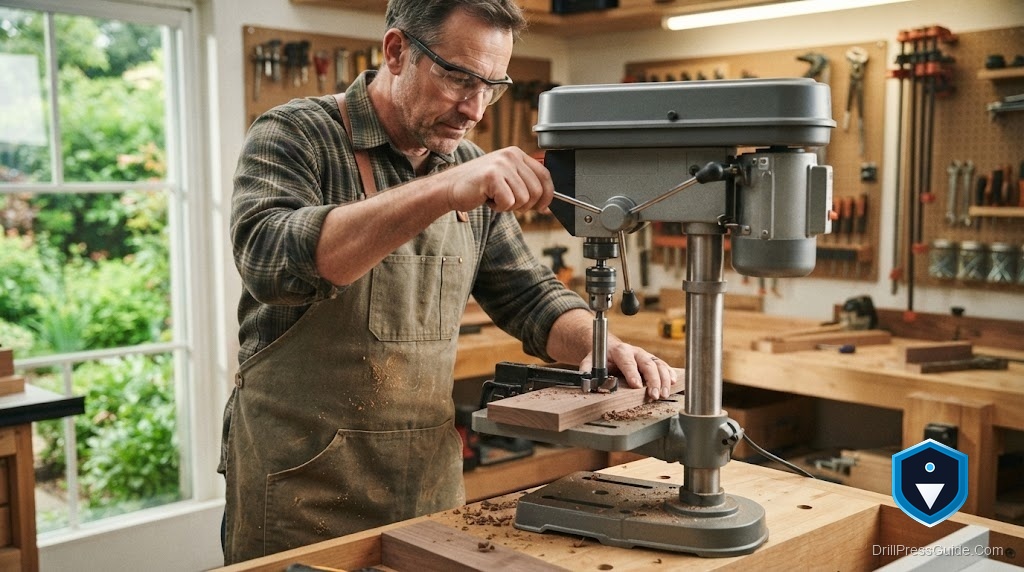
Wood pulls the decision in a clear direction. Speed range leads, because wood bits span a wide band: small twist bits want a high speed while a large Forstner needs a low one near 500 RPM to avoid burning, so a press that reaches both ends handles the full range of woodworking. Table quality comes next, since wood tears out on exit and a flat table with a sacrificial top and a fence backs the fibers for a clean hole and places repeat holes accurately. Runout matters for clean, on-mark holes. What does not matter much is horsepower, because wood cuts with little force, or the laser and big chuck numbers the listings push. Buy for speed range, table, and runout, and wood drilling is handled.
What you can skip
The features wood does not use are exactly the ones the marketing leads with. Horsepower beyond a modest motor is wasted on wood, which cuts easily; a half to two-thirds of a horsepower drives any woodworking bit. A laser crosshair is a rough guide easily knocked askew, no substitute for lowering the bit to the mark. A large chuck-capacity number matters little when woodworking bits rarely need the biggest shanks, and a machine too light to steady the biggest bits gains nothing from accepting them. Skipping these costs you nothing in the shop and saves money for the things that do matter, the speed range and a good table. Buy narrow and deep on what wood needs, not wide and shallow on what sells.
The picks for woodworking
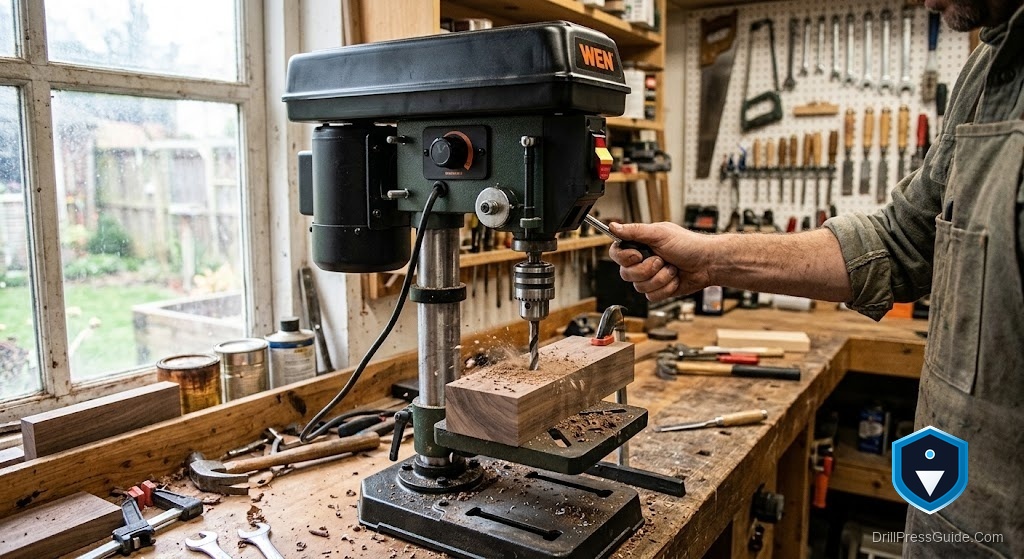
Best all-around: WEN 4214T variable speed. The WEN 4214T 12-inch hits the woodworking sweet spot with a wide variable-speed range, a digital readout, and enough capacity for furniture work at a value price. Its honest flaw is a basic stock table, so plan a wooden top and fence. Who should skip it: those needing the very lowest RPM for oversized Forstners.
Best compact: WEN 4208T 8-inch. The WEN 4208T covers dowels, shelf pins, and light joinery in a small footprint. Its honest flaw is modest travel and a small table. Who should skip it: furniture makers boring deep holes or drilling wide panels.
Best step-up: JET JWDP-12. The JET JWDP-12 adds fit, finish, and a work light with the same wide speed range. Its honest flaw is the price. Who should skip it: anyone a value press covers.
Best bigger capacity: Klutch 13-inch. The Klutch 13-inch benchtop press handles larger panels with more mass. Its honest flaw is weight and footprint. Who should skip it: small-bench woodworkers.
The table upgrade that finishes the job
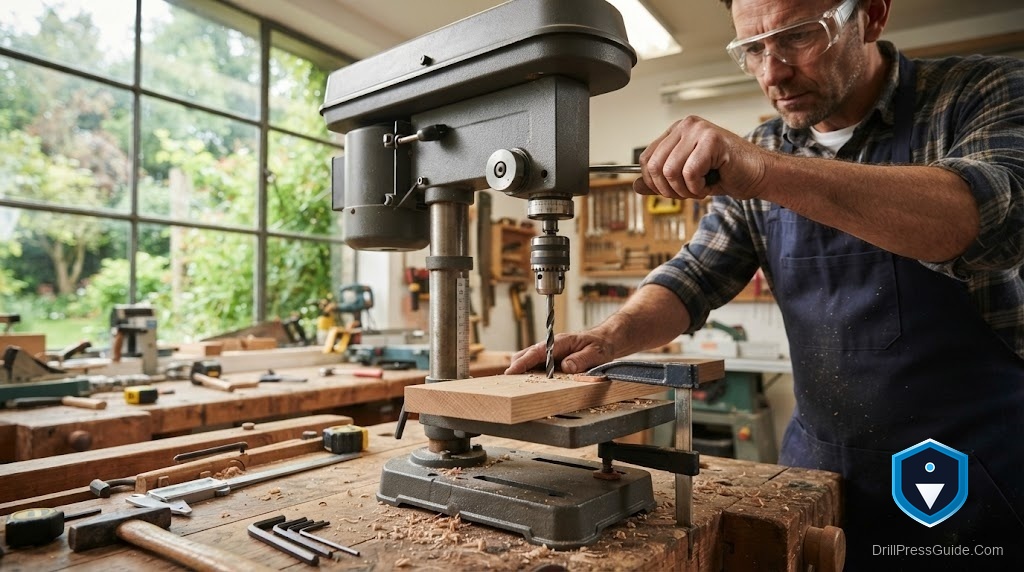
The single most cost-effective thing a woodworker does to a bench press is add a proper table. A flat auxiliary top with a fence and hold-down slots, whether a bought aftermarket table or a shop-built one, backs the work against tearout and turns repeat holes from guesswork into a stop-and-go routine. A carbide-tipped Forstner bit run at the right low speed then delivers the clean, flat-bottomed holes woodworking wants, its only limit being that it scorches if run too fast, which is why the speed range mattered in the first place. This is the loop that defines woodworking on a bench press: the right low speed, a bit that suits wood, and a table that backs it. Get those three and the machine underneath can be a value model.
How the picks compare
Set side by side, the four sort by size and spend, all sharing what wood needs. The WEN 4208T is the compact starter for small joinery. The WEN 4214T is the all-around pick most woodworkers should buy, with the speed range and capacity for furniture at a value price. The JET JWDP-12 is the refined version for those who pay for fit and a light. The Klutch adds capacity for larger panels. Every one drills wood cleanly once fitted with a proper table, so the choice is footprint, capacity, and how much polish you want, not which machine handles wood, because all of them do.
The one to get
The best benchtop drill press for woodworking is the one built around wood’s real needs, a wide low-reaching speed range and a fence-ready table, bought without paying for the horsepower, lasers, and big chuck numbers wood never uses. Get the WEN 4214T for all-around furniture work, the WEN 4208T for compact joinery, the JET JWDP-12 for refinement, or the Klutch for capacity, then add a wooden top and fence and match your speed to the bit. Buy for what wood needs and skip what it does not, and a value bench press does furniture-grade work for decades.
- Woodworking needs a wide, low-reaching speed range and a flat, fence-ready table, not horsepower or lasers.
- Skip the horsepower, laser, and big-chuck marketing; wood cuts easily and rarely needs the biggest bits.
- The WEN 4214T is the all-around pick; the 4208T, JET, and Klutch cover compact, refined, and larger work.
- Add a wooden top and fence and run big bits slow to finish the setup.
The listings sell woodworkers the wrong features. Buy the speed range and the table, add a fence, and a value bench press drills wood as well as anything.
Frequently asked questions
What is the best benchtop drill press for woodworking? For most woodworkers the WEN 4214T, with a wide variable-speed range and enough capacity for furniture at a value price, fitted with a wooden top and fence. The JET JWDP-12 is the refinement step up, and the WEN 4208T the compact option.
What features matter for woodworking on a benchtop drill press? A wide speed range that drops low for large Forstner bits, a flat table you can fence and back with a sacrificial top, and low runout for clean holes. Horsepower, lasers, and big chuck numbers matter far less, since wood cuts easily.
Do I need variable speed for woodworking? It helps a lot, because woodworking bits span a wide speed range and variable speed lets you match it quickly. A stepped-pulley machine that reaches the right speeds works too; the range matters more than whether the adjustment is a dial or a belt.
Is a benchtop drill press enough for woodworking, or do I need a floor model? A benchtop press suits most woodworking, since wood does not demand the mass metal does. Step to a floor model only if you regularly drill large panels or need more swing and travel. Speed range and table quality matter more than the form.
What speed should I use for large Forstner bits in wood? A low speed, around 500 RPM for the largest bits, or they burn the wood and dull quickly. Smaller bits run faster, up to around 3000 RPM for small twist bits. Matching speed to bit size is the core of clean woodworking on a press.
Should I upgrade the table on a woodworking drill press? Yes, it is the most cost-effective upgrade. A flat auxiliary top with a fence and hold-down slots backs the work against tearout and makes repeat holes accurate. Most value presses ship with a basic table that woodworkers replace or supplement for this reason.
References
- Fine Woodworking, drill bit speed chart (PDF): https://images.finewoodworking.com/app/uploads/2020/01/22111726/drill-bit-speed-chart.pdf
- WOOD Magazine, drill press tables and setup: https://www.woodmagazine.com/woodworking-tools/reviews/drill/drill-press-tables
- OSHA, machine guarding and point-of-operation safety: https://www.osha.gov/machine-guarding