
Choosing the Best Wood Drill Press: What Separates a Good Fit from a Bad One
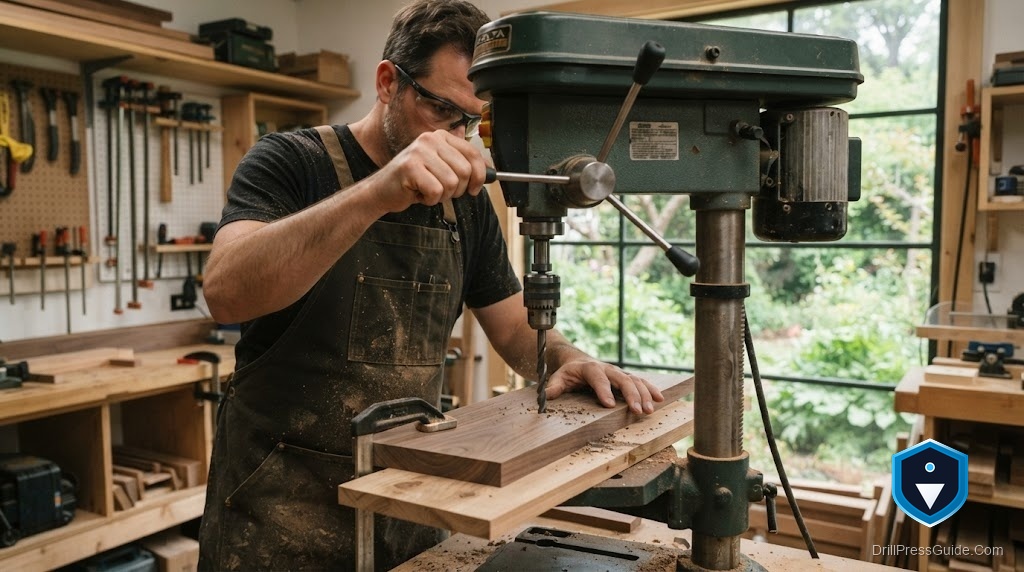
Wood forgives a lot, right up until it does not. A press that seems fine boring shelf pins will scorch the rim of a large Forstner hole, splinter the back of a through hole, or wander on an angled cut, and the reason almost always traces to two things a general drill press guide glosses over: the speed the machine can reach for big bits, and the table it gives you to back and hold the work. The best wood drill press is built around how wood actually cuts, and choosing well means knowing what woodworking asks that metal drilling does not.
The best wood drill press is a machine with a wide speed range that drops low enough for large Forstner and spade bits, plus a flat, fence-ready table that backs the work to prevent tearout. For wood, speed flexibility and table quality matter more than the mass a metalworker prizes.
The short answer: for wood, buy a wide, low-reaching speed range and plan on a good auxiliary table and fence, since those two things prevent the scorching and tearout that ruin woodwork. A value variable-speed press with a wooden top added beats a pricier machine set up for metal.
Why wood is about speed and backing
Woodworking pulls a drill press in a specific direction. Speed range matters because bit size drives it: small twist bits want a high speed around 3000 RPM in wood, while a large Forstner bit needs a low speed near 500 RPM or it burns the wood and dulls itself. A press that reaches both ends covers the range of woodworking bits; one stuck in a narrow band burns big holes or chatters small ones. Backing matters because wood tears out where the bit exits, so a flat table with a sacrificial wooden top supports the fibers and gives a clean exit, and a fence lets you place repeat holes accurately. Get speed range and backing right and wood drills clean; the cast-iron mass a metalworker chases is secondary here.
The picks for wood
Best all-around: WEN 4214T variable speed. The WEN 4214T 12-inch hits the woodworking sweet spot with a wide variable-speed range, a digital readout, and enough swing and travel for furniture work, at a value price. Its honest flaw is a basic stock table, so plan on a wooden top and fence. Who should skip it: those whose work leans on the very largest Forstners needing the lowest possible RPM, where a stepped-pulley machine may drop lower.
Best compact for wood: WEN 4208T 8-inch. The WEN 4208T handles dowels, shelf pins, and light joinery in a small footprint. Its honest flaw is modest spindle travel and a small table, so deep boring and large panels get awkward. Who should skip it: furniture makers boring deep holes or drilling wide stock.
Best step-up for wood: JET JWDP-12. The JET JWDP-12 pairs a wide variable-speed range with a work light and laser and JET’s fit and finish. Its honest flaw is the price. Who should skip it: anyone whose work a value press covers.
Best bigger-capacity for wood: Klutch 13-inch. The Klutch 13-inch benchtop press adds capacity and mass for larger panels. Its honest flaw is weight and footprint. Who should skip it: small-bench woodworkers who rarely go big.
The setup that makes wood drilling clean
A good wood press is only half the job; the setup finishes it. A flat auxiliary table with a fence, whether shop-built or bought, backs the work against tearout and lets you place repeat holes accurately, which is why nearly every serious woodworker adds one to a value machine. Bit choice matters too: a carbide-tipped Forstner bit bores clean, flat-bottomed holes far better than a spade bit, though its honest limit is that even a good Forstner scorches if you run it too fast, which loops back to needing that low speed. The rule that ties it together: match the speed to the bit, back the work with a wooden top, and clamp for angled or small work. A modest press set up this way outperforms a better machine used bare.
How the picks compare
Set side by side, the four sort by size and spend. The WEN 4208T is the compact starter for small joinery, outgrown only when work goes big. The WEN 4214T is the all-around pick most woodworkers should buy, with the speed range and capacity for real furniture work at a value price. The JET JWDP-12 is the same idea with better polish and a laser for those who pay for it. The Klutch adds capacity and mass for larger panels. All four drill wood well once fitted with a proper table; the decision is footprint, capacity, and how much finish you want to pay for.
What to buy
The best wood drill press is built around wood’s real needs, a wide speed range that drops low for big Forstners and a table that backs the work, not the mass a metalworker chases. Buy the WEN 4214T for all-around furniture work, the WEN 4208T for compact joinery, the JET JWDP-12 for refinement, or the Klutch for capacity, then add a wooden top and fence and match your speed to the bit. Set up that way, a value press drills wood as cleanly as anything, and the money you save goes into bits and a good fence.
- Wood needs a wide speed range, high for small bits, low near 500 RPM for large Forstners.
- A flat auxiliary table with a fence backs the work against tearout and places repeat holes.
- The WEN 4214T is the all-around pick; the 4208T, JET, and Klutch cover compact, refined, and larger work.
- Match speed to bit and back the work; a well-set-up value press beats a bare better one.
Wood drilling is speed and backing, not mass. Buy the range, add the table, and the holes come out clean.
Frequently asked questions
What is the best drill press for woodworking? For most woodworkers the WEN 4214T, with a wide variable-speed range and enough capacity for furniture work at a value price, fitted with a wooden auxiliary top and fence. The JET JWDP-12 is the refinement step up, and the WEN 4208T the compact option.
What speed should I drill wood at on a drill press? It depends on the bit. Small twist bits run fast, around 3000 RPM, while large Forstner bits need a low speed near 500 RPM or they burn the wood and dull. A wide speed range that reaches both ends is what wood drilling rewards.
Do I need a special table for woodworking on a drill press? You should add one. A flat auxiliary table with a fence and a sacrificial top backs the work to prevent tearout on exit and lets you place repeat holes accurately. Most value presses come with a basic table that woodworkers upgrade for this reason.
Are Forstner bits better than spade bits in a drill press? For clean, flat-bottomed holes, yes. A carbide-tipped Forstner bores far cleaner than a spade bit, though it needs a low speed to avoid scorching. Spade bits are faster and rougher, fine for hidden holes but not for visible, finished work.
Benchtop or floor drill press for woodworking? A benchtop press suits most woodworking, since wood does not demand the mass metal does. Step to a floor machine only if you regularly drill large panels or need more swing and travel than a bench press offers. Speed range and table matter more than form.
Why does my drill press burn the wood? Usually the speed is too high for the bit, especially with large Forstner bits, which need a low speed. Scorching also comes from a dull bit or feeding too slowly. Drop the speed for big bits, keep them sharp, and feed steadily.
References
- Fine Woodworking, drill bit speed chart (PDF): https://images.finewoodworking.com/app/uploads/2020/01/22111726/drill-bit-speed-chart.pdf
- WOOD Magazine, drill press tables and setup: https://www.woodmagazine.com/woodworking-tools/reviews/drill/drill-press-tables
- OSHA, machine guarding and point-of-operation safety: https://www.osha.gov/machine-guarding


