
The WEN Benchtop Drill Press Lineup: How to Pick the Right One
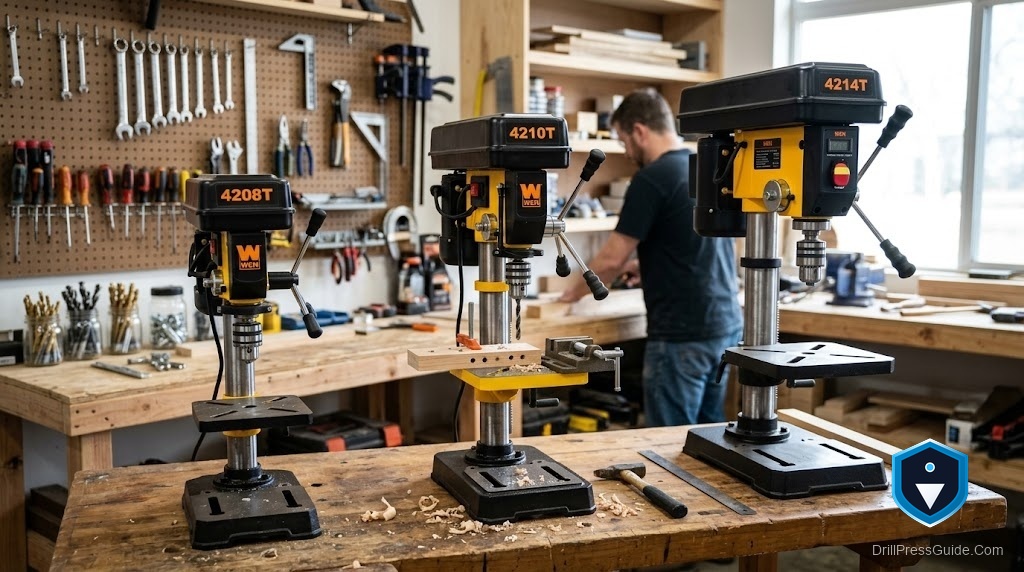
WEN has quietly become the default brand for home-shop drill presses, and the reason is simple: the company covers nearly every benchtop size and feature level a woodworker might want, at a value that keeps it near the top of every recommendation list. The catch is that the lineup is broad enough to confuse a first-time buyer. There is an 8-inch, a 10-inch, a 12-inch, keyed and keyless chucks, fixed-speed and variable-speed models. This guide maps the whole benchtop range so you can pick the right one the first time instead of second-guessing.
The WEN benchtop lineup, mapped
Here is the range in plain terms, from smallest to largest:
- 8-inch (4208 / 4208T). The compact entry press: five belt-driven speeds, a 1/2-inch keyed chuck, and a small footprint. Best for pilot holes, dowels, and small work where bench space is tight.
- 10-inch (4210T). The balanced middle: a 10-inch swing, five speeds spanning roughly 570 to 3050 RPM, and about 2-1/2 inches of travel. The size most first-time buyers should default to.
- 12-inch fixed and variable. The 12-inch machines add capacity, and the variable-speed 4214 stands out by letting you change speed on the fly with a digital readout instead of moving a belt.
- Keyless variants. Some models (such as the 4211 family) add a keyless chuck for faster bit changes, trading a little ultimate grip for convenience.
All are benchtop machines with cast-iron tables that tilt for angled drilling, and all use standard tapers, so tooling crosses over easily.
How to choose
Match the machine to three questions. First, how wide is your typical work? If it fits under an 8- or 10-inch swing, you do not need a 12-inch. Second, do you change speed often? If yes, the variable-speed 4214 pays for itself in convenience; if you mostly drill wood at one or two speeds, a fixed belt press is simpler. Third, how tight is your bench? An 8-inch tucks into small spaces, while the 12-inch machines want a dedicated spot. For most home woodworkers, the 10-inch is the honest default, and the variable-speed 12-inch is the upgrade worth considering if speed changes are constant in your work.
The honest limits across the line
Be clear-eyed about what these are. WEN benchtop presses are light-to-medium home-shop tools, happiest in wood and light metal, not built for hogging large holes in thick steel. The stock chucks are serviceable rather than premium, and many owners eventually upgrade them. Depth stops are functional but not the most precise on the value models. These are normal traits for the class, and they do not undercut the value; they simply set expectations. Buy a WEN for home-shop woodworking and it will not let you down.
Tooling that fits the whole lineup
Because the range shares standard tapers, one set of upgrades serves whichever model you pick. A quality keyed drill chuck with the matching arbor tightens grip and accuracy, a drill press vise makes work-holding safe, and a set of Forstner bits gets the most from the machine in wood. Keep a spare drill press chuck key and a fresh drill press V-belt on hand. Confirm the taper before ordering an arbor, since it differs between the smaller and larger models.
The verdict
The WEN benchtop drill press lineup earns its popularity by covering every size and feature level a home shop needs at strong value, and the trick is simply matching the model to your work. Default to the 10-inch for a first press, step up to the variable-speed 12-inch (4214) if you change speeds constantly, and choose the 8-inch only when bench space is truly tight. Accept the honest limits of the class (light-duty motors, serviceable stock chucks, and functional depth stops), fit a good chuck and vise, and any WEN in the range will handle home-shop woodworking for years. Pick by size and speed needs, not by the longest spec sheet.
Takeaways:
- WEN’s benchtop lineup spans 8-inch, 10-inch, and 12-inch presses in keyed, keyless, fixed, and variable-speed versions.
- The 10-inch (4210T) is the best default for most first-time buyers.
- Step up to the variable-speed 12-inch (4214) if you change speeds constantly.
- All are light-to-medium tools with serviceable stock chucks; match them to wood and light metal.
FAQ
Which WEN benchtop drill press should I buy first? For most home woodworkers, the 10-inch (4210T) is the best default: enough capacity for most work without the footprint of a 12-inch machine.
What is the difference between the WEN 4208, 4210, and 4214? The 4208 is the compact 8-inch, the 4210T is the balanced 10-inch, and the 4214 is the 12-inch with true on-the-fly variable speed and a digital readout.
Should I get a keyed or keyless chuck? Keyless chucks (on models like the 4211 family) change bits faster; keyed chucks grip a little more firmly. Choose convenience or maximum grip based on your work.
Is a WEN benchtop press good for metal? It handles light metal at low speeds. These are light-to-medium tools, not built for hogging large holes in thick steel.
Do I need variable speed? If you change speeds often across wood, metal, and different bits, the variable-speed 4214 is a real convenience. If you mostly drill wood at one or two speeds, a fixed belt press is simpler.
What are the common weaknesses? Serviceable (not premium) stock chucks and functional (not ultra-precise) depth stops. Both are easy to live with or upgrade.
Does tooling carry over between WEN models? Largely yes, since they use standard tapers. Confirm the exact taper (it differs between smaller and larger models) before buying an arbor.
References
- WEN Products, drill press collection and model comparison: https://wenproducts.com/collections/drill-presses
- WEN Products, 4210T 10-inch and 4214 12-inch drill press specifications: https://wenproducts.com/products/wen-4210t-10-inch-drill-press
- WEN Products, drill press owner’s manuals: https://wenproducts.com/pages/manuals


