
The Best Drill Press for Woodworking: Picks That Earn Their Bench Space
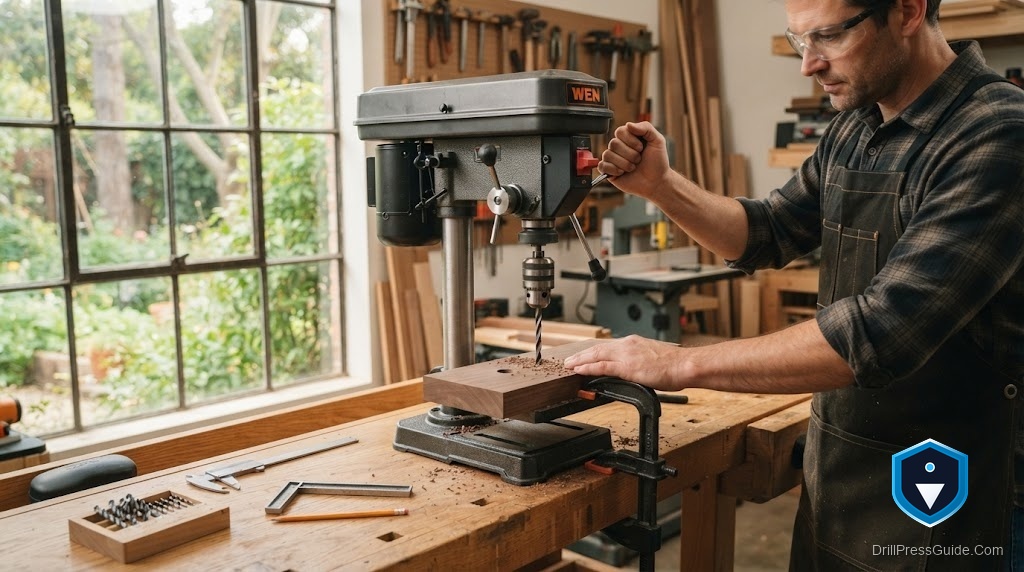
Woodworkers tend to buy a drill press to solve one problem, drilling a row of straight shelf-pin holes, then discover it doing a dozen jobs a hand drill never could. Which press deserves the bench space depends less on power than on two things a wood shop leans on hard: a speed that drops low enough for big Forstner bits, and a table you can actually build a fence onto. Here are the picks that get those right, with the honest flaw of each, so you buy the one that fits your work rather than the one with the loudest spec sheet.
The best drill press for woodworking is a machine with a wide speed range that reaches low for large bits, a solid tilting table that accepts a fence, and enough swing and travel for your projects, in a benchtop or floor form that fits your space. Motor power is a minor concern in wood.
The short answer: for most woodworkers, a well-built variable-speed benchtop press with a good table is the sweet spot, and the picks below cover small shops, serious furniture makers, and everyone between. Match swing, travel, and low speed to your work, then spend the rest on a fence and good bits.
What separates a good woodworking press
Before the picks, the criteria. Speed range matters most, because small bits want to spin fast while big Forstner bits and hole saws must crawl near 500 RPM or they scorch the wood. A tilting table that accepts an auxiliary top and fence turns the press into a repeat-drilling station, which is most of what woodworkers use it for. Swing sets how far you can reach into a panel, and spindle travel sets how deep you can bore in one stroke. Power is far down the list, since wood cuts easily; a modest motor drives any woodworking bit. Judge every press below on those terms.
The picks
Best all-around: WEN 4214T 12-inch variable speed. The WEN 4214T hits the woodworking sweet spot, a wide variable-speed range with a digital readout, a solid table, and enough swing and travel for furniture work, at a value price. Its honest flaw is that the stock table is cast iron with a basic fence, so most owners add a wooden auxiliary top and fence to get the most from it. Who should skip it: anyone whose work leans on the very largest Forstners that need the lowest possible RPM, where a stepped-pulley machine may drop lower.
Best compact: WEN 4208T 8-inch. For a crowded bench, the WEN 4208T handles shelf pins, dowels, and light joinery in a small footprint at a friendly price. Its honest flaws are modest spindle travel and a small table, so deep boring and large panels get awkward. Who should skip it: furniture makers who bore deep holes or drill wide stock; you will outgrow the travel and the table.
Best step-up: JET JWDP-12 variable speed. The JET JWDP-12 pairs a wide variable-speed range with a work light and a laser, plus the fit and finish JET is known for. Its honest flaw is the price, well above the value brands for similar core capability, so you are partly paying for polish and support. Who should skip it: anyone whose work a value-brand press covers, who would rather spend the difference on bits and a fence.
Best bigger-capacity: Klutch 13-inch benchtop. The Klutch 13-inch benchtop press offers a large chuck capacity and a wide multi-speed range with more mass than the small machines, good for bigger bits and heavier work while staying on a bench. Its honest flaw is weight and footprint; it is a big benchtop machine that wants a sturdy bench. Who should skip it: light hobby users who only drill small holes and want something compact.
The accessories that matter more than power
Two add-ons change a woodworking press more than any motor upgrade. A dedicated table with a fence backs up the cut to stop blowout and gives a repeatable stop for rows of holes; a Fulton drill press table with an aluminum fence drops onto most presses and adds that fence and a wide support surface. Its honest flaw is the MDF top, which dents and swells if it gets wet, so treat it as a wear item. And a set of clean-cutting carbide-tipped Forstner bits bores the flat-bottomed holes woodworkers need; their honest flaw is that they demand a low speed, which loops back to buying a press that drops low enough. Skip fancy bits if you only drill small twist-bit holes.
How the picks compare
Lined up, the choice is about size and spend. The WEN 4208T is the compact, wallet-friendly starter that a small shop outgrows only if it goes big. The WEN 4214T is the all-around pick most woodworkers should buy, with the speed range and capacity for real furniture work at a value price. The JET JWDP-12 is the same core idea with better polish, a light, and a laser for those who want it and will pay for it. The Klutch 13-inch is the choice when you want more capacity and mass without stepping to a floor machine. All four drill wood well; the decision is footprint, capacity, and how much finish you want to pay for.
Where this leaves you
The best drill press for woodworking is the one whose speed drops low for big bits, whose table takes a fence, and whose swing and travel fit your projects, not the one with the biggest motor. Start with the WEN 4214T if you want one honest recommendation, size up to the Klutch for more capacity, save space with the 4208T, or pay for polish with the JET. Then add a fenced table and good Forstner bits, and the press quietly becomes the most-used machine on your bench.
- Buy for a low-reaching speed range and a table that accepts a fence.
- The WEN 4214T is the all-around pick; the 4208T saves space; the Klutch adds capacity; the JET adds polish.
- A fenced auxiliary table and good Forstner bits matter more than motor size.
- Match swing and spindle travel to the size and depth of holes you drill.
The right woodworking press is the one that fits your bits and your bench. Every pick here earns its space when matched to the right shop.
Frequently asked questions
What is the best drill press for woodworking? For most woodworkers, a variable-speed benchtop press like the WEN 4214T, with a wide speed range, a solid table, and enough swing and travel for furniture work. Match the low speed and capacity to your bits and projects rather than chasing horsepower.
Do I need variable speed for woodworking? It is convenient, letting you dial from fast for small bits to slow for big Forstners without moving a belt. A stepped-pulley press works too and sometimes reaches lower speeds for the biggest bits. Either way, make sure it drops low enough.
How much horsepower does a woodworking drill press need? Little. Wood cuts easily, so half to three-quarters of a horsepower drives any woodworking bit. Spend on a good speed range, table, and bits instead of a big motor you will not use.
Benchtop or floor drill press for wood? A benchtop press suits most woodworkers and saves space. A floor press adds swing, travel, and mass for large furniture and deep holes. Choose the floor machine only if your projects regularly demand that extra reach and depth.
What accessory should I buy first? A table with a fence. It prevents blowout on the exit side and gives a repeatable stop for drilling rows of identical holes, which is the woodworking job a drill press does best.
Why do big Forstner bits scorch the wood? Because they are being spun too fast. Large Forstner bits need a low speed, near 500 RPM, to cut without burning. A press whose slowest speed is too high will scorch every big hole, which is why low-end speed matters so much.
References
- Fine Woodworking, drill bit speed chart (PDF): https://images.finewoodworking.com/app/uploads/2020/01/22111726/drill-bit-speed-chart.pdf
- WOOD Magazine, drill press tables and setup: https://www.woodmagazine.com/woodworking-tools/reviews/drill/drill-press-tables
- OSHA, machine guarding and point-of-operation safety: https://www.osha.gov/machine-guarding


