Horizontal Wood Drill Press: Match the Bit, Speed, and Support to the Job
The first time you need to bore a lamp cord channel straight down the length of a table leg, you understand why people go looking for a horizontal wood drill press. A standard press drills down into the top of a board beautifully and is useless the moment the hole needs to run along the length of a long workpiece. Turn the drilling axis sideways and a whole class of jobs opens up: deep dowel holes in the end of a rail, cord passages, long boring that a vertical machine simply cannot reach.
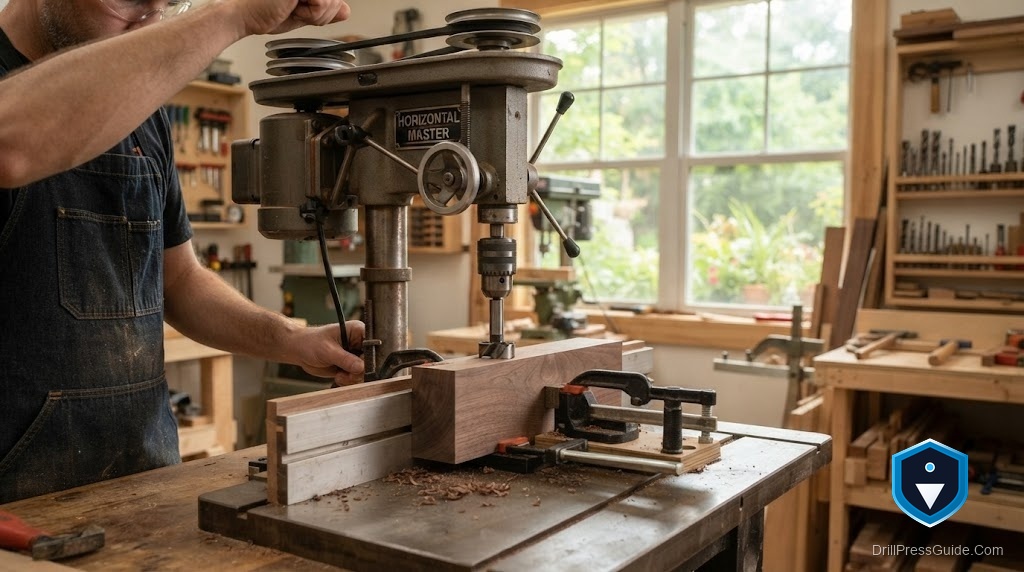
A horizontal wood drill press (also called a horizontal boring machine) holds the drill so it cuts sideways into a workpiece clamped on a table, rather than plunging down from above. That orientation is built for long, straight holes into the end or edge of a board, the kind of boring that end-drilling and cord channels demand.
The honest answer for most home woodworkers: dedicated horizontal boring machines are shop equipment, and the accessible path is usually a horizontal attachment, a well-set-up jig, or a portable guide rather than a standalone machine. Match the bit, the speed, and the support to the job and you can do most horizontal work without buying a large dedicated tool.
Why the sideways axis exists
A vertical drill press registers the work flat on the table and pushes the bit down. That is perfect for a hole in the face of a board and hopeless for a hole running into the end grain of a long rail, because the rail would have to stand taller than the machine. A horizontal machine lays the work down and drives the bit in from the side, so length stops being a problem.
The classic uses are all about depth and direction: boring for dowel joinery into the ends of rails and stiles, drilling lamp and cord channels down a leg, and deep, straight holes for hardware. These are jobs where a vertical press either cannot fit the work or cannot keep the long hole straight.
The realistic options
Most people do not need, and cannot justify, a full dedicated horizontal boring machine. Three more accessible paths cover the work.
A horizontal drilling jig or fixture holds the workpiece and guides the bit for repeatable end-boring, and many woodworkers build their own from plywood and hardware. It costs almost nothing and, for dowel joinery, does the core job well. Its limit is rigidity and repeatability compared with a machine built for it.
A portable drill guide brings guided, square drilling to the work when the work cannot come to a press. The Milescraft 1318 DrillMate portable drill guide clamps a hand drill into a spring-loaded guide with a V-groove for round stock and adjustable angles, so you can bore a reasonably straight hole into an edge or end that no bench press could reach. Its honest flaw is that it is only as accurate as your setup and steady hand; it is guided, not machine-rigid, so precision joinery over many holes will drift. Skip it if you need production-grade repeatability, and reach for it when portability and flexibility matter more than the last thousandth.
A dedicated horizontal boring machine is the right tool for a shop doing volume dowel joinery, but for a home shop it is usually more machine and floor space than the work justifies.
Bit, speed, and support
Horizontal boring lives or dies on three choices. The bit: brad-point and dowel bits start clean and track straight into end grain, while a Forstner gives a flat-bottomed stopped hole where you need one. Auger-style bits pull themselves in for deep holes but demand a firm hold. Long holes especially want a bit that clears its chips, so back it out periodically or the flutes pack and the bit wanders.
Speed follows the bit and the wood the same way it does on a vertical press: small brad-points run fast, large Forstners run slow, around 500 RPM, or they scorch. Support is the part people underestimate. A horizontal hole into a long workpiece needs the piece clamped and, ideally, supported along its length so it cannot deflect, because any wobble turns a straight hole into a curved one. A fence and a stop make repeat holes land in the same place.
Attachment or jig versus a dedicated machine
Set the choices next to each other. A shop-built jig or a portable guide costs little, stores small, and handles occasional end-boring and cord channels, at the price of some accuracy and fiddling per setup. A dedicated horizontal boring machine nails repeatability and depth control for volume joinery, at the price of money and floor space most home shops cannot spare. For the woodworker boring a few dowel joints and the odd lamp channel, the jig or guide wins on every practical count. For a small production shop, the machine pays for itself.
The bottom line
A horizontal wood drill press solves the problem a vertical press cannot: long, straight holes into the end or edge of a board. Unless you are doing volume joinery, you probably want a jig, a fixture, or a portable guide rather than a standalone machine, paired with the right bit, the right speed, and real support along the workpiece. Get those three right and horizontal boring stops being a specialty and becomes just another cut.
- Use a horizontal setup for end-boring, dowel joints, and cord channels a vertical press cannot reach.
- For most home shops, a jig or portable guide beats a dedicated machine on cost and space.
- Match speed to bit size: fast for small brad-points, slow for large Forstners.
- Clamp and support the full length of long workpieces so the hole stays straight.
The axis changes, but the fundamentals of clean boring do not.
Frequently asked questions
What is a horizontal drill press used for? Boring long, straight holes into the end or edge of a workpiece: dowel joinery in rails and stiles, lamp and cord channels down a leg, and deep hardware holes that a vertical press cannot reach because of the workpiece length.
Do I need a dedicated horizontal boring machine? Usually not. Most home woodworkers do horizontal work with a shop-built jig, a fixture, or a portable drill guide. A dedicated machine makes sense mainly for shops doing repeated dowel joinery in volume.
Can I drill horizontally with a portable drill guide? Yes, within limits. A portable guide clamps a hand drill into a square, spring-loaded frame so you can bore a reasonably straight hole into an edge or end. It is guided rather than machine-rigid, so precision drifts over many holes.
What bits work for horizontal boring in wood? Brad-point and dowel bits track straight into end grain, Forstners give a flat-bottomed stopped hole, and auger bits pull themselves in for deep holes. Back the bit out periodically to clear chips on long holes.
How do I keep a long horizontal hole straight? Clamp and support the workpiece along its length so it cannot deflect, use a bit that starts on-center, and clear chips often. Any wobble or a packed flute turns a straight hole into a curved one.
Can a regular drill press drill horizontally? A few models tilt the head or table to allow angled or near-horizontal drilling, but most standard presses only drill vertically. For true horizontal work, use a horizontal machine, a jig, or a portable guide.
References
- WOOD Magazine, drill press tables and technique: https://www.woodmagazine.com/woodworking-tools/reviews/drill/drill-press-tables
- Fine Woodworking, drill bit speed chart (PDF): https://images.finewoodworking.com/app/uploads/2020/01/22111726/drill-bit-speed-chart.pdf
- OSHA, machine guarding and point-of-operation safety: https://www.osha.gov/machine-guarding