
Milling Steel with a Drill Press: The Setup Details That Change the Result
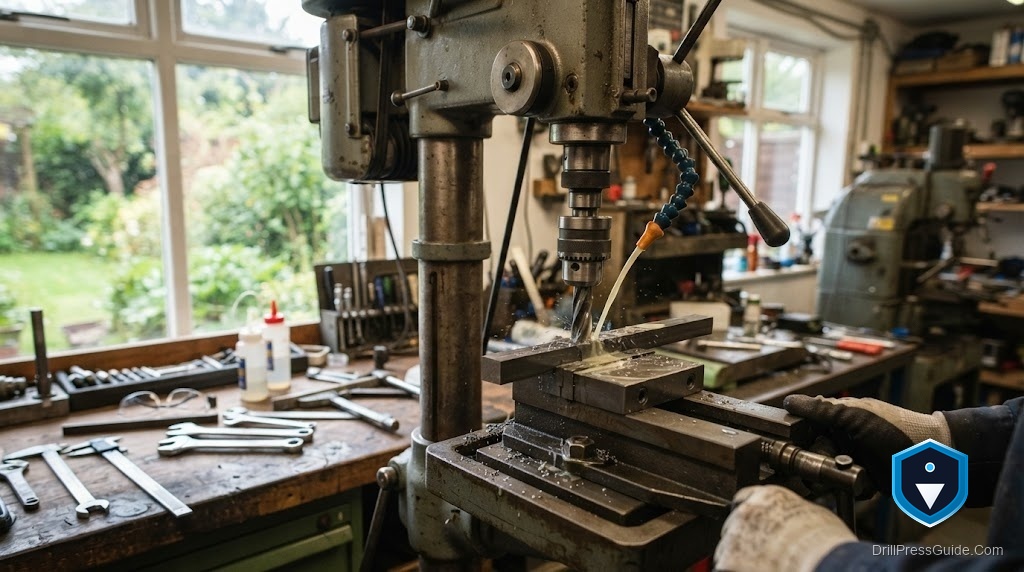
Somewhere online right now, someone is bolting a cross-slide vise to a drill press and calling it a milling machine. I understand the appeal, because the parts look similar and a real mill is a serious purchase. But milling steel with a drill press is where that fantasy meets physics, and physics wins. There is a narrow band of light work a press can do on steel, and a much wider set of jobs that will bend your quill and chew your bearings if you try. Knowing the line between them saves your machine and your knuckles.
Milling on a drill press means using the spinning bit to remove metal from the side, cutting a slot or a face, rather than plunging straight down to make a hole. On steel specifically, the sideways forces are high, and that is exactly the load a drill press is not built to take.
The honest answer up front: a drill press can take very light side cuts in steel for cleanup, slotting a soft bracket, or spot-facing, but it cannot mill steel the way a milling machine does. The spindle bearings and quill are designed for downward thrust, and pushing them sideways in steel is how presses die. If real milling is the goal, a benchtop mill is the correct tool.
Why steel punishes a drill press
A milling machine has an anti-friction spindle in heavy bearings that resist radial (sideways) load, a rigid column, and a table that moves the work precisely against the cutter. A drill press has none of that. Its quill slides in a sleeve so it can plunge, and that sliding fit has play that a side load turns into chatter. Its bearings are set up for thrust down the axis, not force across it.
Steel makes all of this worse than aluminum does. Steel cuts harder, so the sideways force is greater, and the chatter that follows work-hardens the surface and can snap an end mill or bend the quill. The bright scored wall and the screech you get are the machine telling you it is being asked to do a job it was not built for.
What is genuinely possible
Inside those limits, some light work is real. You can spot-face around a hole to seat a bolt head. You can widen or clean a slot in thin, soft steel with a tiny end mill, taking cuts measured in a few thousandths of an inch. You can true up a rough edge with feather passes. The rules that make even this safe are strict.
Use a two- or four-flute end mill made for the job, never a drill bit, because a drill bit is not designed to cut on its flank and will grab. Run a low speed, because a side cut generates heat fast. Take tiny depths of cut and slow, steady feeds, and never climb-cut on a machine with quill play. Lock the quill at the depth you want so it cannot creep down mid-cut. And clamp the work in a solid vise bolted to the table, because side forces will fling a loose part instantly.
A cross-slide compound vise is what makes the positioning possible, moving the work in two axes under the cutter. Its honest limit is the whole point of this article: it lets you position and take a whisper of a cut, but it does not add the rigidity or bearing design that real milling needs. Use it for precise hole layout and the lightest cleanup, and skip the idea that it converts your press into a mill.
Drill press versus a real mill, plainly
Set them side by side and the gap is not subtle. A benchtop mill holds the cutter rigidly, moves the work on precise leadscrews, and takes real depths of cut in steel without complaint. A drill press flexes, chatters, and tops out at cleanup passes. The press wins only on the jobs it was built for, which is making holes, and on the fact that you may already own one.
For cobalt work and honest hole drilling in steel, a cobalt M35 drill bit set plus cutting fluid gets you clean, round holes all day. That is the press playing to its strength, and it is where your steel work should mostly live.
The bottom line
Milling steel with a drill press is possible only at the edges: spot-facing, tiny slot cleanup in soft steel, feather-light truing, all with an end mill, a locked quill, a clamped part, and patience. Anything past that belongs on a milling machine, and the money spent forcing a press into milling usually approaches the cost of an entry-level mill anyway. Use the press for holes, where it is excellent, and buy the right tool for milling.
- A drill press can take only whisper-light side cuts in steel; real milling bends the quill and kills bearings.
- Use end mills, never drill bits, for any side cutting, and lock the quill first.
- Clamp steel in a bolted vise; sideways force flings loose parts instantly.
- If you genuinely need to mill steel, a benchtop mill is the correct and safer purchase.
The machine that makes a hole beautifully is not the machine that mills a slot. Respecting that keeps both your press and your fingers intact.
Frequently asked questions
Can you mill steel with a drill press? Only the lightest work: spot-facing, cleaning a slot in soft steel, or truing an edge with tiny cuts. A drill press spindle is built for downward thrust, not the sideways force of milling, so serious steel milling will damage it.
Why can’t a drill press mill like a milling machine? Its quill slides in a sleeve with some play, and its bearings are designed for thrust down the axis, not radial load. Side cutting turns that play into chatter that ruins accuracy and can bend the quill.
What end mill should I use for light slotting on a press? A two- or four-flute end mill sized for the cut, run at low speed with tiny depths and steady feed. Never use a drill bit for side cutting; it is not designed to cut on its flank and will grab.
Do I need to lock the quill when side cutting? Yes. An unlocked quill can creep downward during a side cut and dig in. Lock it at your chosen depth so only the table movement controls the cut.
Is a cross-slide vise enough to turn my press into a mill? No. It adds two-axis positioning, which helps with layout and the lightest cleanup, but it does not add the rigidity or bearing design real milling requires.
When should I just buy a milling machine? As soon as you need repeatable slots, pockets, or faces in steel. A benchtop mill will do in minutes, safely, what a press does badly or not at all, and the cost is close to what you would spend rigging the press.
References
- Carbide Depot, drill and cutter speeds and feeds formulas: https://www.carbidedepot.com/formulas-drills-speeds.htm
- Viking Drill and Tool, feed and speed reference: http://www.vikingdrill.com/viking-Drill-FeedandSpeed.php
- OSHA, machine guarding and point-of-operation safety: https://www.osha.gov/machine-guarding


