
Woodworking Drill Press: How to Choose and Set One Up
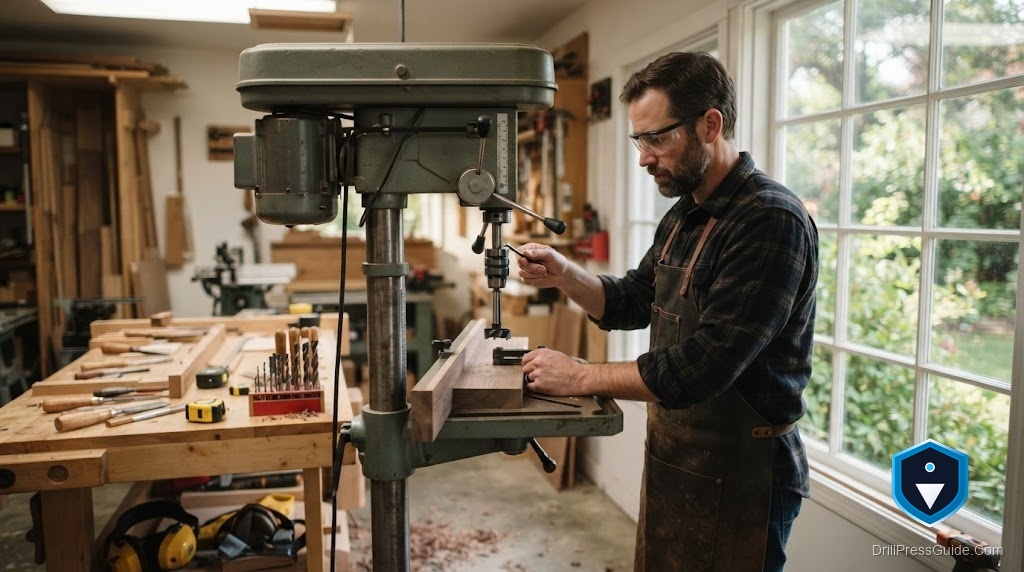
A drill press set up for wood asks for the opposite of a metal machine. Where metal wants low, grinding speeds and heavy mass, wood wants high RPM for small bits, a broad flat table, and easy speed changes for the range from tiny twist bits to big Forstner cutters. Choose with that in mind and a modest press will do beautiful joinery; choose a metal-oriented machine for wood and you will fight it on every small bit.
A woodworking drill press is a press chosen and configured for wood, favoring higher top speeds, a broad supportive table, and clean-cutting wood bits over the low-speed rigidity metal demands. The setup emphasizes accuracy, repeatability, and clean holes.
The short answer: for wood, pick a press with a high top speed and easy speed changes, add an auxiliary table with a fence, and use brad-point and Forstner bits. A benchtop machine is plenty for most woodworking, and the table and fence matter more than raw power.
Speed range: wood wants the high end
Wood bits run fast. Fine Woodworking recommends around 3000 RPM for small twist bits in wood, dropping to about 500 for large Forstner bits. So a woodworking press needs a high top speed for small bits and a low enough setting for big ones, a broad range covered easily.
A benchtop press handles this well. The WEN 4208T 8-inch, 5-speed press covers the common wood range in a compact machine and suits small shops. Its honest limit is a small stock table and short travel, so a shop-made auxiliary table is nearly mandatory, and very large Forstner bits push its low end.
For smoother speed changes across a project, the variable-speed WEN 4214T 12-inch press dials any speed with a digital readout, which is handy when you jump between small drilling and large boring. The tradeoff is higher cost and a heavier footprint than a small bench unit, more than a tight corner shop may want.
The table and fence matter more than the motor
For wood, the single biggest setup factor is the table. The stock cast-iron table is small and open, so an auxiliary wood table with a fence transforms accuracy: a flat sacrificial surface backs the exit against blowout, a fence sets consistent edge distance, and a stop block gives repeatable positions. This upgrade does more for woodworking results than any spec on the motor.
Build it or buy it, but do it early. A modest press with a good table and fence outperforms a fancier press without one for real woodworking.
Bits that cut wood clean
Wood-specific bits make the difference between a crisp hole and a torn one. Brad-point bits start exactly on the mark and slice the rim for clean holes and dowels; Forstner bits cut flat-bottomed, clean-walled holes and handle overlapping and angled bores. A Forstner bit set with carbide tips covers the sizes furniture and cabinet work need.
Run large Forstner bits slowly to avoid scorching, and peck to clear chips. That is the one recurring technique note for wood; otherwise clean bits and the right speed handle the rest.
Setting up and staying safe
Set a high speed for small bits and a low speed for large ones, mount the auxiliary table and fence, and back up every through-hole with scrap. Set the depth stop for repeatable recesses. Clamp the work or use the fence with a stop, since wood spins when a big bit grabs, and cradle round stock in a V-block. Wear eye protection, add a dust mask once a sanding drum is in use, and keep hands clear of the chuck.
The verdict
A woodworking drill press is chosen for a high, easy-to-change speed range and completed with an auxiliary table, a fence, and clean-cutting wood bits. A benchtop machine is enough for most shops, and the table and fence do more for results than horsepower ever will. Set the speed to the bit, back up your holes, and clamp the work, and a woodworking press turns out accurate, repeatable joinery for years. If your shop is tiny, a compact 5-speed with a shop-made table is the smart, affordable path.
Carry these forward:
- Wood favors a high top speed and easy speed changes.
- An auxiliary table with a fence matters more than motor power.
- Brad-point bits for accurate holes, Forstner bits for flat bottoms.
- Slow large Forstner bits, back up through-holes, and clamp the work.
Frequently asked questions
What makes a good woodworking drill press? A high top speed with easy speed changes, a broad table (or room for an auxiliary one), and clean-cutting wood bits. The table and fence matter more than raw power.
Is a benchtop press enough for woodworking? Yes, for most woodworking a benchtop press is plenty. Add a shop-made auxiliary table and fence to get the accuracy and repeatability projects need.
What speed should I use for wood? Around 3000 RPM for small twist bits, down to about 500 RPM for large Forstner bits. Match the speed to the bit, not once for the whole session.
Do I need a special table? A shop-made auxiliary table with a fence greatly improves accuracy and prevents blowout. It is the highest-impact upgrade for a woodworking press.
What bits are best for wood? Brad-point bits for accurate holes and dowels, and Forstner bits for flat-bottomed, large, or angled holes. Run large Forstner bits slowly.
Why do my holes tear or blow out? Tearing usually means the wrong bit or too little speed for small bits; blowout means no backer board. Use brad-point bits and clamp scrap under the workpiece.
References
- Fine Woodworking, Drill Press Speed Chart: https://images.finewoodworking.com/app/uploads/2020/01/22111726/drill-bit-speed-chart.pdf
- WOOD Magazine, Wise Buys: Drill-Press Tables: https://www.woodmagazine.com/woodworking-tools/reviews/drill/drill-press-tables


