
The WEN 10-Inch Drill Press: The Right Size for Most Home Shops
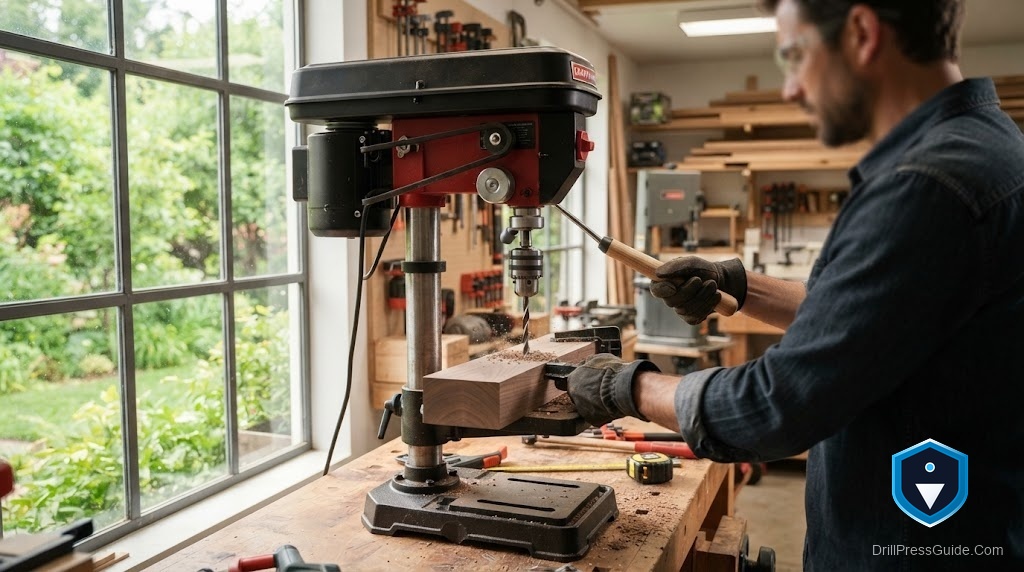
There is a size argument that never ends in woodworking forums: 8 inches, 10 inches, or 12 inches of swing on a benchtop drill press. The 10-inch class, and specifically the WEN 10-inch presses, is where a lot of that argument quietly ends, because it splits the difference so well. Bigger and more capable than the little 8-inch machines, smaller and easier to place than a 12-inch, the WEN 10-inch is the press I point most first-time buyers toward. Here is why, and where it still has limits.
What the WEN 10-inch is
The WEN 10-inch drill press (the 4210T is the core model) is a benchtop machine with a 10-inch swing, so the spindle reaches the center of a 10-inch-wide board. It runs a 3.2-amp motor, uses a stepped-pulley belt drive for five speeds spanning roughly 570 to 3050 RPM, and gives about 2-1/2 inches of spindle travel. The chuck is a 1/2-inch keyed unit on a JT33 taper, and the cast-iron table bevels for angled drilling. WEN also offers keyless and laser-equipped variants in the same family, so it is worth checking which features a given model includes before buying.
That spec sheet reads modest on paper, and it should, because this is a light-to-medium home-shop tool. What matters is that the 10-inch swing and 2-1/2 inches of travel cover the overwhelming majority of jobs a home woodworker actually does, without the bulk of a floor machine.
Where the 10-inch size wins
Here is the practical case. An 8-inch press feels cramped the moment you try to drill anything wider than a narrow board, and its short travel limits deeper holes. A 12-inch press solves both but takes more bench space and more storage. The 10-inch lands in between: enough swing for cabinet parts, shelf pins, dowel joinery, and general shop work, enough travel for most drilling, and a footprint that still fits a crowded bench. For a first drill press, or a second machine dedicated to smaller work, that balance is hard to beat.
Honest limits
Let me name the flaws plainly. At 3.2 amps this is not a machine for hogging large holes in thick steel; it is happiest in wood and light metal. The five fixed belt speeds mean you change speed by moving a belt rather than turning a dial, which is fine but slower than a variable-speed press. And the stock chuck is serviceable rather than premium, so picky users upgrade it. None of this is a surprise at this size and class, but you should hear it before you expect the machine to do a floor press’s job.
Tooling and upgrades
A few additions make the 10-inch noticeably better. A quality 1/2-inch keyed drill chuck with a JT33 arbor tightens up grip and accuracy, a drill press vise makes work-holding safe and repeatable, and a set of Forstner bits gets the most out of the machine in wood. Keep a spare drill press chuck key on hand, and the machine itself is the WEN 10-inch drill press. Confirm the taper before buying an arbor.
The verdict
The WEN 10-inch drill press is the size I recommend to most home woodworkers, because it clears the cramped feeling of an 8-inch machine without the footprint of a 12-inch, and it handles the vast majority of shop drilling with room to spare. Accept its honest limits (a light-duty motor, five fixed belt speeds, and a stock chuck worth upgrading) and match it to wood and light metal, and it will serve for years. If you already know your work runs to wide panels or heavy steel, step up to a 12-inch or a floor press instead. For everyone else, the 10-inch is the smart default.
Takeaways:
- The WEN 10-inch (4210T) is a benchtop press with a 10-inch swing, five speeds (about 570 to 3050 RPM), and roughly 2-1/2 inches of travel.
- The 10-inch size balances real capacity against a bench-friendly footprint, ideal for a first press.
- Honest limits: a light 3.2-amp motor, belt-change speeds, and an upgradeable stock chuck.
- Fit a good chuck, a vise, and Forstner bits, and match it to wood and light metal.
FAQ
What are the WEN 10-inch drill press specs? A 10-inch swing, 3.2-amp motor, five belt-driven speeds spanning roughly 570 to 3050 RPM, about 2-1/2 inches of spindle travel, and a 1/2-inch keyed chuck on a JT33 taper.
Is a 10-inch drill press big enough? For most home woodworking, yes. It reaches the center of a 10-inch-wide board and handles cabinet parts, dowels, and general work. Choose bigger only for wide panels or heavy metal.
8-inch, 10-inch, or 12-inch WEN? The 8-inch is the most compact and light, the 12-inch offers the most capacity and often variable speed, and the 10-inch balances the two for a bench-friendly, do-most-things press.
Is it good for metal? It handles light metal at low speeds, but the 3.2-amp motor is not built for hogging large holes in thick steel.
What is its biggest weakness? The fixed belt-change speeds and a stock chuck that is serviceable rather than premium. Both are easy to live with or upgrade.
Does it have a laser or keyless chuck? Some WEN 10-inch variants add a laser or a keyless chuck. Check the specific model, since the core 4210T uses a keyed chuck.
Should I upgrade the chuck? Many owners fit a quality 1/2-inch keyed chuck with a matching arbor for better grip and less runout. It is the most common upgrade.
References
- WEN Products, 4210T 10-inch Drill Press specifications and manual: https://wenproducts.com/products/wen-4210t-10-inch-drill-press
- WEN Products, drill press lineup and comparison: https://wenproducts.com/collections/drill-presses
- WEN 4210T owner’s manual (speeds, travel, setup): https://wenproducts.com/cdn/shop/files/4210T_Manual.pdf


