Metalworking Drill Press: Match the Bit, Speed, and Support to the Job
Most drill presses on a store shelf are sold to woodworkers, and it shows in what they are good at. A press built or set up for metalworking is a different animal: it runs slower, holds work more rigidly, and shrugs off the heat and grabbing that metal throws at it. If you are choosing a press for metal, or setting up the one you have, the priorities flip from what a wood-focused buyer looks for.
A metalworking drill press is a drill press chosen and configured to drill metal well, with low available speeds, a rigid build, and the workholding and tooling to handle steel, stainless, and aluminum. The emphasis is low-end speed and rigidity over top RPM.
The short answer: for metal, pick a press that reaches low RPM and has real mass, then add a solid vise, cobalt bits, and cutting fluid. A floor machine with a low speed range and a heavy table beats a light, fast wood-oriented press for metal every time.
Low speed is the metalworking priority
Woodworkers want high RPM for small bits; metalworkers want low RPM for steel and stainless. Mild steel runs around 80 to 100 surface feet per minute and stainless just 20 to 40, which for a half-inch bit means roughly 690 RPM in steel and 230 in stainless. A press that bottoms out at 600 RPM cannot drill large stainless holes without cooking the bit.
That makes the low end of the speed range the first spec to check for metal. A machine with a broad, low range serves metal far better than one tuned for fast wood drilling, even if the fast one has a stronger-sounding top speed.
Rigidity and mass matter as much as the motor
Metal cutting forces are high, and a light press chatters, which drills oval, out-of-round holes. A heavy cast-iron floor machine resists that. The WEN 4227T 17-inch, 12-speed floor press reaches down to 150 RPM and carries enough mass to stay steady in thick plate, with generous spindle travel for deep holes. Its honest costs are weight and floor space, and belt changes take longer than a dial, so a cramped shop or frequent speed changes argue against it.
For lighter or mixed metal work, the variable-speed WEN 4214T 12-inch press dials any speed and shows it on a display, which makes matching numbers easy. The tradeoff is a lighter build and a modest 5-amp motor, so heavy steel wants a patient feed. Anyone drilling thick steel daily should skip it for the floor machine.
Tooling and workholding for metal
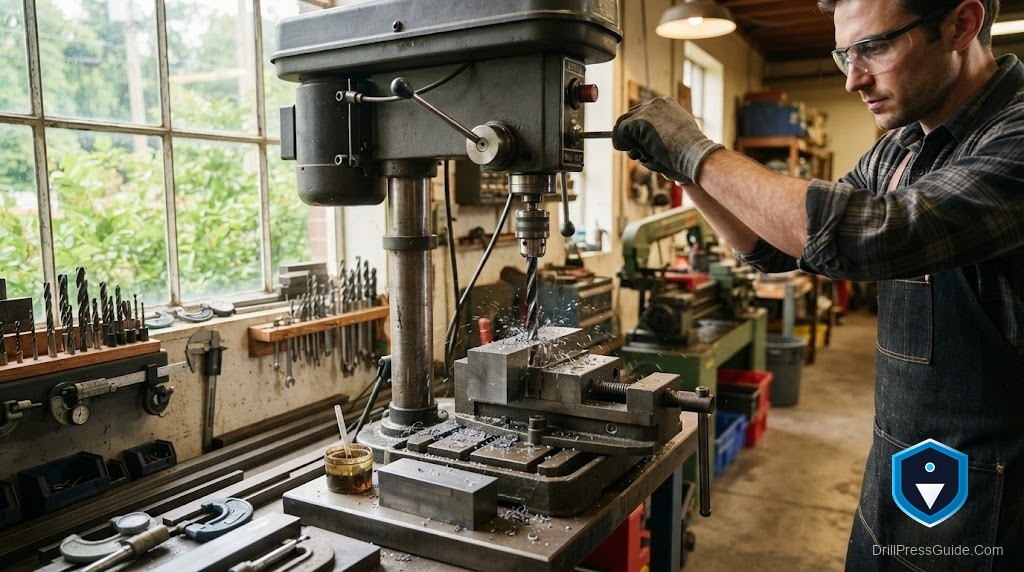
The press is half the setup. Metal grabs at breakthrough, so a rigid drill press vise with serrated jaws, bolted to the table, is essential to keep the work still and your hands safe. For hard metal, a cobalt M35 twist drill set holds its edge in the heat that glazes plain HSS, and a 135-degree split point resists walking. Center-punch every hole, and keep cutting fluid at the machine for steel and stainless.
These are not optional extras for metal; they are what make the difference between clean holes and a graveyard of dull bits. Budget for them alongside the press.
Setting up and using it well
Bolt a floor machine to the floor, tram the table square to the spindle, and clamp every part. Set the speed by the metal and bit size, feed firmly enough to peel a real chip so the bit cuts instead of rubbing, and reduce speed and feed by half on holes deeper than three to four bit diameters. Pilot-drill larger holes so the full-size bit cuts cleanly. Clear hot chips with a brush, wear eye protection, and keep sleeves and gloves away from the rotating chuck.
The verdict
A metalworking drill press is chosen for low-end speed and rigidity, not top RPM, and then completed with a solid vise, cobalt bits, and cutting fluid. A heavy floor machine that reaches 150 RPM will out-drill a light, fast wood press on every metal job. Buy for the low speed range first, add real workholding, and a metalworking press becomes a machine that drills steel and stainless cleanly for years. If your shop is tight or your metal work occasional, a rigid benchtop with a low range and a patient feed is the sensible compromise.
Worth carrying forward:
- For metal, the low end of the speed range is the first spec to check.
- Mass and rigidity prevent chatter and out-of-round holes.
- A solid vise, cobalt bits, and cutting fluid complete the setup.
- Match speed to metal and bit size, and clamp everything.
Frequently asked questions
What makes a good metalworking drill press? A low available speed range, a rigid heavy build, and generous spindle travel, plus a solid vise and cobalt bits. Low-end speed matters more than top RPM.
What speed do I need for metal? Mild steel around 80 to 100 SFM (near 690 RPM for a half-inch bit) and stainless just 20 to 40 SFM (near 230 RPM). The press must reach those low speeds.
Is a floor or benchtop press better for metal? A heavy floor press is better for thick steel and large holes because of its low speeds and mass. A rigid benchtop suits lighter or occasional metal work.
Do I need cobalt bits for a metalworking press? For stainless, hardened steel, and cast iron, yes. Cobalt holds its edge in heat. Plain HSS is fine for mild steel, aluminum, and brass.
Why does my press chatter when drilling metal? Usually too little mass or rigidity, an unclamped part, or a dull bit. Use a heavier machine if you can, clamp the work, and keep bits sharp.
How deep can a drill press drill in metal? One plunge is limited by spindle travel, and deep holes need reduced speed and feed plus chip clearing. Check travel, not just chuck capacity, for deep work.
References
- Carbide Depot, HSS Twist Drill Recommended Speeds and Feeds: https://www.carbidedepot.com/formulas-drills-speeds.htm
- Norseman Drill and Tool, Feeds and Speeds for Drills: http://www.norsemandrill.com/feeds-speeds-drill.php