
Drill Press Projects in Wood: Speed, Tooling, and Workholding Choices
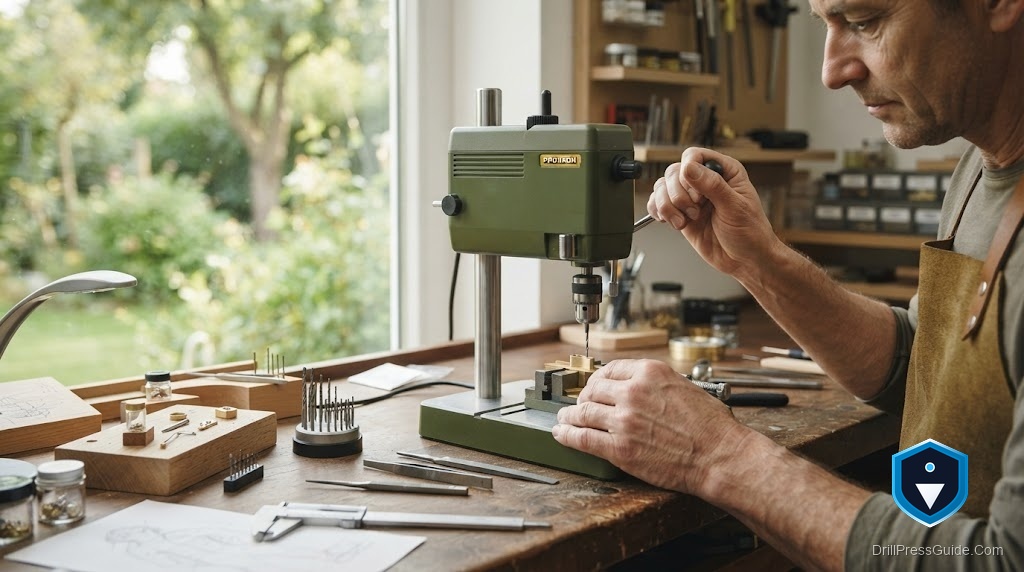
A drill press earns its footprint the day you stop thinking of it as a hole-maker and start thinking of it as a joinery machine. Dowel joints, pegboards, candle holders, cutting boards with finger holes, shop jigs: nearly all of them come down to holes placed accurately and repeatably, which is exactly what a press does better than anything else in the shop. The projects below are chosen because each teaches a technique you will reuse for years.
Drill press wood projects are woodworking builds that rely on the press’s accurate, repeatable holes, from dowel-joined boxes and pegboard organizers to lidded candle holders and shop jigs. The machine’s value is precise placement and clean, square holes.
The short answer for anyone starting out: pick projects that use a fence and stop block for repeatable holes, brad-point and Forstner bits for clean cuts, and a backer board to stop blowout. Master those on simple builds and the harder projects take care of themselves.
Start with repeatable-hole projects
The fastest skill to bank is drilling identical holes, and a pegboard tool organizer or a shelf-pin drilling jig teaches it directly. Both use a fence to set distance from the edge and a stop block to fix position, so every hole matches. Get this right and cabinet shelving, knife blocks, and dowel racks all become easy.
The technique transfers everywhere. Once you can index a workpiece against a stop and drill a row of identical holes, you can build anything that needs regular spacing, which is a huge share of woodworking.
Move to joinery: dowels and plugs
Dowel joinery is the natural next project, a small box or a picture frame joined with dowels drilled on the press. A brad-point bit is the tool here, because its center spur starts exactly on the mark and its spurs slice a clean rim, so the dowels seat square. Drill both mating pieces with the same fence setting and the joint lines up.
Plugs are the companion skill: counterbore a screw hole with a Forstner bit, drive the screw, then glue a wood plug over it for a finished surface. A Forstner bit set with carbide tips cuts the flat-bottomed counterbores plugs need, across the sizes most projects use. Run the larger sizes slowly so they do not scorch.
Projects that show off flat-bottom holes
Candle holders, coaster sets, and tea-light blocks all rely on a clean, flat-bottomed recess, which only a Forstner bit delivers. These make satisfying gift projects and teach depth control using the press’s depth stop, so every recess is the same depth. Set the stop once and drill a dozen identical holders.
The honest challenge is scorching. Large Forstner bits build heat, so slow the press down and peck to clear chips, especially in dense hardwoods like maple. That single habit separates clean recesses from browned ones.
Shop jigs, the projects that pay you back
The most useful drill press projects are the jigs you build for the press itself: an auxiliary table with a fence, a V-block for drilling round stock, a doweling jig. These cost scraps and transform the machine, and building them teaches every core technique at once. A plywood table with a replaceable insert and a fence is the single best first project for any press owner.
Clamp the work for all of this, back up through-holes with scrap, wear eye protection, and keep hands clear of the chuck. Big bits and round stock especially want a hold-down or V-block so nothing spins.
The verdict
The best drill press wood projects are the ones that teach repeatable holes, clean joinery, and flat-bottom recesses, because those three skills underpin nearly everything else. Start with a pegboard or shelf-pin jig, move to dowel joints and plugged screws, then build shop jigs that make the press better. Buy good brad-point and Forstner bits early, since clean holes come from sharp, purpose-built bits as much as from technique.
Carry these forward:
- Choose early projects that build repeatable-hole skills with a fence and stop.
- Brad-point bits for joinery, Forstner bits for flat-bottom recesses and plugs.
- Slow the press and peck for large Forstner bits to avoid scorching.
- Shop jigs are the highest-value projects; build the table and fence first.
Frequently asked questions
What can I make with a drill press in wood? Dowel-joined boxes, pegboard organizers, candle and tea-light holders, shelf-pin jigs, V-blocks, and shop tables. Anything needing accurate, repeatable, or flat-bottomed holes suits the press.
What is a good beginner drill press project? An auxiliary table with a fence, or a pegboard tool organizer. Both teach repeatable-hole technique and immediately make the press more useful.
What bits do I need for wood projects? Brad-point bits for accurate holes and dowels, and Forstner bits for flat-bottomed recesses, counterbores, and plugs. Add a backer board to prevent blowout.
How do I drill holes the same depth every time? Set the press’s depth stop once, then drill each hole to that stop. This gives identical depths for candle holders, recesses, and counterbores.
Why do my Forstner holes look burned? Too much speed. Large Forstner bits need a slow spindle speed and chip-clearing pecks, especially in hardwoods.
How do I hold round stock to drill it? Use a V-block, which cradles the round piece and keeps it from spinning. A shop-made V-block is a quick, useful project itself.
References
- Fine Woodworking, Drill Press Speed Chart: https://images.finewoodworking.com/app/uploads/2020/01/22111726/drill-bit-speed-chart.pdf
- WOOD Magazine, Wise Buys: Drill-Press Tables: https://www.woodmagazine.com/woodworking-tools/reviews/drill/drill-press-tables


