Drill Press Metal Lathe: Match the Bit, Speed, and Support to the Job
The idea is tempting: you already own a drill press, so why not turn it into a metal lathe and skip buying another machine? The internet is full of people who tried. The honest report is that a drill press and a metal lathe orient their forces in opposite directions, and pretending otherwise is how spindles get wrecked. There is a narrow, careful version of this that works, and a lot of versions that do not.
A drill press metal lathe is an attempt to use a drill press to turn metal the way a lathe does, either by improvising a horizontal setup or bolting on an attachment. Because a press spins the work vertically and is built for downward thrust, only very light turning is realistic, and a purpose-built lathe is the right tool for real work.
The short answer: a drill press cannot safely replace a metal lathe for turning between centers, but it can do limited vertical work like light sanding, polishing, or truing a small part held in the chuck. For anything structural, buy a lathe. Understanding why saves both your machine and your knuckles.
Why the two machines fight each other
A lathe spins the workpiece horizontally and feeds a rigid cutting tool into it, with the headstock bearings built to take that constant side load. A drill press spins a tool vertically and is built for downward thrust into fixed work. Turning on a lathe means steady radial force, exactly the load a drill press spindle is least able to handle.
Push a cutting tool into a workpiece spinning in a drill press chuck and you load the quill and bearings sideways, and you risk the chuck working loose from its tapered mount and dropping. That is the core reason drill-press-to-lathe conversions stay in the realm of light duty.
What actually works on a press
There is a legitimate light version. A small part held in the chuck can be spun for sanding, polishing, deburring, or truing with a file or abrasive, essentially using the press as a vertical spindle. Pen turners and hobbyists sometimes shape soft material this way. The loads stay tiny and mostly downward or gentle, which the machine tolerates.
What does not work is turning steel between centers, parting off, or taking real cutting passes. Those need a lathe’s rigidity and tool support. If your project involves reducing a diameter with a cutting tool under load, the press is the wrong machine, full stop.
If you want lathe-like capability
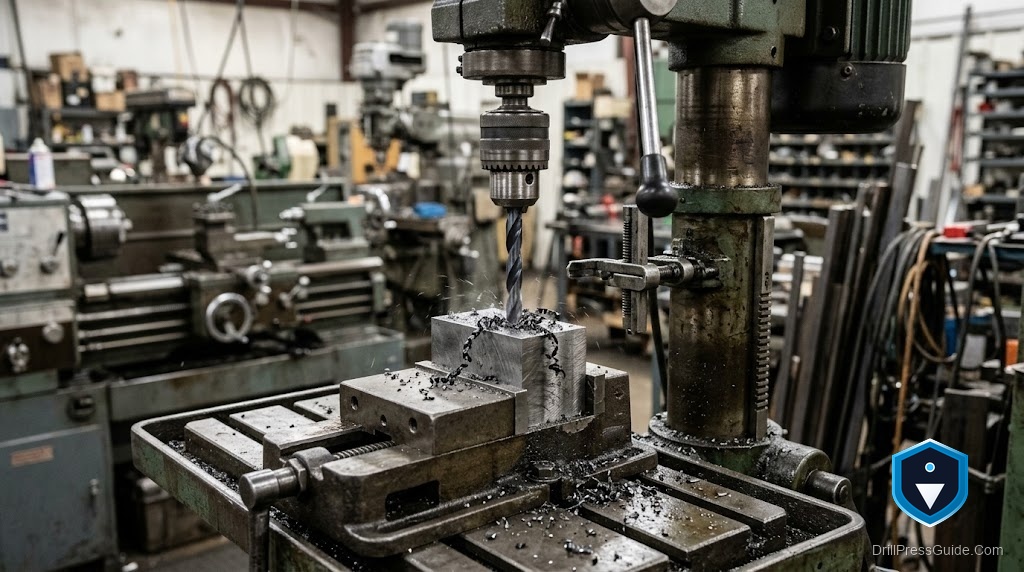
For light positioning and cutting that leans toward milling rather than turning, a cross-slide compound vise bolted to the table lets you feed work under an end mill in two axes. It is not a lathe, and its screw backlash means single-direction feeding only, but it is the realistic accessory for edging its way toward machining on a press.
Be honest with yourself about the work. If lathe operations are a recurring need, a small benchtop metal lathe is the correct purchase, and it will do in minutes what a converted press does badly in an hour. The press then stays a great drill press.
Speed and safety if you try light work
Keep speeds moderate and matched to the material, run soft metals faster and steel slower, and clamp or hold everything so nothing can fly. Watch the chuck for any sign of loosening, since side loads work it free. Wear eye protection, keep hands clear of the rotating work and chuck, and stop the moment the quill deflects or chatter starts. Those are the machine’s limits telling you the job belongs on a lathe.
The verdict
A drill press makes a poor metal lathe and a fine vertical spindle for light sanding, polishing, and truing small parts. The two machines load their bearings in opposite directions, so real turning under a cutting load is out of bounds. Use a press for the light work it tolerates, reach for a cross-slide vise if you want to nibble toward milling, and buy an actual lathe when turning is a genuine need. Respecting that line keeps your spindle alive.
Keep these in mind:
- A lathe takes side loads; a drill press is built for downward thrust.
- Light sanding, polishing, and truing of small parts is realistic; real turning is not.
- A cross-slide vise leans toward light milling, not turning, and only in one feed direction.
- Chuck loosening, quill deflection, or chatter means stop and use a lathe.
Frequently asked questions
Can you turn a drill press into a metal lathe? Not for real turning. A press is built for downward thrust, not the side loads turning creates. It can do light sanding, polishing, and truing of small parts held in the chuck.
Why is a drill press bad for lathe work? Turning loads the spindle sideways, which a drill press’s bearings and tapered chuck mount are not designed for. The chuck can loosen and drop under that load.
What light work can a drill press do like a lathe? Spinning a small part to sand, polish, deburr, or true it with an abrasive or file. The loads stay small and mostly downward, which the machine tolerates.
Is there an attachment to make a drill press a lathe? There is no safe true-lathe attachment. A cross-slide vise leans toward light milling, not turning, and even that requires single-direction feeding and light cuts.
When should I just buy a metal lathe? Whenever you need to turn diameters, cut between centers, or part off. A small benchtop lathe does those jobs safely and far faster than a converted press.
Can I turn steel on a drill press? No. Steel’s cutting loads are far too high for a press spindle. Even light aluminum work is marginal; steel turning belongs on a lathe.
References
- University of Florida Design and Manufacturing Lab, Speeds and Feeds: https://web.mae.ufl.edu/designlab/Advanced%20Manufacturing/Speeds%20and%20Feeds/Speeds%20and%20Feeds.htm
- Occupational Safety and Health Administration, machine guarding: https://www.osha.gov/machine-guarding