
Can You Mill Aluminum With a Drill Press? An Honest Look at the Limits
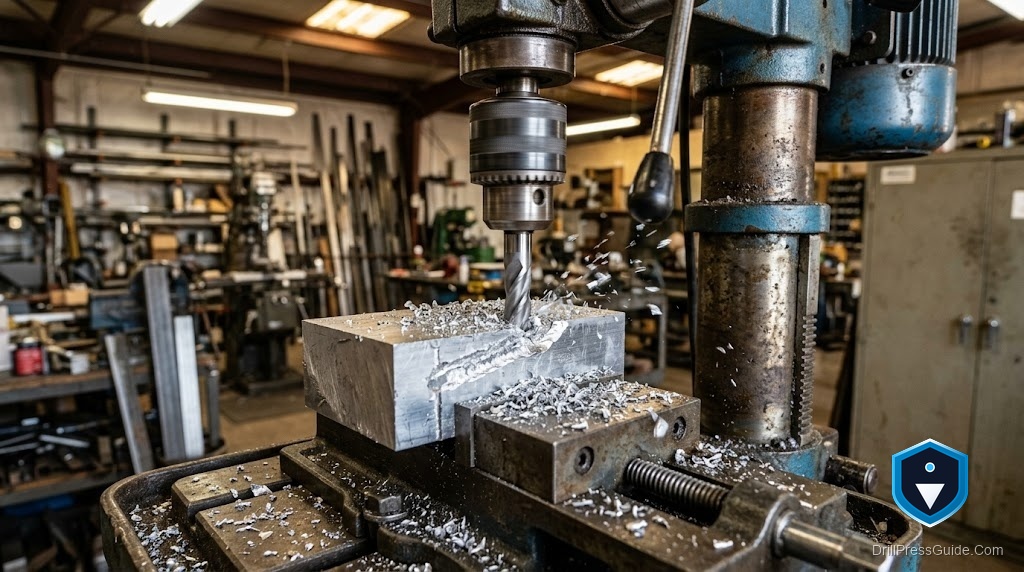
The question comes up in every home shop: I have a drill press and some aluminum, so can I skip buying a mill? The honest answer is a qualified yes for very light work, and a firm no for anything real. A drill press is built to push a bit straight down, while milling asks a tool to cut sideways, and those two loads are exactly opposite. Knowing where that line sits saves your spindle, your project, and your patience.
Milling aluminum with a drill press means using an end mill and a cross-slide vise to cut aluminum from the side, within the tight limits of a spindle designed for downward drilling, not sideways milling. It suits small, shallow jobs like a short slot or a trued edge, and nothing heavier.
The short answer: you can remove small amounts of soft aluminum on a drill press with a cross-slide vise, sharp end mills, light passes, and lubricant, but the spindle, the drill chuck, and the lack of rigidity cap you at tiny work. For real material removal or accuracy, a milling machine is the correct tool. Here is where the limits actually fall.
Why a drill press is the wrong shape for milling
A milling machine spins a cutter and feeds the work sideways into it, with a spindle and bearings built to take that constant side load. A drill press spins a bit and pushes down, and its bearings and tapered chuck mount resist downward thrust, not sideways force. Milling loads the quill sideways, exactly where a press is weakest.
The consequences are predictable: the quill deflects, the cut chatters, and worst of all the chuck can work loose from its taper and drop. Aluminum is soft enough that light cuts stay within tolerance; steel is not, which is why this is strictly an aluminum conversation.
What actually works
The realistic version is small and shallow. With a cross-slide vise feeding the work in two axes, you can cut a short slot, true up an edge, or nibble a small pocket in soft aluminum, taking passes a fraction of a millimeter deep. A cross-slide compound vise bolts to the table and provides that X and Y movement, with a cast-iron body that clamps aluminum firmly.
Its honest flaw is backlash in the feed screws, so you must feed in one direction only, never reverse into a cut, and it is a light-milling and positioning tool, not a substitute for a milling machine’s rigid table. Anyone expecting to hog out material will be disappointed.
The chuck is the real weak link
The part that surprises people is the chuck. A standard drill chuck grips a bit against downward pull, not against the sideways force an end mill sees, so it can let the end mill slip or pull out mid-cut. This, more than motor power, is what limits milling on a press.
Use the smallest end mill the job allows, take the lightest possible cuts, and watch constantly for any sign of the cutter shifting. If it slips even slightly, stop; the setup is telling you it has reached its limit. Never assume the chuck will hold an end mill the way a mill’s collet does.
Speed, lubricant, and a light touch
Aluminum likes speed, cutting around 200 to 300 surface feet per minute, so set a moderate to higher speed for the small end mill. Add cutting lubricant or even a spray like WD-40, because aluminum is gummy and welds to a dry cutter, clogging the flutes and ruining both finish and safety. Take many light passes rather than one deep one, feed slowly and steadily in a single direction, and clear chips often.
Wear eye protection, keep hands clear of the cutter, and stop at the first sign of quill deflection, chatter, or a loosening chuck. Those are not quirks to push through; they are the machine’s limits.
Where this leaves you
You can mill aluminum on a drill press for small, shallow work with a cross-slide vise, sharp end mills, light passes, moderate speed, and lubricant, but the spindle and especially the drill chuck cap you at tiny jobs. It is a genuine capability for a short slot or a trued edge, and a false economy for anything more. When the work calls for real material removal or accuracy, a benchtop milling machine is the right and safer buy. Respect the chuck and keep every cut light, because side load and a slipping end mill are what turn this from clever to dangerous.
Worth carrying forward:
- Milling loads the spindle sideways, the direction a drill press is weakest.
- This is aluminum-only, light-duty work; steel is out.
- A cross-slide vise enables light milling but has backlash; feed one way.
- A drill chuck grips end mills poorly, so use tiny cutters and light passes.
Frequently asked questions
Can you mill aluminum with a drill press? Only small, shallow work, using a cross-slide vise, sharp end mills, light passes, and lubricant. A press is built for downward thrust, not the side loads milling creates.
Why is milling on a drill press risky? Side loads can deflect the quill, cause chatter, and loosen the tapered chuck mount, and a standard drill chuck can let an end mill slip or pull out.
What do I need to try it? A bolted-down cross-slide vise, small end mills made for aluminum, cutting lubricant, and the discipline to take very light passes in one feed direction.
Can I mill steel on a drill press too? No. Steel’s cutting loads are far too high for a press spindle. Even light aluminum milling is marginal, so steel belongs on a milling machine.
Why does my end mill keep pulling out of the chuck? A drill chuck is not made to grip against side loads. Use the smallest end mill possible, take lighter cuts, and if it keeps slipping, stop and use a mill.
When should I just buy a mill? Whenever you need to remove real material, hold a tolerance, or cut anything beyond light aluminum. A benchtop mill does it safely and far faster.
References
- University of Florida Design and Manufacturing Lab, Speeds and Feeds: https://web.mae.ufl.edu/designlab/Advanced%20Manufacturing/Speeds%20and%20Feeds/Speeds%20and%20Feeds.htm
- Occupational Safety and Health Administration, machine guarding: https://www.osha.gov/machine-guarding


