
The Jayhawk Bowling Ball Drill Press: How the Drilling System Works
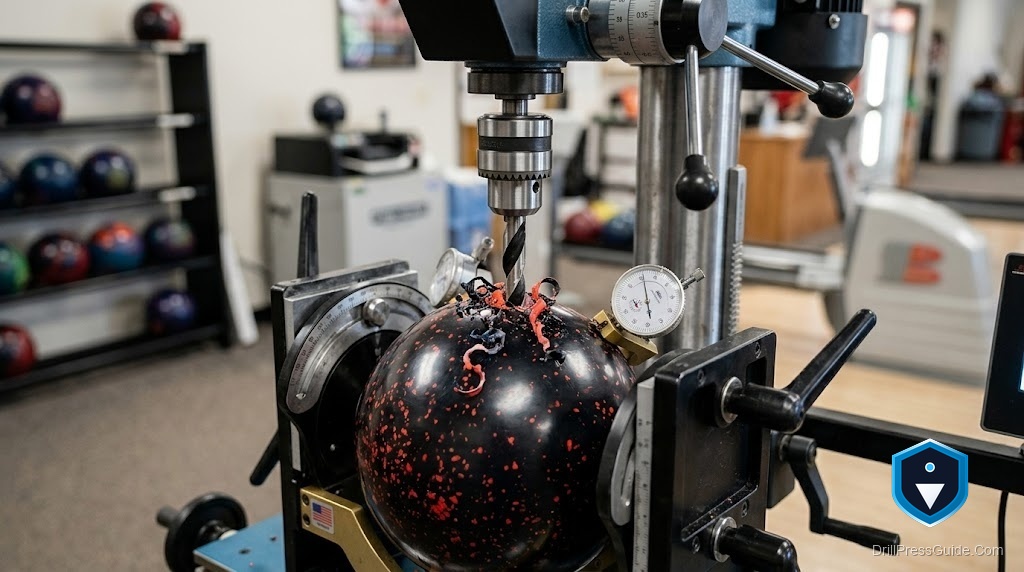
Ask pro shop operators which name they trust for drilling equipment and Jayhawk comes up again and again. What Jayhawk builds is not really a drill press in the hardware-store sense; it is a family of jigs and complete drilling systems that either mount onto a rigid press or stand on their own, engineered around one goal: putting bowling ball holes exactly where the driller wants them, ball after ball. Understanding the Jayhawk approach is understanding how a modern pro shop drills.
A Jayhawk bowling ball drill press is a drilling setup built around Jayhawk Bowling Supply equipment, ranging from jigs that mount to a standard rigid press to complete systems like the Tri-Oval that drill every hole without unclamping the ball. Jayhawk’s focus is precise, repeatable layout and pitch.
The short answer: Jayhawk offers everything from a Professional Jig that retrofits a rigid press with about five inches of spindle travel, up to the standalone Tri-Oval mill-drill system, all run at a slow cutting speed around 450 to 500 RPM. The value is accuracy and repeatability, scaled to how much a shop drills.
The range: from a jig to a full system
Jayhawk’s line spans a wide range, which is its real strength. At the accessible end, the Professional Jig mounts to a standard rigid drill press, using a rubber-tipped clamp to hold the ball while you drill, so a shop can turn a press it already owns into an accurate drilling station. A Mini Jig serves lighter needs.
At the high end sits the Tri-Oval, a complete mill-drill system that drills all the holes without unclamping the ball, with a floor stand, a digital pitch display, a carousel of carbide bits, and a plug-trimming blade. There is even a CNC option, the DrillBot, for shops that want automation. The point is that Jayhawk scales from a simple retrofit to a full production machine.
What the jig needs from the press
For the mounting jigs, the host press matters. Jayhawk’s Professional Jig expects a rigid press with roughly five inches of spindle travel, enough to drill a full-depth thumb hole in one plunge while the ball stays clamped. Common sturdy presses from makers like Jet or Rong Fu are typical hosts.
So evaluating a jig-based Jayhawk setup means checking the press for rigidity, true running, and travel, then adding the jig on top. The standalone systems like the Tri-Oval sidestep this by being complete machines, which is part of what a shop pays for at that tier.
Speed, bits, and technique
Jayhawk recommends a slow cutting speed, around 450 to 500 RPM, because heat from a fast bit gums the coverstock and dulls the carbide tooling. Keep the bits sharp, use the jig or system to hold the ball dead still, and feed steadily. The carbide bit carousel on the Tri-Oval keeps sized bits ready, which speeds a busy bench.
Depth and pitch are set through the jig’s gauges or the system’s digital display, so use them together with a steady feed. A ball is heavy and drilling forces are real, so the clamp is a safety feature as much as an accuracy one; never freehand a ball.
How Jayhawk options compare
The Professional Jig versus the Tri-Oval is a volume-and-workflow decision. The jig is the sensible entry for a shop with a good press and moderate volume, and its honest limit is that you still change bits and manage the press manually. The Tri-Oval drills every hole without unclamping and displays pitch digitally, which pays off at high volume, and its honest cost is that it is a full standalone machine that takes floor space. Against a bare press with a shop-made cradle, any Jayhawk jig wins on repeatable pitch and safety.
A low-volume or hobby driller rarely needs the Tri-Oval; the jig, or a shop’s drilling service, fits better. A high-volume shop that values speed and consistency is exactly who the standalone systems are built for.
Bottom line
A Jayhawk bowling ball drill press is really a scalable drilling system, from a Professional Jig that upgrades a rigid press to the standalone Tri-Oval that drills a whole ball without unclamping. Match the tier to your volume: a jig for moderate work on a good press, a full system for a busy bench. Run any of them slow, around 450 to 500 RPM, keep the carbide sharp, and let the clamp hold the ball. Buy more system than you need and it sits idle; buy the right tier and Jayhawk earns its reputation daily.
Keep these in mind:
- Jayhawk scales from a press-mounted jig to the standalone Tri-Oval system.
- A mounting jig needs a rigid press with about five inches of travel.
- Run slow, around 450 to 500 RPM, and keep carbide bits sharp.
- Match the tier to your drilling volume; the full system suits busy shops.
Frequently asked questions
What is a Jayhawk bowling ball drill press? A drilling setup built around Jayhawk Bowling Supply equipment, from jigs that mount to a rigid press to complete systems like the Tri-Oval that drill every hole without unclamping the ball.
Do I need a special press for a Jayhawk jig? For the mounting jigs, yes: a rigid press with about five inches of spindle travel, such as common sturdy Jet or Rong Fu machines. Standalone systems are complete on their own.
What speed does Jayhawk recommend? Around 450 to 500 RPM. A slower cutting speed prevents the heat that gums the coverstock and dulls the carbide bits.
What is the Jayhawk Tri-Oval? A complete mill-drill system that drills all of a ball’s holes without unclamping it, with a floor stand, digital pitch display, a carbide bit carousel, and a plug-trimming blade.
Is a Jayhawk system worth it for a small shop? A Professional Jig on a good press suits moderate volume well. The standalone Tri-Oval pays off at high volume and is usually more than a small shop needs.
Can I use a Jayhawk jig on a press I already own? Yes, if the press is rigid, runs true, and has roughly five inches of spindle travel. The Professional Jig is designed to retrofit such presses.
References
- Jayhawk Bowling Supply, Drilling Equipment: https://www.jayhawkbowling.com/Products/Drilling_Equipment.html
- Jayhawk Bowling Supply, Tri-Oval drilling system: https://www.jayhawkbowling.com/Products/Tri-Oval.html


