
Drilling Metal With a Drill Press: Speed, Feed, and Support That Actually Work
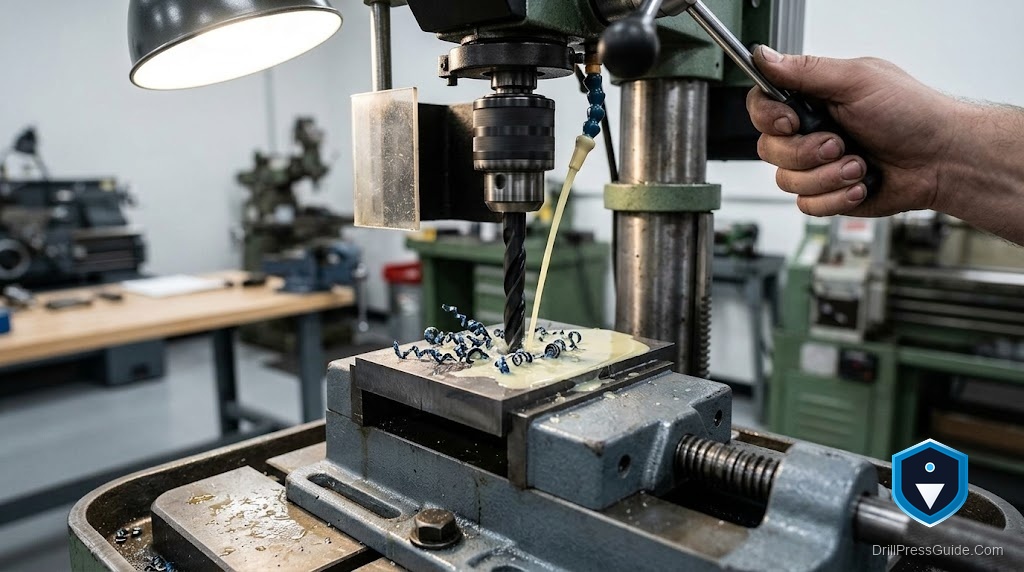
The drill press is the best friend metal drilling ever had, and most people waste that advantage by running it like a hand drill. They spin the bit too fast, lean on it too little, skip the clamp, and then blame the bit when the hole comes out oval and the metal turns blue. Drilling metal with a drill press is mostly about slowing down, holding the work still, and letting the machine do what your wrist never could: apply steady, square pressure at a controlled speed.
Drilling metal with a drill press means boring holes in steel, aluminum, brass, and other metals using the press’s controlled speed and steady downward feed, matched to the metal with the right bit, speed, and lubricant. The press’s rigidity and adjustable speed are exactly what metal needs.
The short answer: pick the speed by the metal and bit size (slower for hard metal and big bits), clamp the work every time, feed firmly enough to peel a real chip, and use cutting fluid on steel. Get those four right and clean metal holes follow, whatever press you own.
Speed is the thing people get wrong
Metal wants slower speeds than most people expect, and heat is the reason. Too much RPM builds heat that dulls the bit and hardens the metal. Speed is set by the metal’s cutting rate and the bit diameter: aluminum runs fast, around 200 to 300 surface feet per minute, while mild steel wants roughly 80 to 100 and stainless just 20 to 40.
Translated to the dial, a quarter-inch bit runs near 1375 RPM in mild steel, about 2675 in brass, and only around 460 in stainless. Bigger bits run slower still. When in doubt, slow down; a slower bit that stays cool outlasts and outcuts a fast one that overheats.
Hold the work like it wants to hurt you
Metal grabs hard at breakthrough, snatching an unclamped part into a spinning blur that ruins the hole and can gash a hand. So the rule is simple: clamp everything. A drill press vise with serrated jaws bolted to the table is the baseline, and table clamps with step blocks handle shapes a vise cannot grip.
Think of it as the difference between a machinist and a patient in the making. The best bit at the perfect speed still cuts a triangle if the work can move, and it is the one habit that keeps your hands intact. Never hold metal by hand against a drill press bit.
The right bit, and fluid to help it
Bit choice tracks the metal. Plain HSS handles aluminum, brass, and mild steel, but stainless, hardened steel, and cast iron demand cobalt. A cobalt M35 twist drill set keeps its edge in the heat that glazes standard bits, and a 135-degree split point starts on the mark without walking. Center-punch every hole first so the bit bites where you want it.
Cutting fluid is the cheap step that changes everything on steel. It carries away heat, extends bit life, and leaves a cleaner hole. Skip it on aluminum if you like, but keep a can at the machine for anything ferrous. A plain HSS bit with fluid often beats a cobalt bit run dry.
Technique: pilot, peck, and feed
For holes over about a quarter inch, drill a pilot hole first so the larger bit’s chisel edge is not fighting to cut center. Feed firmly enough to peel a continuous chip, since a bit that only rubs generates heat and work-hardens the metal, especially stainless. On deep holes, peck by retracting to clear chips and let fluid back in, and cut speed and feed by half once the hole passes three to four bit diameters.
Watch the chip: a good curl of metal means you are cutting right. Dust or discoloration means too fast or too little feed. Wear eye protection, brush chips away rather than using fingers, and keep sleeves and gloves clear of the chuck.
Bottom line
Drilling metal on a drill press comes down to four habits: the right speed for the metal and bit, a clamped workpiece, the right bit with cutting fluid on steel, and a firm feed that makes real chips. Do them and a modest press drills clean, round holes in everything from aluminum to stainless. Skip the clamp or run too fast and no bit will save the result. If you remember one thing, slow down, because heat is what ruins both the hole and the bit.
Worth remembering:
- Match speed to metal and bit size; slower for hard metal and big bits.
- Clamp every workpiece; metal grabs viciously at breakthrough.
- Use cobalt for stainless and hardened steel, and cutting fluid on all steel.
- Pilot-drill large holes, feed to make chips, and peck deep holes.
Frequently asked questions
What speed should I drill metal at on a drill press? Match it to the metal and bit size. Aluminum runs fast (200 to 300 SFM), mild steel slower (80 to 100), and stainless slowest (20 to 40). Bigger bits run slower.
Do I need to clamp metal to a drill press? Yes, always. Metal grabs hard at breakthrough and can spin an unclamped part into a hazard. Use a bolted vise or table clamps every time.
What bits drill metal best? HSS for aluminum, brass, and mild steel; cobalt for stainless, hardened steel, and cast iron. A center punch and a 135-degree split point help the bit start true.
Why does my metal turn blue when I drill it? Too much speed or too little feed, both of which build heat. Slow down, feed firmly enough to make chips, and use cutting fluid on steel.
Do I need cutting fluid for metal? For steel and stainless, yes; it cools the bit and improves the hole. Aluminum can often be drilled dry, though a little lubricant still helps.
Should I drill a pilot hole? For holes over about a quarter inch, yes. A pilot hole lets the larger bit cut cleanly instead of its chisel edge fighting to bore center.
References
- Carbide Depot, HSS Twist Drill Recommended Speeds and Feeds: https://www.carbidedepot.com/formulas-drills-speeds.htm
- Norseman Drill and Tool, Feeds and Speeds for Drills: http://www.norsemandrill.com/feeds-speeds-drill.php


