
The "Bridgeport Drill Press": Clearing Up a Common Mix-Up
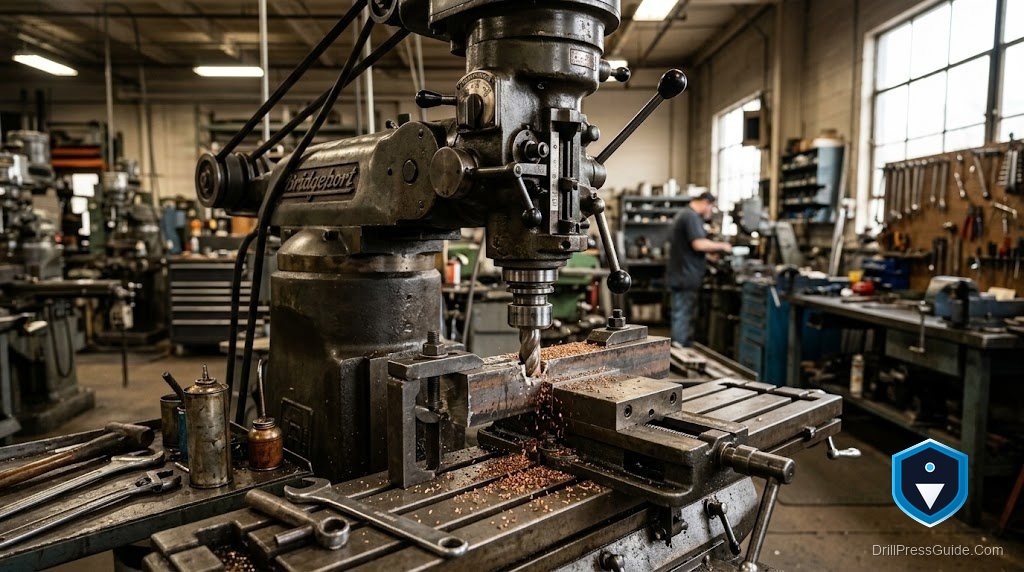
Search for a Bridgeport drill press and you run straight into a small myth. Bridgeport, the legendary name stamped on more machine-shop tools than almost any other, is famous for milling machines, not drill presses. So if you are hunting for one, the useful question is not “which Bridgeport drill press should I buy,” but “what am I actually trying to do, and what machine really does it?” Once you sort that out, the path gets clear fast, and you avoid chasing a machine that was never really built under that name.
Why there is no true Bridgeport drill press
Bridgeport built its reputation on the vertical knee mill, especially the J-head and the earlier M-head models. Those machines are milling machines with a quill, and here is where the confusion starts: a mill’s quill can absolutely drill. Put a drill chuck in a Bridgeport mill and it drills holes accurately, which is why generations of machinists have used their Bridgeport as a drill press when the job called for it. That practical overlap, plus the sheer number of Bridgeports in the world, is why people go looking for a “Bridgeport drill press” that the company never really sold as such.
What people usually mean
When someone types that phrase, they usually want one of three things:
- A Bridgeport mill used for drilling. If you own or want a Bridgeport J-head or M-head, it will drill beautifully. You just need the right tooling in the spindle.
- A round-column mill/drill. These are the import machines often shelved next to Bridgeports in people’s minds: a combination that mills and drills on a round column. They are a different class of tool with their own tradeoffs (the round column can lose alignment when raised).
- A heavy pedestal drill press with Bridgeport-level quality. If you just want to drill, and drill accurately, a good geared-head floor drill press is the honest answer, not a mill.
Drilling with a Bridgeport mill: the tooling that matters
If your plan is to drill with a Bridgeport, the spindle is almost always an R8 taper, and that decides your tooling. You will want an R8 drill chuck with arbor to hold twist drills, a set of R8 collets for end mills and precise tool holding, and a quality drill press or milling vise to hold work square to the spindle. A set of Forstner and twist bits rounds out general drilling. Confirm your spindle taper before ordering, since a few older or import machines differ from the standard R8.
Which machine actually fits your work
Here is the honest guidance. If you need to mill and drill and have the space, a used Bridgeport mill is one of the best tools a shop can own, and it will handle drilling as a bonus. If you only need to drill, do not buy a mill for it; a dedicated geared-head floor drill press gives you more travel, a bigger table, and simpler operation for that one job. And if a round-column mill/drill tempts you as a do-everything compromise, go in knowing its main flaw: raising the head on a round column can shift your alignment, so it asks for care that a true knee mill or a real drill press does not.
The verdict
There is no genuine “Bridgeport drill press,” and knowing that saves you from chasing a machine that does not exist. What exists is a Bridgeport milling machine that drills very well, a round-column mill/drill that compromises, and dedicated drill presses that do the drilling job better than any mill. Decide whether you truly need milling. If you do, a Bridgeport is a superb choice that drills as a side benefit; if you only need holes, buy a proper drill press and put the savings into good bits and a solid vise. Match the machine to the work, and the Bridgeport myth stops costing you time.
Takeaways:
- Bridgeport is known for milling machines, not drill presses; there is no true Bridgeport drill press.
- A Bridgeport mill drills accurately using its quill, which is why the name gets attached to drilling.
- If you only need to drill, a dedicated geared-head drill press beats using a mill.
- Bridgeport spindles are almost always R8, which determines your chuck and collet tooling.
FAQ
Did Bridgeport make a drill press? Not as a signature product. Bridgeport is famous for its vertical knee milling machines. People use those mills for drilling, which is why the phrase “Bridgeport drill press” persists.
Can I use a Bridgeport mill as a drill press? Yes. A drill chuck in the spindle lets a Bridgeport drill accurately, and machinists do this routinely.
What spindle taper does a Bridgeport use? Almost always R8, which determines your drill chuck, arbor, and collet choices. Confirm on older or import machines before buying tooling.
Should I buy a mill or a drill press if I only need to drill? Buy a dedicated drill press. A geared-head floor press gives more travel, a larger table, and simpler operation than using a mill for drilling.
What is a round-column mill/drill? A combination machine that mills and drills on a round column. Its main flaw is that raising the head can shift alignment, so it asks for extra care.
What is the difference between the M-head and J-head Bridgeport? They are two generations of Bridgeport’s vertical mill head. Both can drill; the J-head is the later, more common design.
Is a used Bridgeport mill worth it? If you need milling and have the space and power, yes. It is one of the most capable tools a small shop can own, and it drills as a bonus.
References
- Hardinge / Bridgeport, Series I knee mill documentation and history: https://www.hardinge.com/product/series-i-standard-mill/
- VintageMachinery.org, Bridgeport Machines Inc. manufacturer index: http://vintagemachinery.org/mfgindex/detail.aspx?id=1440
- Practical Machinist, Bridgeport spindle and tooling reference discussions: https://www.practicalmachinist.com/


