All Metal Tools Drill Press: Match the Bit, Speed, and Support to the Job
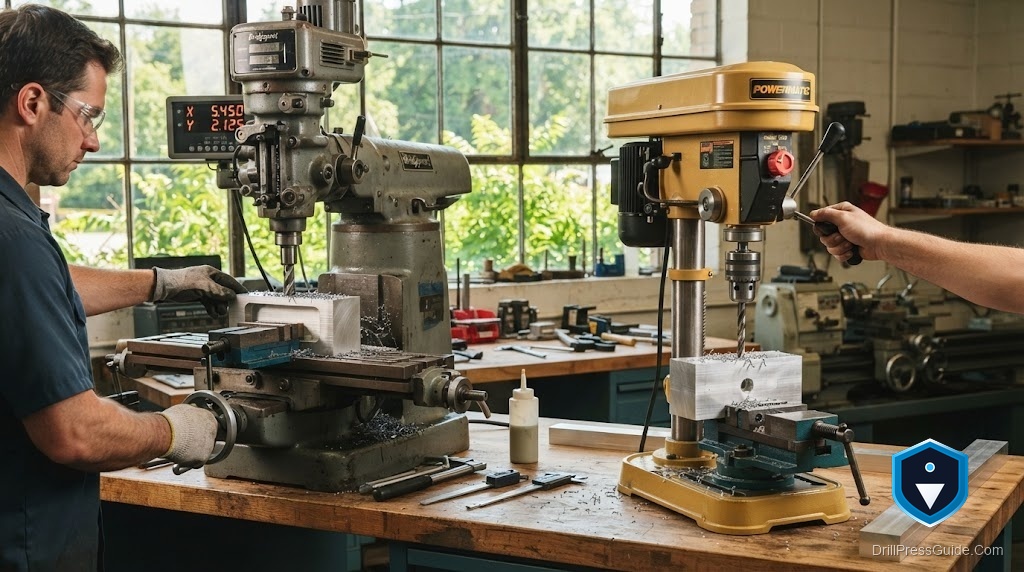
There is a moment every new metalworker hits: the drill press is running, the bit is sharp, and the hole still comes out wrong. Oversized, ragged, or walked off the mark. Nine times out of ten the machine is fine and the problem is a mismatch between the bit, the speed, and how the work was held. Get those three lined up and a modest press drills metal like it means it.
An all-metal drill press setup is really a system: a bit suited to the metal, a spindle speed set to that metal and bit size, and workholding rigid enough that nothing moves when the drill breaks through. Skip any one of the three and the other two cannot save the hole.
So the practical answer to drilling metal well is to treat those three choices together. Pick the right bit, set speed by surface feet per minute and diameter, and clamp the part in a vise. Do that and the machine itself matters far less than most people think.
Match the bit to the metal
Plain high-speed steel bits handle mild steel, aluminum, and brass all day. Once you hit stainless, hardened steel, or cast iron, HSS glazes and dulls fast, and cobalt earns its cost. A cobalt M35 twist drill set tolerates the heat of hard metal and keeps a working edge where standard bits give up. For thin sheet, a step bit leaves a cleaner hole than a twist bit, which tends to grab and triangulate.
Point angle matters too. A standard 118-degree point suits soft metals, while a 135-degree split point self-centers in hard steel and resists walking. If your bits walk off the mark, that is often the fix, along with a center punch to start the hole.
Match the speed to the bit and metal
Speed is set by surface speed and diameter, not by feel. Use RPM = (SFM x 3.82) / diameter in inches. Mild steel runs around 80 to 100 SFM, stainless drops to 20 to 40, aluminum and brass climb to 150 to 300. So a 1/4-inch bit in mild steel wants roughly 1400 RPM, the same bit in stainless closer to 600 RPM, and in aluminum it runs as fast as the machine allows.
The pattern to internalize: bigger bits and harder metals both mean lower RPM. When in doubt, slow down. A bit that is too slow just cuts leisurely; a bit that is too fast overheats and dies.
Match the support to the job
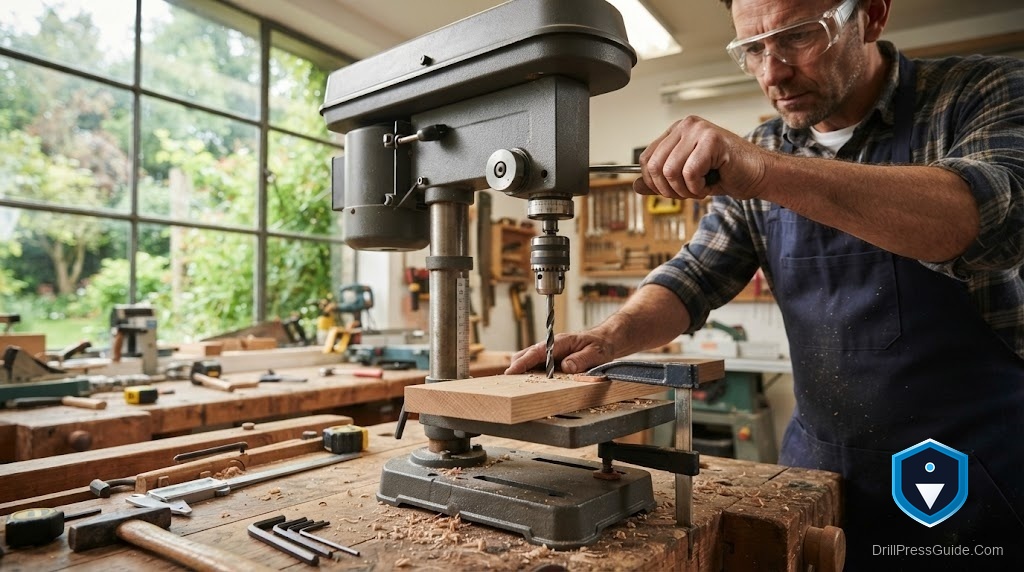
Metal grabs on breakthrough, and an unclamped part becomes a spinning hazard. Hold the work in a drill press vise, or clamp it to the table. This is a safety rule and an accuracy rule at once: a part that cannot move cannot wander, and it cannot hit you.
The machine needs support too. A rocking base or an out-of-square table shows up as an angled, oversized hole. Bolt a floor press down, and check the table is square to the spindle before precision work.
A machine that suits mixed metal work
Because metal speeds swing so widely, a variable-speed press is the friendliest choice. The WEN 4214T 12-inch variable-speed press lets you dial 600 RPM for stainless and spin up for aluminum without moving a belt, and the digital readout keeps you honest. It is a light machine, though, so heavy holes in thick plate call for a slow, patient feed. If you prefer a simple, sturdy five-speed, the SKIL 10-inch press has a strong induction motor and reaches down to 610 RPM, enough for most steel, though its lowest speed is a little high for the slowest stainless jobs.
Neither is a true production machine. For occasional and hobby metalwork they are plenty; for constant heavy drilling, step up to a heavier floor press.
Bringing the three together
Here is the whole method in one pass. Center-punch the mark. Chuck a cobalt bit with the right point for the metal. Set RPM from the material’s SFM and the bit size. Clamp the part in a vise. Add cutting fluid, feed steadily for a real chip, and back out to clear swarf on deeper holes. That sequence turns a wrong hole into a right one every time.
The verdict
Drilling metal well is not about owning an expensive press, it is about matching bit, speed, and support to the job. A cobalt bit, a speed set by SFM, and a clamped part will out-drill a pricier machine used carelessly. Line up the three and the results stop being luck.
Keep these in mind:
- Cobalt bits and the right point angle fix most walking and burning in hard metal.
- Bigger bit or harder metal means lower RPM, every time.
- Clamp the work; it is both the safety rule and the accuracy rule.
- Variable speed suits mixed metalwork because material speeds vary so much.
Frequently asked questions
What bit should I use to drill hard steel or stainless? Cobalt. It handles the heat far better than plain HSS, and a 135-degree split point keeps it from walking.
How do I set the right speed for metal? Use RPM = (SFM x 3.82) / diameter. Mild steel around 80 to 100 SFM, stainless 20 to 40, aluminum and brass 150 to 300.
Why does my bit walk off the mark? No center punch, a worn point, or too high a speed at the start. Punch the mark and use a split-point bit.
Do I really need to clamp small metal parts? Yes. Metal grabs on breakthrough and can spin. A vise keeps the part still and your hands safe.
Can a benchtop press drill metal properly? For light and occasional work, yes, if it is rigid and can slow down enough. Heavy, frequent drilling wants a floor machine.
What is the single most common mistake in drilling metal? Running too fast. Slowing down solves burned bits, oversized holes, and rough edges more often than any other change.
References
- Carbide Depot, HSS Twist Drill Recommended Speeds and Feeds: https://www.carbidedepot.com/formulas-drills-speeds.htm
- Norseman Drill and Tool, Feeds and Speeds for Drills: http://www.norsemandrill.com/feeds-speeds-drill.php