What Size Drill Press for Woodworking: Speed, Tooling, and Workholding Choices
The first drill press I regretted was the small one. It bored clean holes in scrap pine and felt like plenty, right up until I tried to center a hole on a 16-inch cabinet side and the column stopped me two inches short. That gap between what a machine does on a test block and what it does on your actual project is the whole question behind what size drill press for woodworking. Get it right and the tool disappears into the work. Get it wrong and you buy a second one inside a year.
Drill press size is quoted as swing: twice the distance from the center of the chuck to the front of the column. A 10-inch drill press reaches the center of a 10-inch-wide board. The second number that matters, and the one most beginners forget, is spindle travel: how far the quill drops in a single pull of the handle.
For most woodworking, a 10 to 12 inch benchtop with variable speed and at least 2 inches of spindle travel covers the large majority of jobs: dowels, shelf pins, Forstner work, drum sanding. Step up to a 15 to 17 inch floor model only if you regularly bore into the middle of wide panels, drill deep, or stand tall stock upright.
How drill press size is actually measured
Swing is the headline spec, and it is exactly twice the throat depth. Put a tape from the center of the chuck to the column, double it, and that is the size on the box. So the reach into a board is only ever half the swing number, which is why a 10-inch machine feels smaller than it sounds the first time you try to hit a panel’s centerline.
Two more numbers decide how a press feels in daily use. Chuck capacity is almost always 1/2 inch on woodworking machines, enough for the shank of nearly any bit you will buy. Spindle travel is the sleeper spec: 2 inches is workable, 3 inches or more lets you drill deep mortises or thick stock without flipping and re-registering the piece.
What woodworking actually asks of a drill press
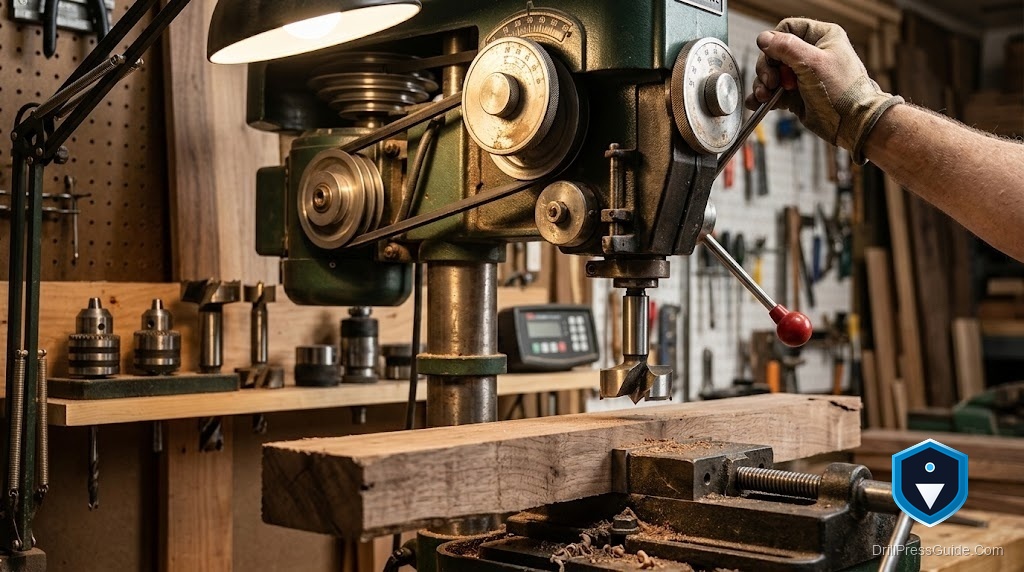
Woodworking leans on big-diameter, low-speed cutting far more than metalwork does. A 2-inch Forstner bit wants to turn slowly and steadily, and it loads the motor hard on the way through hardwood. That is a different demand than a machinist’s, and it is why speed range, not raw horsepower, is the spec that separates a pleasant wood machine from a frustrating one.
You also ask a wood press to wear a lot of hats: sanding drums, plug cutters, pocket jigs, the occasional metal bracket. A machine that changes speed easily and holds a table flat will do all of that. A one-speed machine will fight you on half of it.
Benchtop or floor: where the line really is
The honest dividing line is not power, it is reach and travel. A benchtop press bolted to a solid bench handles dowels, joinery, and Forstner holes in anything you can slide under it near an edge. The moment you need to reach the middle of a 24-inch panel, or drill a 4-inch-deep hole in one pass, a floor model earns its footprint.
Floor machines also give you taller headroom above the table, so a lamp finial or a tall leg fits standing up. The cost is real estate and weight. If your shop is a corner of a garage, that tradeoff cuts the other way fast.
The picks, matched to the work
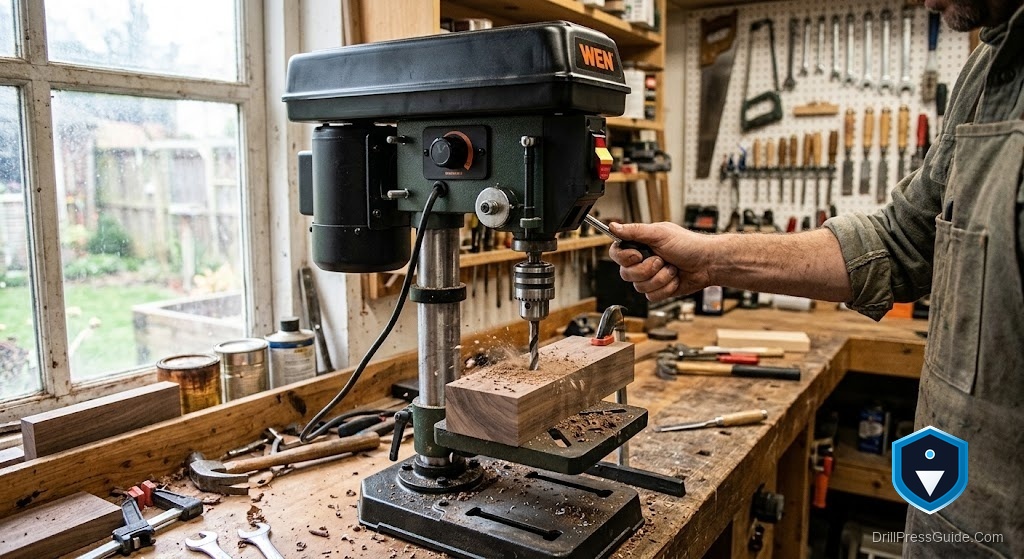
For a tight bench or a first machine, the WEN 4208T 8-inch, 5-speed benchtop is the smallest press I would still call useful. It has a cast iron head, a 1/2-inch keyed chuck, and five belt-change speeds from 740 to 3140 RPM. The honest drawbacks: an 8-inch swing reaches only 4 inches into a board, the worktable is a cramped 6.5 inches square, and you change speeds by moving a belt rather than turning a dial. Anyone drilling panels wider than a few inches from the edge should skip it.
The sweet spot for most shops is a 10 to 12 inch machine. The SKIL 10-inch 6.2-amp 5-speed press with laser keeps things simple with five belt speeds from 610 to 2800 RPM and a strong induction motor. Its ceiling of 2800 RPM is a touch low for tiny twist bits in softwood, where a hair more speed cleans up the exit. If you would rather dial speed than move a belt, the WEN 4214T 12-inch variable-speed press adds a speed lever, a digital readout, and more travel, which makes swapping between a Forstner bit and a brad point painless. Its laser tends to drift out of alignment and needs resetting now and then, so treat it as a rough aid, not a precision sight.
When reach and big bits are the point, the WEN 4227T 17-inch, 12-speed floor press gives you 4-3/4 inches of spindle travel, a 14-by-14 cast iron table, and speeds from 150 to 3150 RPM. It is heavy at 214 pounds, and its three-pulley belt changes are fiddlier than a single lever. A small shop that never drills large or deep does not need it.
| Machine | Swing | Speeds | Spindle travel | Best for |
|---|---|---|---|---|
| WEN 4208T | 8 in | 740 to 3140 RPM (5) | 2 in | First press, small parts |
| SKIL 10-inch | 10 in | 610 to 2800 RPM (5) | ~2.4 in | Simple, sturdy all-rounder |
| WEN 4214T | 12 in | 530 to 3100 RPM (variable) | ~3.1 in | The do-everything wood press |
| WEN 4227T | 17 in | 150 to 3150 RPM (12) | 4.75 in | Big bits, deep holes, panels |
Speed range: the spec that quietly decides everything
Wood cutting spans a huge speed spread. A 2-inch Forstner bit wants roughly 250 to 500 RPM or it scorches and chatters, while a 1/8-inch twist bit is happy near 3000 RPM. Fine Woodworking’s drill press speed chart puts small twist bits around 3000 RPM and large Forstner bits far slower, which tells you the same thing your ears will: a press that only lives at one speed will burn holes at one end of your bit collection and tear out at the other.
That is the real argument for variable speed on a wood machine. It is not a luxury feature, it is what lets a single press serve both a shelf-pin jig and a 2-inch bit for a candle cup.
Table and workholding
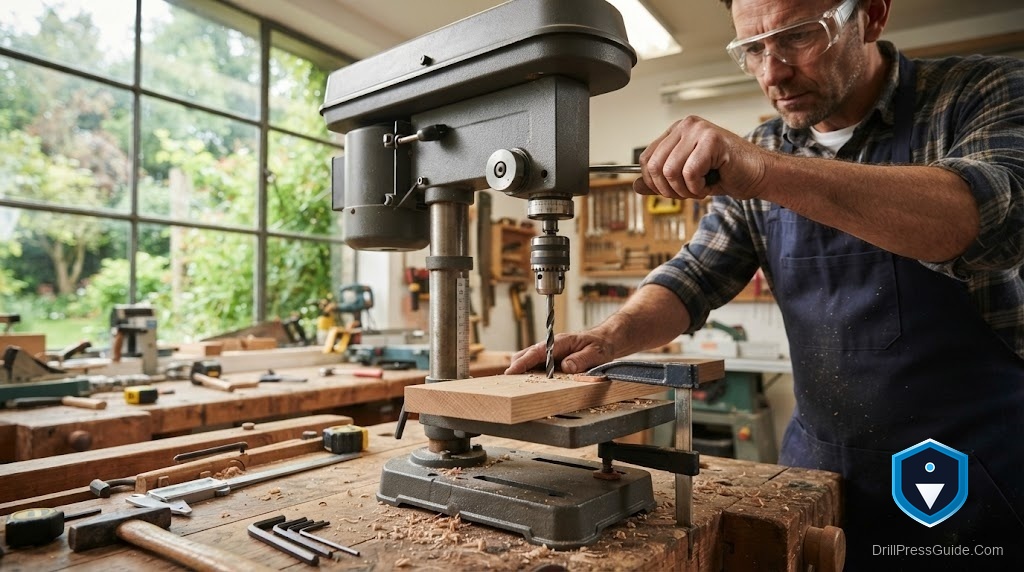
The cast iron table that ships with most presses is small and has a large center relief hole, and the ribs underneath make clamping awkward. That is why an auxiliary wooden table with a fence and a stop is the first upgrade almost everyone makes. Clamp the work, do not pinch it in your fingers: a bit that grabs will spin a small part into a propeller, and secure clamping is the single habit that keeps hands away from the point of operation.
The verdict
For a one-machine woodworking shop, a 12-inch variable-speed benchtop is the size that regrets the least. It reaches the center of most cabinet parts, turns slowly enough for big Forstner bits, and spins fast enough for small twist work, all without eating floor space.
A few things to hold onto:
- Buy for reach and spindle travel first, then speed range, then everything else.
- Variable speed matters more in wood than horsepower, because your bit sizes swing so wide.
- Plan on an auxiliary table and fence as a first-week upgrade, whatever machine you choose.
- Only go floor-standing if you truly drill big, deep, or into wide panels.
Frequently asked questions
What size drill press do I need for an 80 percent lower? You want at least a 12-inch machine with a solid, flat table and enough travel to clear the jig. The holes are in aluminum, so run slower speeds and clamp the jig hard; a wobbly small press makes that job miserable.
Is an 8-inch drill press big enough for woodworking? For small parts, dowels, and edge-of-board work, yes. For anything where the hole lands more than 4 inches from an edge, an 8-inch swing runs out of reach.
How much spindle travel do I actually need? Two inches covers most joinery. If you drill deep mortises, thick slabs, or use long Forstner bits, look for 3 inches or more so you are not drilling in two bites.
What speed should I run for woodworking? Match it to bit diameter: small twist bits near 3000 RPM, mid brad points around 1500 to 2000 RPM, and large Forstner bits down near 250 to 500 RPM.
Benchtop or floor model for a home shop? Benchtop for most people. Choose floor only if reach into panels, deep travel, or tall workpieces are a regular part of what you build.
How do I measure the size of a used drill press? Measure from the center of the chuck to the front of the column and double it. That doubled number is the swing, which is how size is quoted.
References
- Fine Woodworking, Drill Press Speed Chart: https://images.finewoodworking.com/app/uploads/2020/01/22111726/drill-bit-speed-chart.pdf
- WOOD Magazine, Wise Buys: Drill-Press Tables: https://www.woodmagazine.com/woodworking-tools/reviews/drill/drill-press-tables
- Norseman Drill and Tool, Feeds and Speeds for Drills: http://www.norsemandrill.com/feeds-speeds-drill.php