
The Buffalo No. 18 Drill Press: What That Tall Column Is Really Worth
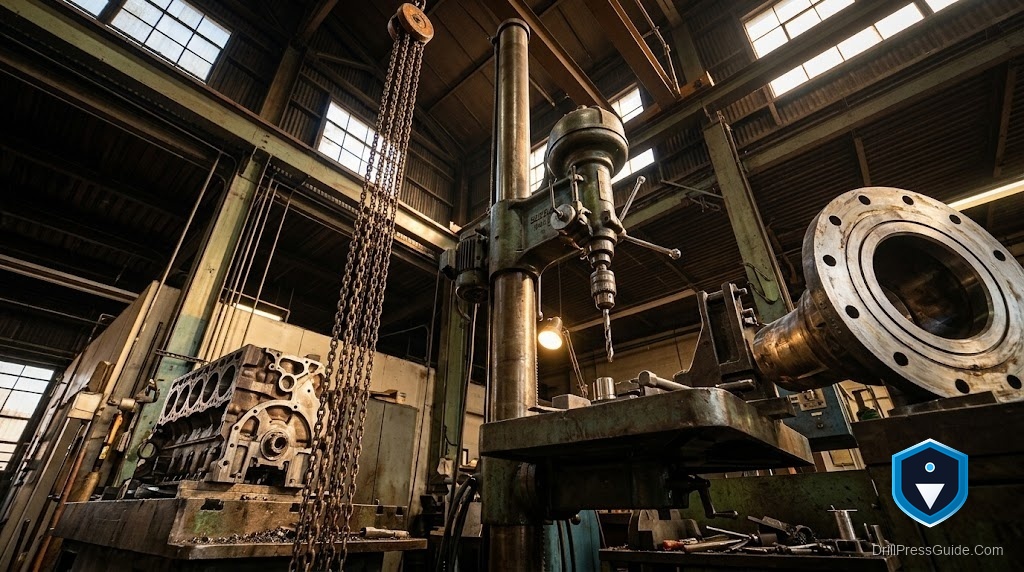
You find it in the back of a shop or in an estate listing: a floor-standing drill press about six and a half feet tall, standing on a slim round column, with “Buffalo” cast into the head. That is almost certainly a Buffalo No. 18, and it is one of those vintage American machines that instantly sorts the people who know old iron from the people who are about to walk past a gem or take home a problem. Here is what you are actually looking at, and how to buy one without regret.
What the Buffalo No. 18 is
The Buffalo Forge Company of Buffalo, New York, built blowers, forges, and a line of drilling machines from the late 1800s into the middle of the twentieth century. The No. 18 is one of its floor-standing, back-geared drill presses. Typical examples stand around 78 inches tall on a column close to 3.9 inches in diameter, run a 3/4 HP motor, and use a Morse taper spindle with back gearing for slow, high-torque drilling in steel. This is a metalworking machine first and foremost, built in an era when a drill press was expected to run hard for fifty years.
Back gearing is the detail worth understanding. A lever on the head engages a second set of gears that drops the spindle speed way down while multiplying torque, which is exactly what you want when pushing a large bit through thick steel. Most light modern presses cannot do this, and it is a big part of why people hunt these machines down.
How to identify one
Look for the Buffalo Forge Co. name cast into the head or base, the tall slim column, and the back-gear lever. Serial and casting details can be matched against the catalog scans and photo index on VintageMachinery.org, which is the first place to confirm you have a genuine No. 18 rather than a different Buffalo model or a look-alike.
What to check before buying
This is a used machine, often a very old one, so inspect it like a mechanic:
- Spindle and quill. Turn the spindle by hand for smoothness, and check the quill for side play that points at worn bearings.
- Back gears. Engage and disengage the back gear. It should shift cleanly, and the gear teeth should be intact.
- Runout. A little chuck runout is usually a tired chuck; a lot can mean a bent spindle.
- Castings. Hunt for cracks, especially around the head and table. Cracked iron is the one fault you cannot easily fix.
- Motor and power. Many shop examples are wired three-phase, which needs a phase converter or a motor swap for a home shop. Factor that in honestly before you commit.
Parts, chucks, and tooling
Because the machine uses a standard Morse taper and generic consumables, keeping it running is easier than its age suggests. A quality keyed drill chuck with the matching Morse taper arbor restores accuracy, a fresh drill press V-belt smooths the drive, and a spare drill press chuck key replaces the one that always disappears. Add a solid drill press vise for safe metal work. Confirm the exact spindle taper before ordering an arbor, and lean on the vintage-machine community for back-gear and spindle spares.
The verdict
A Buffalo No. 18 drill press is worth owning when you find a complete example with sound castings, working back gears, and a motor you can actually power in your shop. Its back gearing and heavy iron give it slow-speed torque and rigidity that light modern presses cannot match, which makes it a genuine metalworking machine rather than a hobby tool. Inspect the spindle, quill, gears, and castings, sort out the motor and power situation before you buy, and walk away from cracked iron. Do that, and you get a machine that has already run for most of a century and is ready to run for the rest of yours.
Takeaways:
- The Buffalo No. 18 is a tall, floor-standing, back-geared drill press from Buffalo Forge Co. of Buffalo, New York.
- Back gearing gives it slow-speed torque for heavy steel that light presses lack.
- Check spindle, quill, back gears, and castings, and confirm you can power the motor (many are three-phase).
- Standard tapers and generic consumables make it practical to keep running.
FAQ
What is a Buffalo No. 18 drill press? It is a floor-standing, back-geared metalworking drill press built by the Buffalo Forge Company of Buffalo, New York, standing roughly 78 inches tall on a column about 3.9 inches in diameter with a 3/4 HP motor.
What does back gearing do? It engages a second gear set that lowers spindle speed while multiplying torque, which is ideal for driving large bits through thick steel.
How do I confirm mine is a genuine No. 18? Check for Buffalo Forge Co. casting marks and match the serial and casting details against the catalog scans and photo index on VintageMachinery.org.
What spindle taper does it use? A Morse taper. Confirm the exact size by removing the existing chuck and reading the arbor before buying a replacement.
What is the biggest gotcha when buying one? Power. Many shop examples are wired three-phase and need a phase converter or a motor swap to run in a single-phase home shop.
Can I still get parts? Wear items such as belts, chucks, and keys are generic. Back-gear and spindle parts come from the vintage-machine community and salvage.
Is it worth restoring? If the castings are sound and the back gears work, yes. A restored No. 18 offers torque and rigidity that new light presses cannot match.
References
- VintageMachinery.org, Buffalo Forge Co. manufacturer index and publication reprints: http://vintagemachinery.org/mfgindex/detail.aspx?id=170
- OWWM.org, Old Woodworking Machines and metalworking forums, Buffalo Forge drilling machines: https://owwm.org/
- Buffalo Forge Company history and product background, VintageMachinery archives: http://vintagemachinery.org/pubs/


