A Practical Guide to Milling Metal with a Drill Press
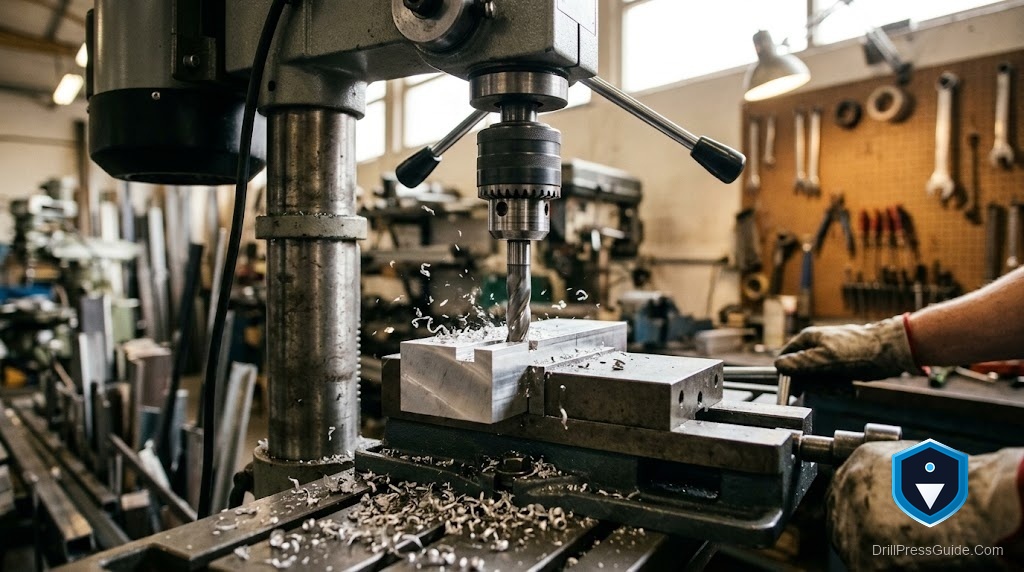
This is one of the most common workshop questions, and it deserves a straight answer rather than a flat no or a false yes. Can a drill press mill metal? It can take very light cuts in soft metal under tight conditions, and it cannot do real milling. Understanding exactly where that line sits saves you a damaged machine, a dangerous grab, and the money you might waste trying to make a drill press into something it is not.
Quick answer: a drill press can lightly true or clean a soft-metal surface with a cross-slide vise and tiny passes, but it cannot mill in any real sense, because the quill and chuck are built for downward thrust and not the side loads milling creates. For anything beyond light finishing, a mill is the correct tool.
The one fact that governs everything
Milling pushes the cutter sideways into the work. A drill press quill is supported to resist downward force, not sideways force. That single mismatch is behind every limitation and every warning in this guide. When you push a cutter sideways, the quill deflects, accuracy drops, and a taper-mounted chuck can work loose. No accessory changes that basic design; it only manages around it.
What light work is possible
Within the limits, people true a slightly high surface, clean up a rough edge, or take a whisper cut on soft metal like aluminum. This works because a tiny pass in soft metal creates little side force. It is finishing, measured in thousandths, not shaping or stock removal. Treated that way, with the right holding, it can be useful for small corrections. Treated as milling, it fails and becomes dangerous.
The conditions that keep it safe
If you work in that narrow band, the conditions are strict:
- A cross-slide vise to control movement with handwheels, never freehand.
- Passes of only a few thousandths, keeping the cutter cutting rather than rubbing.
- Soft metals like aluminum, where side force is lowest.
- Constant attention to the chuck, stopping the moment it shifts.
Miss any of these and the side load quickly overwhelms what the machine can take.
Why steel is worse than aluminum
Steel needs much more cutting force than aluminum, so even a light pass loads the quill and chuck harder. That is why milling steel on a drill press is riskier than aluminum and why most cautious advice limits any attempt to soft metals. Harder steel raises the force further. The tougher the metal, the more the machine’s side-load weakness bites, which is the opposite of what milling that material would need.
What to use instead
For real milling of metal, a milling machine is the right tool, and even a compact benchtop mill is built to take side loads safely and hold an accurate cut. If your need is occasional and light, the drill press covers small corrections. If it is real material removal, slots, or pockets, spending on a mill is cheaper than damaging a drill press and far safer than pushing it past its design.
The verdict
Milling metal with a drill press is a narrow exception, not a capability:
- The quill and chuck take downward thrust, not the side loads milling requires.
- Light truing of soft metal with a cross-slide vise and tiny passes is the limit.
- For real milling, use a mill, because it is built for side loads and stays accurate.
Who should stop at drilling? Most people. Keep the drill press for holes and light corrections, and reach for a mill when the job is actual milling.
Frequently asked questions
Can a drill press mill metal at all? Only very lightly in soft metal, as finishing measured in thousandths. It cannot do real milling because the spindle resists side loads poorly.
Why is side load the problem? Milling pushes the cutter sideways, but the drill press quill is supported for downward thrust. Side force deflects it and can loosen the chuck.
Is steel or aluminum safer to attempt? Aluminum, because it cuts with far less force. Steel loads the machine harder even on a light pass, so it is riskier.
What accessory is required for any attempt? A cross-slide vise, so movement is controlled by handwheels. Freehand milling grabs the cutter and is unsafe.
Will this damage my drill press? Heavy or repeated side loads can wear the quill and loosen the chuck mount. Light passes reduce but do not remove that risk.
What is the right tool for real milling? A milling machine, even a small benchtop model, which is built to take side loads and hold an accurate, clean cut.
References
- CCOHS, Metalworking Machines - Drill Presses: https://www.ccohs.ca/oshanswers/safety_haz/metalworking/drillpresses.html
- Delta 17-900 Instruction Manual: https://powertool.manualsonline.com/manuals/mfg/delta/17900.html
- Pro Tool Reviews, How to Use a Drill Press: https://www.protoolreviews.com/how-to-use-drill-press/