Turning Wood on a Drill Press: Speed, Tooling, and Workholding Choices
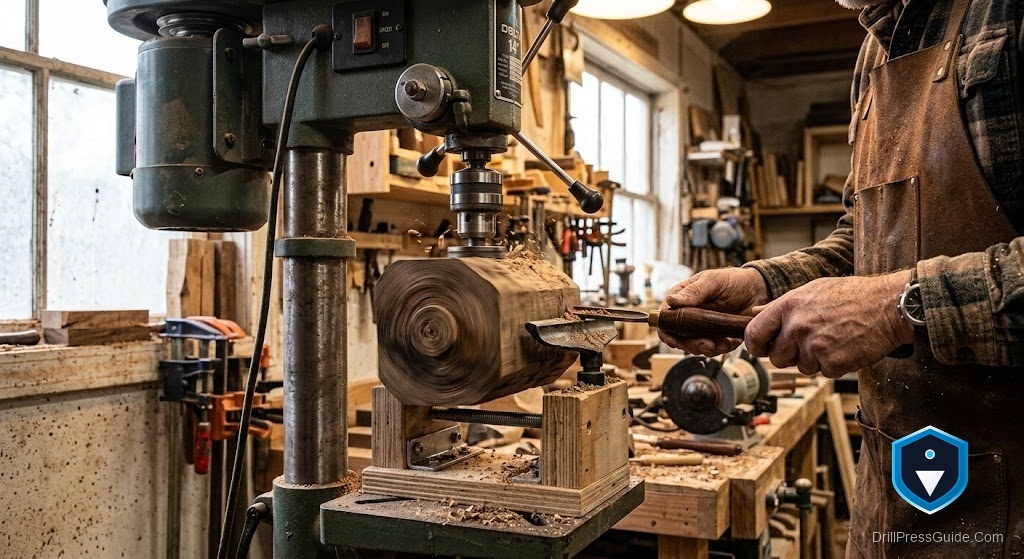
A drill press spins a chuck, so it is natural to wonder whether you can turn a small wooden piece on it like a lathe. The honest answer is that you can do a narrow slice of what a lathe does, and only with the grain oriented one way and the tool held one way. It is worth understanding what actually works, because the wrong approach loads the machine sideways and can throw the work.
Quick answer: you can shape and sand small wooden pieces mounted in the chuck by holding sandpaper or a file against them as they spin, and you can round the end of a dowel or a pen blank this way. You cannot safely turn wood with a lathe gouge on a drill press, because the side force and the way the work is held do not support it.
What the drill press can honestly do
Mount a short wood blank in the chuck and spin it, and you can smooth, round, or taper it with abrasives or a file held against the surface. This is sanding and light shaping, and it works because the tool is not digging in; it is riding the surface. People finish pen blanks, round dowel ends, and sand small turned shapes this way. Within that narrow scope, a drill press is genuinely useful for wood shaping.
Why a gouge is a different story
Real woodturning cuts with a gouge that digs into the spinning wood, and that cut pushes sideways hard. A drill press quill is supported for downward thrust, not side load, and the chuck may seat on a taper that relies on downward force to stay put. Bring a gouge into wood spinning in a drill press and it can grab, deflect the quill, and pull the chuck loose. The motion looks like turning, but the machine is not built to resist the forces turning creates.
Speed for shaping
For sanding and light shaping, run a moderate speed, roughly 1000 to 2000 RPM for a small blank. Fast enough to abrade smoothly, slow enough to stay controlled. If the piece is out of balance or vibrates, slow down. The speed is not the risky part here; the risky part is any attempt to use a cutting tool that digs in rather than an abrasive that rides the surface.
Holding the work safely
The work goes in the chuck, so tighten it well and keep the piece short so it does not whip. There is no tailstock to support a free end, which is another reason long pieces are unsafe; anything sticking far out will flex and vibrate. Keep hands and abrasive below and to the side, never wrapped around the spinning piece where a grab could pull them in. Short, balanced, well-chucked blanks are the safe envelope.
The verdict
Turning wood on a drill press is really sanding and light shaping, not lathe work:
- Use abrasives or a file to smooth, round, and taper short blanks in the chuck.
- Do not use a lathe gouge or any tool that digs in, because the side load can throw the work.
- Run moderate speeds, keep blanks short and balanced, and chuck them tightly.
Who should get a lathe? Anyone wanting to actually turn bowls, spindles, or pens with cutting tools. For rounding and sanding small pieces, the drill press covers it within the limits above.
Frequently asked questions
Can I turn a bowl or spindle on a drill press? No. Real turning uses cutting tools that push sideways, and the drill press quill and chuck are not built for that force. Use a lathe.
What can I safely do to wood in the chuck? Sand, round, and taper short blanks with abrasives or a file held against the surface. That is shaping, not cutting.
Why is a gouge dangerous here? It digs in and pushes sideways, which can deflect the quill and loosen a taper-mounted chuck, throwing the work.
What speed for sanding a blank? Roughly 1000 to 2000 RPM for a small piece. Slow down if it vibrates or feels out of balance.
Do I need a tailstock? A drill press has none, which is why only short pieces are safe. Long work with an unsupported end will whip and flex.
Can I use a drum sander in the chuck? Yes, a sanding drum is a good drill press accessory for shaping edges, and it rides the surface rather than digging in, which suits the machine.
References
- OSHA Woodworking eTool, Drill Press: https://www.osha.gov/etools/woodworking/production/machines-tools/drill-press
- Delta 17-900 Instruction Manual: https://powertool.manualsonline.com/manuals/mfg/delta/17900.html
- Pro Tool Reviews, How to Use a Drill Press: https://www.protoolreviews.com/how-to-use-drill-press/