Using a Benchtop Drill Press for Metal Without Sacrificing Finish or Accuracy
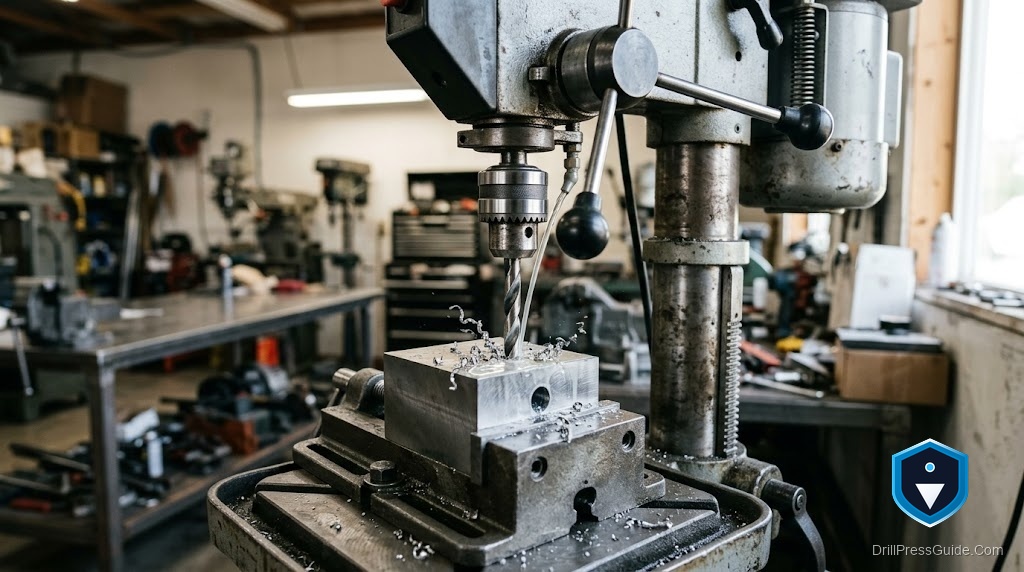
A benchtop drill press can drill metal well, despite what you sometimes hear. The limits people run into are real, but most of them come from setup and technique rather than the machine itself. A benchtop unit will not hog out huge holes in thick steel all day, and that is fine, because most home and small-shop metal work is well within its range. The key is working with the machine’s strengths instead of asking it to behave like a floor model.
Quick answer: a benchtop press handles metal cleanly if it has variable or low speeds, if you keep holes to a sensible diameter, and if you back it up with center punching, cutting fluid, and solid clamping. Push it into oversized holes in thick steel and finish suffers; stay in its range and it is accurate.
Speed is the make-or-break feature
Metal needs low speeds, and that is where cheaper benchtop presses fall short. A machine that only offers high belt steps will burn bits on anything past small holes in mild steel. A variable-speed benchtop press solves this because you can dial the spindle down for larger bits and for stainless. A machine like the WEN 4214T 12-inch variable-speed benchtop drill press reaches the low speeds steel needs while keeping the compact footprint, which is exactly the combination metal work wants from a benchtop unit.
Know the machine’s honest range
A benchtop press is happiest with small to medium holes in mild steel, aluminum, and light stainless. It can do larger holes if you pilot them and take your time, but a light machine will bog and chatter if you ask for a big bit in thick steel in one pass. Accepting that range is not a compromise; it is how you get clean holes. Work inside it and the finish stays crisp.
Technique protects the finish
The habits that keep holes clean are the same ones a floor machine needs, and they matter more on a lighter press. Center punch so the bit starts true. Use cutting fluid to keep the edge cool and flush chips. Feed steadily to make chips rather than powder. Peck deeper holes to clear the flutes. On a benchtop machine these habits do double duty, because they also reduce the load that would otherwise make a light press chatter.
Rigidity you can add
You can help a benchtop press stay accurate. Bolt it to a solid bench so it cannot rock. Keep the belt tension correct so the spindle does not slip under load. Check and minimize table sag by supporting long work. Use a drill press vise to hold metal instead of hand pressure. None of these change the machine, but together they remove the small movements that blur a hole’s finish.
Clamp every time
Metal grabs at breakthrough, and a benchtop press does not have the mass to shrug off a spinning part. Clamp the work in a vise or to the table on every metal hole. This is both a safety rule and an accuracy rule, because a part that shifts even slightly at breakthrough leaves a torn, out-of-round hole.
The verdict
A benchtop press drills metal accurately when you play to its strengths:
- Choose variable or low speeds, because metal lives or dies on RPM.
- Stay within a sensible hole size for a light machine and pilot the larger ones.
- Back it with center punching, fluid, pecking, and a solid clamp.
Who outgrows a benchtop press? Anyone routinely drilling large holes in thick steel. For typical metal work, a good variable-speed benchtop machine holds accuracy just fine.
Frequently asked questions
Can a benchtop press really drill steel? Yes, within a sensible size range and at low speed with fluid. Small and medium holes in mild steel and light stainless are well within reach.
What is the most important feature for metal? A low or variable speed range. Metal needs slow RPM, and a press stuck on high speeds will burn bits on anything but tiny holes.
How large a hole can a benchtop press handle in steel? It varies by machine, but pilot larger holes and take your time. If it bogs or chatters, the bit is too big for one pass on that press.
Do I need to bolt it down? Bolting or clamping the press to the bench improves accuracy and safety by stopping it from rocking under load. It is a worthwhile step.
Why does my benchtop press chatter on metal? Usually too high a speed, too large a bit, a loose belt, or an unclamped part. Slow down, pilot the hole, tension the belt, and clamp the work.
Is variable speed worth it over stepped belts? For metal, variable speed is very convenient because you can fine-tune RPM to the bit and material without re-routing a belt.
References
- CCOHS, Metalworking Machines - Drill Presses: https://www.ccohs.ca/oshanswers/safety_haz/metalworking/drillpresses.html
- WEN Drill Press FAQs: https://wenproducts.com/pages/drill-press-faqs
- Dynabrade HSS Drill Speed Recommendation Chart: https://www.dynabrade.com/pdf/lit/D1201_Singles/D12.01_pg134.pdf