
Drilling Straight Holes in Wood Without Drill Press: Match the Bit, Speed, and Support to the Job
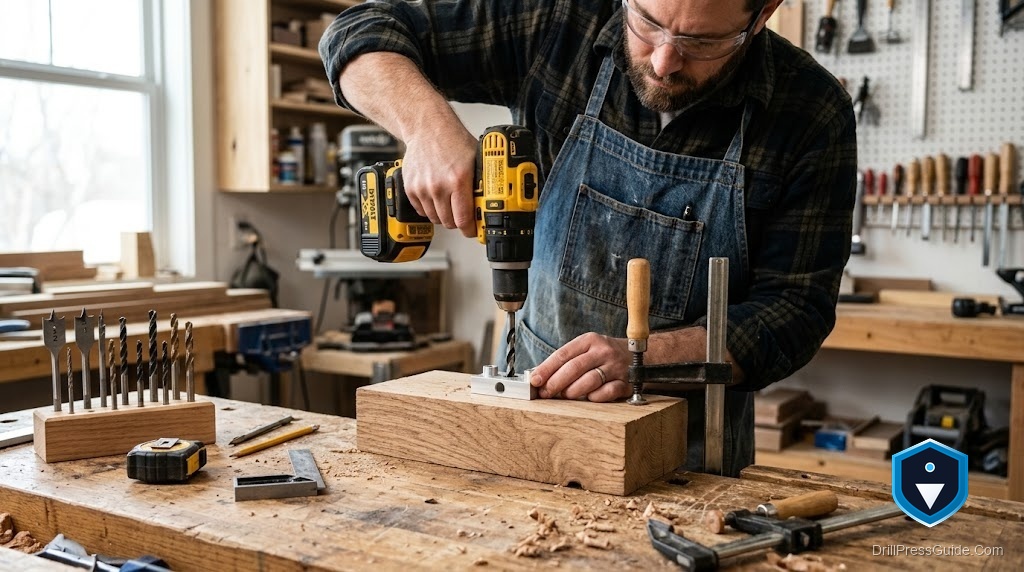
A drill press guarantees a square hole because the machine holds the bit vertical for you. Without one, that job moves to your hands and eyes, and small errors add up over the depth of the hole. The good news is that a straight hole by hand is mostly a matter of setup, not talent. Match the right bit, a controllable speed, and some physical support, and you can hit vertical closely enough for shelf pins, dowels, and hardware.
Quick answer: use a brad-point bit so it starts on your mark, run a moderate speed you can control, and give the drill a physical reference to follow, whether that is a guide block, a jig, or a simple square stood next to the bit. Support beats freehand skill every time.
The bit does half the work
A brad-point bit has a center spur that bites first, so the hole starts exactly where you punched it instead of wandering. That single feature removes the most common cause of a crooked hole, which is a bit skating at the start. For larger flat-bottomed holes, a Forstner bit tracks well too, but it needs a slow speed and a steady hand because it has no spur to self-center as aggressively.
Give the drill something to follow
Your eyes cannot judge vertical well from a single angle. The fixes are physical:
- A drill guide that rides on the surface and holds the bit square is the closest thing to a press. A tool like the Milescraft DrillMate handheld drill guide clamps the drill and rides on a base, keeping the bit vertical and setting depth without a machine.
- A simple wooden guide block with a pre-drilled square hole works for a single size.
- Two combination squares set at right angles on the work give you sightlines to keep the drill plumb.
Speed you can control
Without a press to hold the tool, control matters more than raw speed. Run a moderate speed you can start and stop cleanly. Too fast and the bit grabs and pulls off line before you react. For small bits, a middle trigger setting is fine. For larger bits and Forstners, go slow so the bit cuts steadily and you have time to correct.
Support the work and the exit
Clamp the workpiece so it cannot shift while you concentrate on the drill. Put a backer board underneath so the bit exits into wood instead of blowing out the back face. If the hole must be a set depth, wrap tape around the bit as a depth mark or use the collar on a guide. A clamped workpiece lets you use both hands on the drill, which is most of the battle for a straight hole.
The verdict
Straight holes without a press come down to removing guesswork with setup:
- Start with a brad-point bit so the hole begins on your mark.
- Give the drill a physical guide to follow instead of trusting your eye.
- Clamp the work, back up the exit, and run a speed you can control.
Who should still get a press? Anyone drilling long runs of holes that must all match. For occasional straight holes, a guide and good setup will get you there.
Frequently asked questions
How straight can I really get by hand? With a guide block or drill guide, close enough for dowels, shelf pins, and hardware. Truly deep or precision holes still favor a press.
What is the single biggest cause of crooked holes? The bit wandering at the start. A center punch mark and a brad-point bit fix most of it before you even begin.
Can I use a speed square to stay vertical? Yes. Stand it next to the bit and line the drill up to it from two directions. It is a free, effective sightline.
Do I need a special bit for deep straight holes? A brad-point helps, and an auger or a bit extension keeps long holes tracking, but depth magnifies any starting error. Guides matter more as holes get deeper.
How do I set depth without a press stop? Wrap tape around the bit at the target depth, or use the adjustable collar on a drill guide. Stop when the mark reaches the surface.
Is a drill guide worth it over a shop-made block? A block is fine for one hole size. A guide handles many sizes, sets depth, and holds the drill square, so it earns its place if you drill often.
References
- OSHA Woodworking eTool, Drill Press: https://www.osha.gov/etools/woodworking/production/machines-tools/drill-press
- Pro Tool Reviews, How to Use a Drill Press: https://www.protoolreviews.com/how-to-use-drill-press/
- WEN Drill Press FAQs: https://wenproducts.com/pages/drill-press-faqs


