
What Is a Drill Press Used for in Woodworking? A Practical Shop Explanation
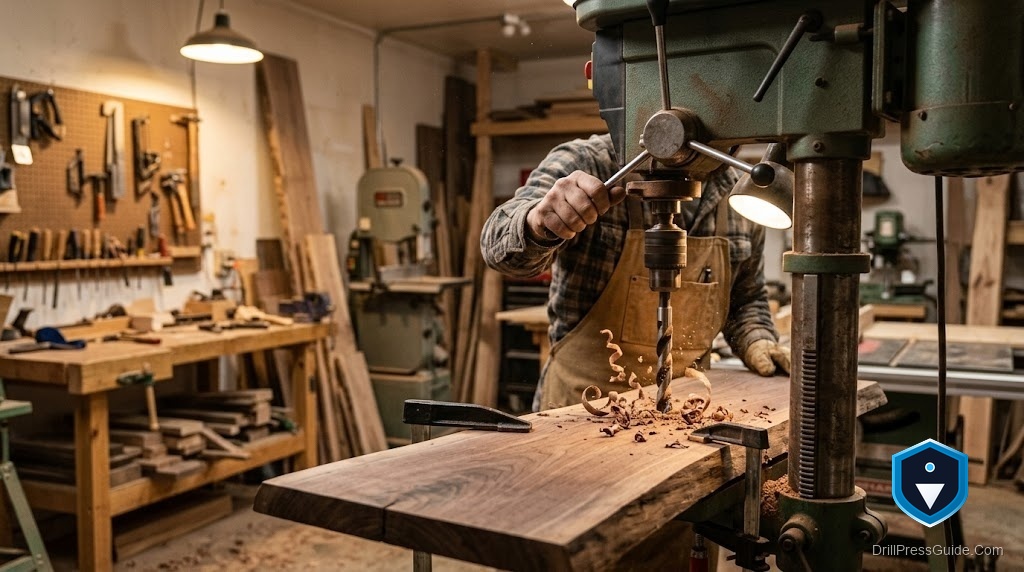
Many woodworkers get a drill press and then use it for one thing, drilling a straight hole, without realizing how much of their joinery, hardware, and even shaping it could handle. In a wood shop the machine is quietly one of the most versatile tools on the bench, because so much of woodworking comes down to putting an accurate hole in the right place. Here is a practical rundown of what a drill press is actually used for in woodworking, from the obvious jobs to the ones people miss.
In woodworking a drill press is used to drill perfectly square, consistent, and repeatable holes for joinery (dowels, shelf pins), hardware (hinges, handles, knobs), and stopped or flat-bottomed holes with Forstner bits, plus large holes with hole saws and, with attachments, sanding curved edges and cutting mortises. Its value is accuracy and repeatability a handheld drill cannot match.
The everyday woodworking jobs
Most of the work falls into a few familiar categories:
Joinery holes. Dowel holes and shelf-pin holes that must be square and evenly spaced, which the press delivers with a fence and depth stop.
Hardware holes. Pilot holes and mortises for hinges, handles, knobs, and fasteners, placed exactly on the layout.
Flat-bottomed holes. Forstner bits cut clean, flat-bottomed holes for hinge cups, inlays, and stopped holes that do not go all the way through.
Large holes. Hole saws and big Forstner bits bore openings for dust ports, clocks, and hardware.
All of them rely on the machine’s square, repeatable action, described in setup guides like Pro Tool Reviews.
The uses people miss
Beyond drilling, a drill press does more in a wood shop than most owners try. Fit a sanding drum and it becomes a spindle sander for smoothing curved edges and cleaning up bandsaw cuts. Add a hollow-chisel mortising attachment and it cuts the square mortises for mortise-and-tenon joinery. Use a stop block on the fence and it drills rows of identical holes, for shelf pins or a line of dowels, without measuring each one. These are the jobs that turn the press from a hole-driller into a genuine shop workhorse.
What a drill press is used for at a glance
| Woodworking job | Tooling | What it delivers |
|---|---|---|
| Dowel and shelf-pin holes | Brad-point bit | Square, evenly spaced holes |
| Hinge and hardware mortises | Forstner bit | Clean, flat-bottomed holes |
| Large openings | Hole saw, large Forstner | Dust ports, clock holes |
| Repeat holes | Bit plus fence stop | Identical spacing every time |
| Smoothing curves | Sanding drum | Spindle-sander action |
| Mortise-and-tenon joints | Mortising attachment | Square mortises |
The verdict
In woodworking a drill press is used for far more than a straight hole: square joinery holes, clean hardware mortises, flat-bottomed Forstner holes, large hole-saw openings, and, with attachments, sanding curves and cutting mortises. Three takeaways: its core value is square, repeatable holes a handheld drill cannot match; a fence and depth stop turn it into a repeat-hole machine for joinery; and sanding and mortising attachments make it a true shop workhorse. Who benefits most? Anyone building furniture or cabinets, where accurate, repeatable holes are constant work.
Frequently asked questions
What is a drill press used for in woodworking? Drilling square, consistent, repeatable holes for joinery like dowels and shelf pins, hardware like hinges and handles, and flat-bottomed holes with Forstner bits, plus large holes with hole saws and, with attachments, sanding curves and cutting mortises.
Why use a drill press instead of a handheld drill for wood? Because it drills perfectly perpendicular, consistent, and repeatable holes that a handheld drill cannot match. A fence and depth stop let you place and repeat holes exactly, which matters for joinery, shelf pins, and hardware.
What bits are used most in woodworking on a drill press? Brad-point bits for clean, located holes, Forstner bits for flat-bottomed and hardware holes, and spade or hole-saw bits for large openings. Brad-point and Forstner bits give the cleanest results for visible work.
Can a drill press cut mortises for joinery? Yes, with a hollow-chisel mortising attachment. It combines a drill bit inside a square chisel to cut the clean, square mortises used in mortise-and-tenon joints, one of the machine’s most useful woodworking add-ons.
Can I sand on a woodworking drill press? Yes. A sanding drum mounts in the chuck and turns the press into a spindle sander for smoothing curved edges and cleaning up bandsaw cuts. Use a table opening or scrap so the drum can pass below the workpiece.
How do I drill evenly spaced holes for shelf pins? Use a fence with a stop block, or a spacing jig, so each hole indexes off the last. Set the depth stop for consistent depth, and every hole lands at the same spacing and depth without measuring each one.
Does a drill press replace a handheld drill in woodworking? No, they complement each other. The press handles accurate, repeatable, and large holes at the bench, while a handheld drill drives screws and drills where the work cannot come to the machine. Most shops use both.
References
- Pro Tool Reviews, How to Use and Set Up a Drill Press. https://www.protoolreviews.com/how-to-use-drill-press/
- OSHA, Woodworking eTool: Drill Press. https://www.osha.gov/etools/woodworking/production/machines-tools/drill-press
- CCOHS, Metalworking Machines: Drill Presses. https://www.ccohs.ca/oshanswers/safety_haz/metalworking/drillpresses.html


