
Bowling Ball Drill Press: What It Is and Why It's a Specialized Machine
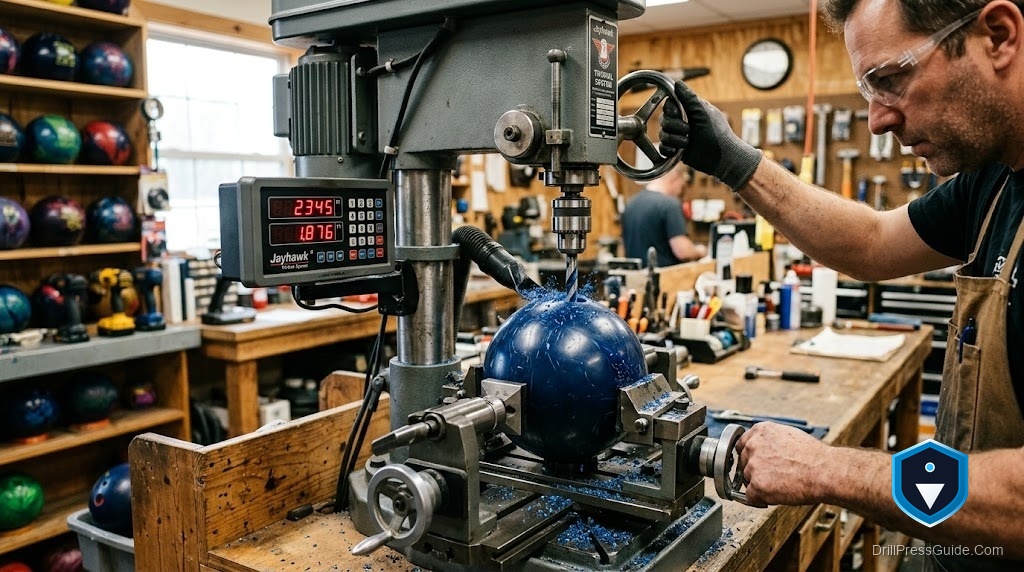
Search for a bowling ball drill press and you will find something that looks like a shop drill press but is not one. Drilling a bowling ball is a precision fitting job, the finger and thumb holes have to match a bowler’s hand, span, and pitch angles exactly, and a standard drill press cannot hold a sphere or angle the holes the way the work demands. This is a specialized machine, and understanding why explains both what it does and why you should not try to substitute a regular press. Here is a clear look at the bowling ball drill press and how the job actually works.
A bowling ball drill press is a specialized machine that holds a bowling ball securely and drills finger and thumb holes at precise, adjustable angles to fit a bowler’s hand. Unlike a standard drill press, it uses a ball cradle or cup to grip the sphere and a tilting or articulating head to set pitch and span, so the holes match measured hand dimensions. It is purpose-built pro-shop equipment.
Why a standard drill press will not do
The problem is geometry. A bowling ball is a sphere, so it has no flat face to sit on and no edge to clamp squarely, and the holes are not straight down, they are drilled at deliberate angles (pitches) that tilt toward or away from the fingers to fit a hand and a bowling style. A standard drill press drills straight into a clamped, flat-referenced workpiece, exactly what a ball is not. Trying to force it risks a cracked ball, a spinning sphere, and holes that ruin the fit, none of it worth the danger the OSHA and CCOHS workholding rules warn against.
How the specialized machine solves it
A purpose-built ball drill press adds the two things a standard press lacks:
A ball cradle or cup grips the sphere firmly from multiple points so it cannot roll or spin under the bit.
An adjustable, tilting head or table sets the exact pitch angle and lets the operator index the ball to the marked layout, so each hole goes in at the planned angle and spacing.
With the ball locked and the angle set, the operator drills each hole to a measured depth with a ball-specific bit, checking span and pitch against the bowler’s measurements.
Standard press versus ball drill press
| Feature | Standard drill press | Bowling ball drill press |
|---|---|---|
| Workholding | Flat table, vise, clamp | Ball cradle or cup |
| Hole angle | Straight down | Adjustable pitch angles |
| Reference | Flat face and edge | Marked layout on the sphere |
| Purpose | General drilling | Fitting finger and thumb holes |
The table makes the point plainly: these machines share a silhouette and little else.
The verdict
A bowling ball drill press is specialized pro-shop equipment that cradles a ball and tilts to drill finger and thumb holes at precise fitting angles, something a standard drill press cannot safely or accurately do. Three takeaways: the job is precision hand-fitting, not general drilling; a sphere needs a cradle and an adjustable head that a flat-tabled press lacks; and forcing a regular press risks a cracked ball and a dangerous spin. Who needs one? Pro shops and serious ball drillers, casual users should have fitting done by a shop rather than improvise.
Frequently asked questions
What is a bowling ball drill press? A specialized machine that holds a bowling ball in a cradle and drills finger and thumb holes at precise, adjustable angles to fit a bowler’s hand, span, and preferred pitches. It is purpose-built pro-shop equipment, not a general shop tool.
Can I drill a bowling ball with a regular drill press? It is strongly discouraged. A standard press cannot grip a sphere securely or set the angled pitches a proper fit needs, so you risk cracking the ball, a dangerous spin, and holes that ruin the fit. A cradle-equipped machine is the right tool.
Why do the holes need to be drilled at angles? Finger and thumb holes are drilled with pitch angles that tilt toward or away from the fingers to match a bowler’s hand and release. Straight-down holes would not fit comfortably or perform well, which is why the machine’s head tilts.
What holds the ball while it is drilled? A ball cradle or cup grips the sphere firmly from several points so it cannot roll or spin under the bit. This secure holding is the main thing a standard flat-tabled drill press cannot provide.
How are the holes positioned correctly? The operator marks a layout on the ball from the bowler’s measured span and hand dimensions, then indexes the ball on the machine’s adjustable head to drill each hole at the planned position, angle, and depth.
Do I need special bits to drill a bowling ball? Yes, ball drilling uses bits sized for finger and thumb holes and often a cone or bevel tool to finish the edges. These are matched to the coverstock material and the fitting method the shop uses.
Should a beginner drill their own ball? Generally no. Fitting is a measured, specialized process, and mistakes are hard to undo on a single ball. Most bowlers have a pro shop drill and fit the ball, then adjust as their game develops.
References
- OSHA, Woodworking eTool: Drill Press. https://www.osha.gov/etools/woodworking/production/machines-tools/drill-press
- CCOHS, Metalworking Machines: Drill Presses. https://www.ccohs.ca/oshanswers/safety_haz/metalworking/drillpresses.html
- Pro Tool Reviews, How to Use and Set Up a Drill Press. https://www.protoolreviews.com/how-to-use-drill-press/


