Woodworking Drill Press: The Setup Details That Change the Result
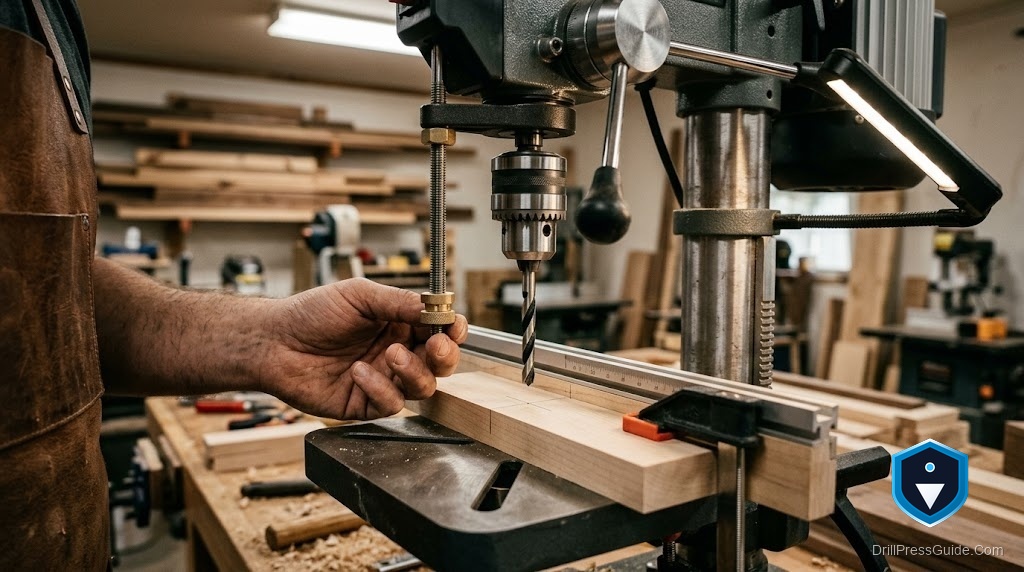
Most woodworkers buy a drill press for one job, drilling square holes, then discover it is only as good as its setup. The bare machine drills a hole, but a flat auxiliary table, a fence, a depth stop, and the right speed are what turn it into a precision tool for joinery, shelf pins, and clean hardware mortises. The difference between a torn, wandering hole and a crisp one is rarely the press itself; it is the details around it. Here is how to set up and run a drill press for woodworking so the results match the effort.
A woodworking drill press works best with a flat auxiliary wood table and fence for support and repeatability, a backer board to stop tear-out, speeds matched to the bit (faster for small bits, slower for large Forstner bits and hole saws), a depth stop for consistent holes, and the work clamped or held to the fence. Setup, not horsepower, determines the finish.
Add a table and fence
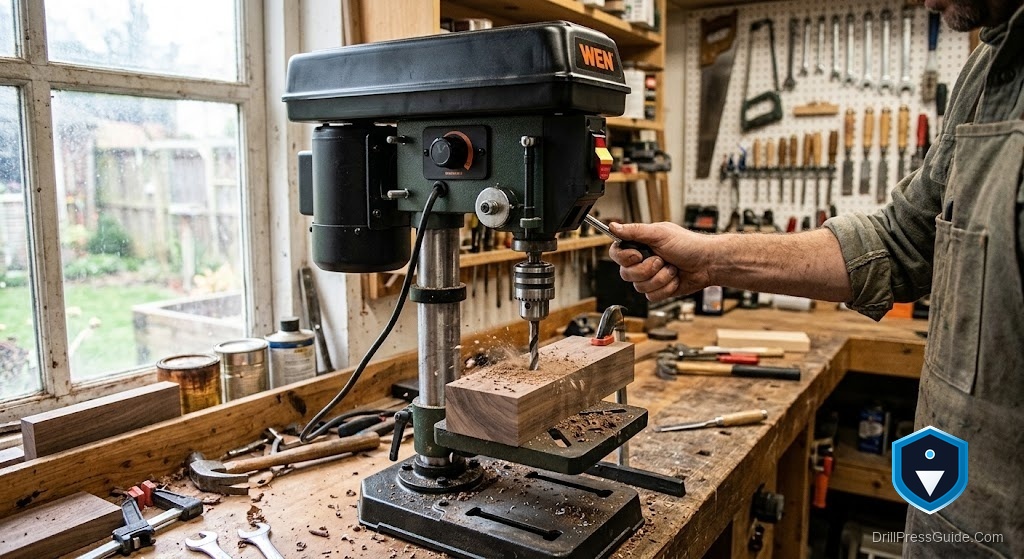
The small metal table that comes with most presses is fine for metal but limiting for wood. A larger auxiliary table with a fence gives you support, repeatable positioning, and a sacrificial surface that prevents blowout underneath. A purpose-built top such as the WEN drill press table with fence and stop block mounts to the existing table and adds hold-down clamps, a fence, and a stop block for repeat holes. It is the single upgrade that most changes woodworking results, because it turns freehand drilling into indexed, repeatable work.
Speed and tooling for wood
Wood tolerates a wide speed range, but matching speed to the bit still matters for a clean cut:
| Tooling | Typical speed | Notes |
|---|---|---|
| Twist and brad-point bits, small | 1800 to 3000 RPM | Fast is fine for clean holes |
| Brad-point, 1/2 in and up | 1500 to 1800 RPM | Slow slightly as diameter grows |
| Forstner up to 1 in | 1800 to 2000 RPM | Clear chips often |
| Forstner 1 to 2 in | 700 to 1200 RPM | Slower prevents burning |
| Hole saw | 300 to 700 RPM | Large diameters slowest |
Brad-point bits give clean, located holes; Forstner bits give flat-bottomed ones; back off large bits often to clear chips and avoid scorching. These starting points mirror the diameter-and-material logic in the Dynabrade chart.
Tear-out, depth, and workholding
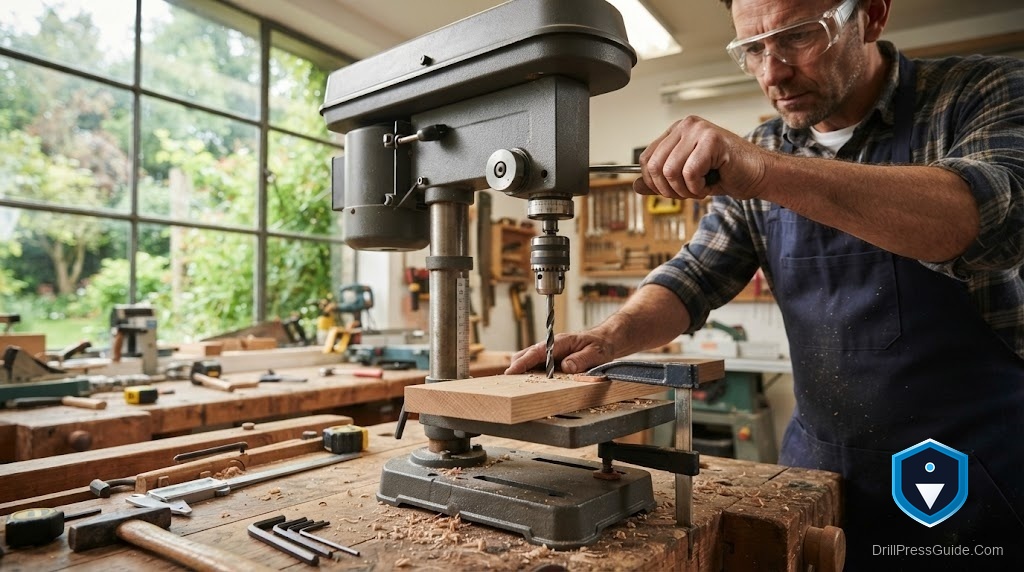
Three habits separate clean woodworking from rough. Put a backer board under the workpiece so the bit exits into wood, not air, which stops blowout on the underside. Set the depth stop for blind holes like shelf pins and hardware mortises so every hole matches. And hold the work against the fence or clamp it, both for accuracy and because a spinning workpiece is dangerous, the point OSHA and CCOHS keep making, with more setup detail at Pro Tool Reviews.
The verdict
A woodworking drill press delivers clean, repeatable holes when you add a flat table and fence, match speed to the bit, use a backer board against tear-out, set a depth stop, and hold the work to the fence. Three takeaways: a table-and-fence upgrade changes results more than any spec on the box, Forstner bits and large tooling need slower speeds and frequent chip clearing, and a backer board plus depth stop are what make joinery and hardware holes look professional. Who benefits most? Anyone doing joinery, shelf pins, or hardware, where square, consistent holes are the whole point.
Frequently asked questions
What speed should a drill press be for woodworking? Most wood drilling runs 1800 to 3000 RPM for small twist and brad-point bits, dropping to around 1500 RPM for larger bits, 700 to 1200 RPM for big Forstner bits, and 300 to 700 RPM for hole saws. Slow down as the bit diameter grows.
Do I need a special table for a woodworking drill press? Not strictly, but a larger auxiliary table with a fence and hold-downs is the upgrade that most improves woodworking. It adds support, repeatable positioning, and a sacrificial surface that prevents tear-out underneath the workpiece.
How do I stop tear-out when drilling wood? Place a backer board directly under the workpiece so the bit drills into wood rather than exiting into open air. Brad-point and Forstner bits also help, and slowing the feed as the bit breaks through reduces blowout.
What bits are best for a woodworking drill press? Brad-point bits for clean, accurately located holes, Forstner bits for flat-bottomed holes and hardware mortises, and spade or hole-saw bits for large openings. Twist bits work too but wander more without a center spur.
How do I drill the same depth every time? Set the depth stop on the quill. Lower the bit to your target depth once, lock the stop, and every following hole will bottom out at the same depth, which is what you want for shelf pins and hinge mortises.
Can a woodworking drill press also drill metal? Yes, if it reaches low enough speeds. Metal needs much slower speeds than wood, a sharp HSS or cobalt bit, and cutting fluid on steel, so a press with a wide speed range handles both wood and occasional metal.
Why is my drill press burning the wood? Usually the speed is too high for the bit, especially with large Forstner bits, or the bit is dull, or chips are not clearing. Slow down, keep the bit sharp, and back it out often to clear chips and let the hole cool.
References
- Dynabrade, HSS Drill Speed Recommendation Chart. https://www.dynabrade.com/pdf/lit/D1201_Singles/D12.01_pg134.pdf
- Pro Tool Reviews, How to Use and Set Up a Drill Press. https://www.protoolreviews.com/how-to-use-drill-press/
- OSHA, Woodworking eTool: Drill Press. https://www.osha.gov/etools/woodworking/production/machines-tools/drill-press
- CCOHS, Metalworking Machines: Drill Presses. https://www.ccohs.ca/oshanswers/safety_haz/metalworking/drillpresses.html