
What Can You Use a Drill Press For? A Guide by What Goes in the Chuck
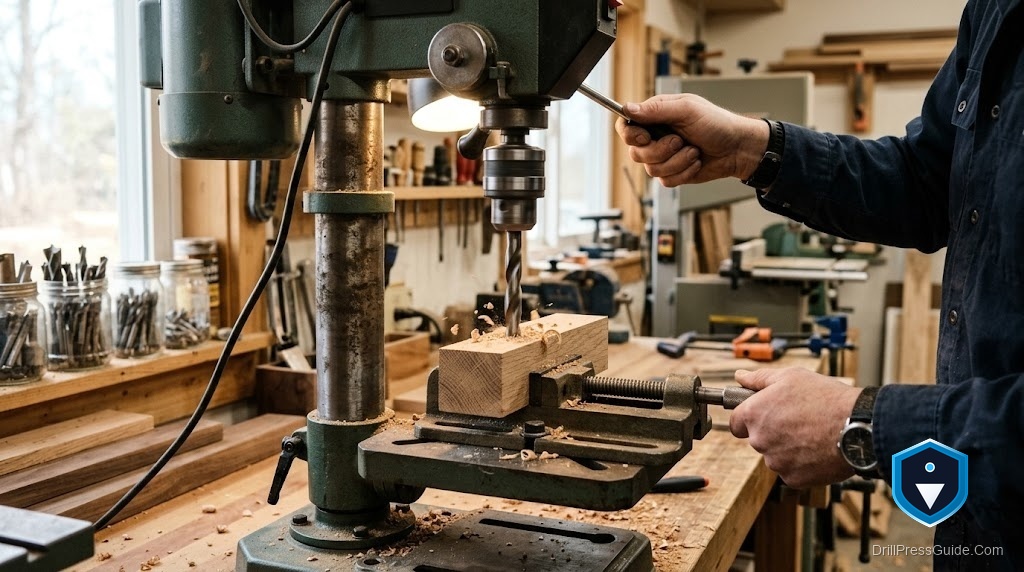
The fastest way to understand everything a drill press can do is to look at what you can put in the chuck. The machine itself is just a controlled, powered spindle; its range comes entirely from the bit, cutter, or accessory you mount. Learn the tooling, and the uses follow naturally, each type of bit or wheel opens a different job. This guide walks through the drill press’s capabilities organized by tooling, from everyday twist bits to sanding drums and wire wheels, so you can see exactly what the machine covers.
You can use a drill press for whatever its tooling allows: twist and brad-point bits for general and clean wood holes, Forstner bits for flat-bottomed holes, spade and hole-saw bits for large holes, step bits for sheet metal, plus non-drilling accessories like sanding drums, wire wheels, and buffing wheels. The chuck is the key, match the right bit or accessory to the job.
Drilling bits and what each is for
Most of the machine’s work comes from drilling tooling, and each type has a purpose:
Twist bits are the all-rounders for general holes in wood, metal, and plastic.
Brad-point bits have a center spur for clean, precisely located holes in wood, ideal for dowels.
Forstner bits cut flat-bottomed, clean-walled holes for hinges, inlays, and hardware. A set such as the Irwin Marples Forstner bit set covers the common sizes.
Spade bits clear large holes fast in wood where finish matters less.
Step bits drill and enlarge holes in thin sheet metal.
Matching speed to each bit’s diameter is essential, as Pro Tool Reviews stresses, larger bits run slower.
Large-hole tooling
When the hole gets big, two tools take over. Hole saws cut large-diameter holes through wood, plastic, and thin metal by cutting a ring, leaving a plug. A hole saw kit with several diameters covers everything from door hardware to dust-port holes. Large Forstner bits handle big flat-bottomed holes where the hole will show. Both need the drill press’s slow speeds and controlled feed, exactly the work that overwhelms a handheld drill.
Non-drilling accessories
The chuck holds more than bits, and this is where many owners find new uses:
Sanding drums turn the press into a spindle sander for smoothing curves and edges.
Wire wheels and brushes strip rust, paint, and scale from metal parts.
Buffing and flap wheels polish metal and smooth wood.
Each mounts in the chuck like a bit, expanding the machine from drilling into shaping and finishing.
Tooling-to-task at a glance
| Tooling | Use it for | Notes |
|---|---|---|
| Twist bit | General holes, any material | The all-rounder |
| Brad-point bit | Clean, located wood holes | Center spur |
| Forstner bit | Flat-bottomed, clean holes | Hinges, inlays |
| Spade bit | Fast large wood holes | Rougher finish |
| Hole saw | Large-diameter holes | Leaves a plug |
| Step bit | Sheet metal holes | Drills and enlarges |
| Sanding drum | Smoothing curves | Spindle-sander action |
| Wire or buffing wheel | Cleaning, polishing metal | Finishing |
One caution on tooling
Not everything that fits the chuck belongs there. Router bits and end mills are made for high-speed, side-cutting machines with collets and side-load bearings, so running them in a drill press cuts poorly and can loosen the chuck or wear the spindle. Stick to drilling bits and accessories designed for downward or straight-in work, in line with the tool-to-job guidance from OSHA and CCOHS, and clamp the work for every one.
The verdict
What you can use a drill press for is defined by what goes in the chuck: twist, brad-point, Forstner, spade, and step bits for a full range of holes, hole saws and big Forstners for large holes, and sanding drums, wire wheels, and buffing wheels for shaping and finishing. Three takeaways: the machine’s range comes from its tooling, so learn the bits and the uses follow; match speed to each bit’s diameter; and avoid router bits and end mills, which the chuck holds but the machine is not built to drive. Who benefits? Anyone building out a bit collection, the right tooling turns one press into many tools.
Frequently asked questions
What can you use a drill press for? For any job its tooling allows: general and clean wood holes with twist and brad-point bits, flat-bottomed holes with Forstner bits, large holes with spade bits and hole saws, sheet-metal holes with step bits, and shaping or finishing with sanding drums and wire or buffing wheels.
What bits can you use in a drill press? Twist bits, brad-point bits, Forstner bits, spade bits, hole saws, and step bits are all suited to it. Avoid router bits and end mills, which are made for side-cutting machines and can loosen the chuck or wear the spindle.
Can you use Forstner bits in a drill press? Yes, and the press is the ideal machine for them. Its fixed quill and controlled feed give the clean, flat-bottomed holes Forstner bits are known for. Run them at slower speeds, especially the larger sizes.
Can you use a hole saw in a drill press? Yes. The press’s slow speeds and steady feed suit hole saws well for large-diameter holes in wood, plastic, and thin metal. Clamp the work, since a hole saw can grab, and clear the plug as needed.
Can you use a drill press as a sander? Yes. A sanding drum mounts in the chuck and turns the press into a spindle sander for smoothing curves and edges. Kits offer several drum diameters to match tight or gentle curves.
Can you put router bits in a drill press? No. Router bits need very high speed and a collet on a machine built for side loads. A drill press spins too slowly and its friction chuck can loosen, giving poor cuts and risking damage. Use a router instead.
What accessories besides bits fit in the chuck? Sanding drums for smoothing, wire wheels and brushes for stripping rust and paint, and buffing or flap wheels for polishing. Each mounts like a bit and expands the press from drilling into shaping and finishing.
References
- Pro Tool Reviews, How to Use and Set Up a Drill Press. https://www.protoolreviews.com/how-to-use-drill-press/
- OSHA, Woodworking eTool: Drill Press. https://www.osha.gov/etools/woodworking/production/machines-tools/drill-press
- CCOHS, Metalworking Machines: Drill Presses. https://www.ccohs.ca/oshanswers/safety_haz/metalworking/drillpresses.html


