
What Can I Use a Drill Press For: A Material-by-Material Guide
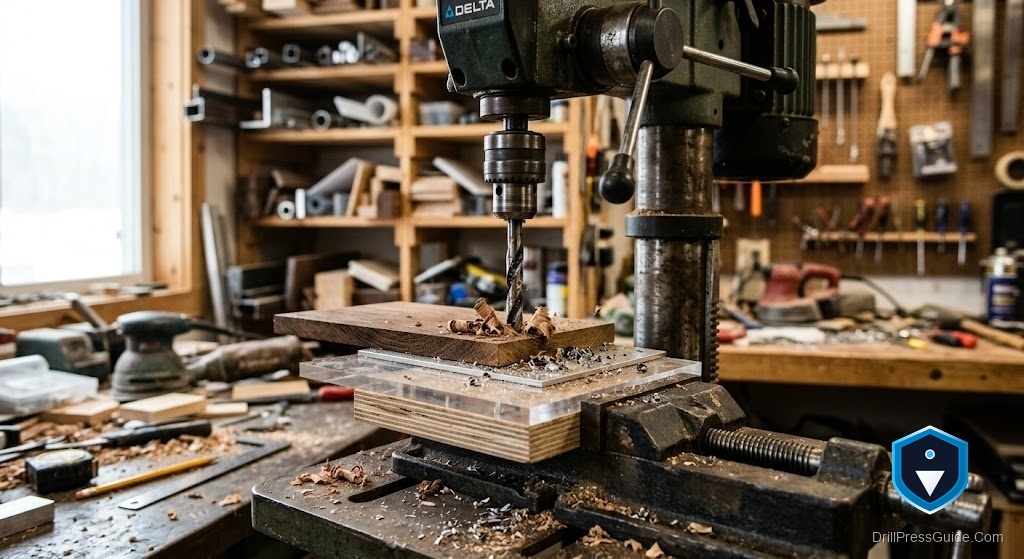
The same drill press behaves like a different machine depending on what is clamped under the bit. Wood forgives a lot; steel punishes the wrong speed; acrylic cracks if you rush it. So the most useful way to answer “what can I use it for” is not a flat list of tasks but a tour through the materials you will actually drill, what the press does well in each, and the one or two things to get right so the results come out clean. Work through your material and you will know exactly what to expect.
You can use a drill press on wood, metal, and plastics, and it handles each well when you match the speed and technique to the material. Wood drills fast and clean; mild steel and aluminum need slow speeds, steady feed, and clamped work; acrylic and plastics need moderate speeds and gentle feed to avoid melting or cracking. The machine’s accuracy and controlled feed help in every material.
Wood: the most forgiving
Wood is where the press feels effortless. It drills clean, perpendicular holes for joinery and hardware, drives Forstner bits for flat-bottomed holes, and sinks large spade and hole-saw cuts with the feed handle’s controlled force. Run higher speeds for small bits and slow down for large ones to avoid burning. Back the workpiece with a scrap board so the bit does not blow out splinters as it exits. Beyond drilling, wood is also where drum sanding and mortising attachments do their best work.
Metal: slow down and clamp
Metal is where speed and clamping matter most. Mild steel and aluminum drill well, but only at slow speeds, too fast and the bit overheats and dulls. Feed steadily and firmly so the bit cuts rather than rubs, use cutting fluid on steel to keep the edge cool, and clamp the work hard, because a bit that grabs in metal will spin an unclamped piece instantly. This clamp-always rule is central to the safety guidance from OSHA and CCOHS. Done right, the press drills accurate holes in bar, plate, and angle for brackets and repairs.
Plastics and acrylic: gentle and moderate
Plastics reward patience. Acrylic in particular cracks or melts if you drill it too fast or push too hard, so use a moderate speed, feed gently, and ease off as the bit breaks through. Backing the piece and clearing chips help avoid grabbing. With that light touch, the press makes clean holes in acrylic, PVC, and similar plastics for signs, guards, and enclosures.
Material settings at a glance
| Material | Speed | Key technique |
|---|---|---|
| Softwood | Fast for small bits, slow for large | Back the exit side |
| Hardwood | Moderate | Sharp bits, steady feed |
| Aluminum | Moderate to slow | Steady feed, clear chips |
| Mild steel | Slow | Cutting fluid, firm feed, clamp |
| Stainless | Very slow | Fluid, firm feed, sharp bit |
| Acrylic / plastic | Moderate | Gentle feed, ease through |
What stays the same across materials
Whatever you drill, a few things never change. Set the speed to suit the material and bit diameter, using a chart if you are unsure, a habit general references like Pro Tool Reviews treat as fundamental. Clamp or vise the work rather than holding it. Center-punch metal so the bit does not skate. And let the bit stop before clearing chips. These constants are why the press gives cleaner, safer results than a handheld drill in every material.
The verdict
You can use a drill press across wood, metal, and plastics, and the machine’s value is that it drills each accurately once you match speed and technique to the material: fast and clean in wood, slow and clamped in metal, gentle and moderate in plastics. Three takeaways: the material, not the machine, dictates your speed and feed; metal demands slow speeds, cutting fluid, and hard clamping; and plastics need a gentle touch to avoid cracking or melting. Who is this for? Anyone drilling more than one kind of material, knowing the per-material rules is what turns the same press into a clean performer on all of them.
Frequently asked questions
What can I use a drill press for? Drilling accurate holes in wood, metal, and plastics, plus sanding and mortising with attachments. The key is matching speed and technique to the material: fast in wood, slow and clamped in metal, gentle in plastics.
Can I drill metal on a drill press? Yes. Mild steel and aluminum drill well at slow speeds with steady feed and firmly clamped work. Use cutting fluid on steel to keep the bit cool, and center-punch first so the bit does not skate.
What speed should I use for different materials? Fast for small bits in wood, slower for large bits and for metal, and moderate for plastics. Bigger bits and harder materials always call for slower speeds. Use a speed chart when unsure and adjust by feel.
Can a drill press drill acrylic without cracking it? Yes, with care. Use a moderate speed, feed gently, back the piece, and ease off as the bit breaks through. Drilling acrylic too fast or pushing too hard is what causes cracking and melting.
Do I need cutting fluid for metal? For steel, yes, it keeps the bit cool and cutting cleanly, extending bit life and improving the hole. Aluminum can often be drilled dry or with a little lubricant. Stainless especially needs fluid and slow speed.
Why do I need to clamp the work? Because a bit that grabs, especially in metal, can spin an unclamped piece instantly, which is dangerous and ruins the hole. Clamping or using a vise keeps the work still for a safe, accurate cut.
Is a drill press better than a handheld drill for these materials? Yes, for accuracy and control. The fixed quill drills perpendicular, the feed handle gives controlled force for metal and large bits, and set speeds match each material, results a handheld drill struggles to equal.
References
- Pro Tool Reviews, How to Use and Set Up a Drill Press. https://www.protoolreviews.com/how-to-use-drill-press/
- OSHA, Woodworking eTool: Drill Press. https://www.osha.gov/etools/woodworking/production/machines-tools/drill-press
- CCOHS, Metalworking Machines: Drill Presses. https://www.ccohs.ca/oshanswers/safety_haz/metalworking/drillpresses.html


